L'Hospital's Rules
In mathematics, more specifically calculus, L'Hôpital's rule or L'Hospital's rule (French: [lopital], English: /ˌloʊpiːˈtɑːl/, loh-pee-TAHL) is a theorem which provides a technique to evaluate limits of indeterminate forms. Application (or repeated application) of the rule often converts an indeterminate form to an expression that can be easily evaluated by substitution. The rule is named after the 17th-century French mathematician Guillaume de l'Hôpital. Although the rule is often attributed to L'Hôpital, the theorem was first introduced to him in 1694 by the Swiss mathematician Johann Bernoulli.
L'Hôpital's rule states that for functions f and g which are differentiable on an open interval I except possibly at a point c contained in I, if Failed to parse (MathML with SVG or PNG fallback (recommended for modern browsers and accessibility tools): Invalid response ("Math extension cannot connect to Restbase.") from server "https://wikimedia.org/api/rest_v1/":): {\textstyle \lim_{x\to c}f(x)=\lim_{x\to c}g(x)=0 \text{ or } \pm\infty,} and Failed to parse (MathML with SVG or PNG fallback (recommended for modern browsers and accessibility tools): Invalid response ("Math extension cannot connect to Restbase.") from server "https://wikimedia.org/api/rest_v1/":): {\textstyle g'(x)\ne 0} for all x in I with x ≠ c, and Failed to parse (MathML with SVG or PNG fallback (recommended for modern browsers and accessibility tools): Invalid response ("Math extension cannot connect to Restbase.") from server "https://wikimedia.org/api/rest_v1/":): {\textstyle \lim_{x\to c}\frac{f'(x)}{g'(x)}} exists, then
- Failed to parse (MathML with SVG or PNG fallback (recommended for modern browsers and accessibility tools): Invalid response ("Math extension cannot connect to Restbase.") from server "https://wikimedia.org/api/rest_v1/":): {\displaystyle \lim_{x\to c}\frac{f(x)}{g(x)} = \lim_{x\to c}\frac{f'(x)}{g'(x)}.}
The differentiation of the numerator and denominator often simplifies the quotient or converts it to a limit that can be evaluated directly.
Contents
History
Guillaume de l'Hôpital (also written l'Hospital) published this rule in his 1696 book Analyse des Infiniment Petits pour l'Intelligence des Lignes Courbes (literal translation: Analysis of the Infinitely Small for the Understanding of Curved Lines), the first textbook on differential calculus. However, it is believed that the rule was discovered by the Swiss mathematician Johann Bernoulli.
General form
The general form of L'Hôpital's rule covers many cases. Let c and L be extended real numbers (i.e., real numbers, positive infinity, or negative infinity). Let I be an open interval containing c (for a two-sided limit) or an open interval with endpoint c (for a one-sided limit, or a limit at infinity if c is infinite). The real valued functions f and g are assumed to be differentiable on I except possibly at c, and additionally on I except possibly at c. It is also assumed that Thus the rule applies to situations in which the ratio of the derivatives has a finite or infinite limit, but not to situations in which that ratio fluctuates permanently as x gets closer and closer to c.

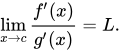
If either
- Failed to parse (MathML with SVG or PNG fallback (recommended for modern browsers and accessibility tools): Invalid response ("Math extension cannot connect to Restbase.") from server "https://wikimedia.org/api/rest_v1/":): {\displaystyle \lim_{x\to c}f(x) = \lim_{x\to c}g(x) = 0}
or
- Failed to parse (MathML with SVG or PNG fallback (recommended for modern browsers and accessibility tools): Invalid response ("Math extension cannot connect to Restbase.") from server "https://wikimedia.org/api/rest_v1/":): {\displaystyle \lim_{x\to c}|f(x)| = \lim_{x\to c}|g(x)| = \infty,}
then
- Failed to parse (MathML with SVG or PNG fallback (recommended for modern browsers and accessibility tools): Invalid response ("Math extension cannot connect to Restbase.") from server "https://wikimedia.org/api/rest_v1/":): {\displaystyle \lim_{x\to c}\frac{f(x)}{g(x)}=L.}
Although we have written x → c throughout, the limits may also be one-sided limits (x → c+ or x → c−), when c is a finite endpoint of I.
In the second case, the hypothesis that f diverges to infinity is not used in the proof (see note at the end of the proof section); thus, while the conditions of the rule are normally stated as above, the second sufficient condition for the rule's procedure to be valid can be more briefly stated as Failed to parse (MathML with SVG or PNG fallback (recommended for modern browsers and accessibility tools): Invalid response ("Math extension cannot connect to Restbase.") from server "https://wikimedia.org/api/rest_v1/":): {\displaystyle \lim_{x\to c}|g(x)| = \infty.}
The hypothesis that Failed to parse (MathML with SVG or PNG fallback (recommended for modern browsers and accessibility tools): Invalid response ("Math extension cannot connect to Restbase.") from server "https://wikimedia.org/api/rest_v1/":): {\displaystyle g'(x)\ne 0} appears most commonly in the literature, but some authors sidestep this hypothesis by adding other hypotheses elsewhere. One method is to define the limit of a function with the additional requirement that the limiting function is defined everywhere on the relevant interval I except possibly at c. Another method is to require that both f and g be differentiable everywhere on an interval containing c.
Requirement that the limit exist
The requirement that the limit
- Failed to parse (MathML with SVG or PNG fallback (recommended for modern browsers and accessibility tools): Invalid response ("Math extension cannot connect to Restbase.") from server "https://wikimedia.org/api/rest_v1/":): {\displaystyle \lim_{x\to c}\frac{f'(x)}{g'(x)}}
exists is essential. Without this condition, Failed to parse (MathML with SVG or PNG fallback (recommended for modern browsers and accessibility tools): Invalid response ("Math extension cannot connect to Restbase.") from server "https://wikimedia.org/api/rest_v1/":): {\displaystyle f'} or Failed to parse (MathML with SVG or PNG fallback (recommended for modern browsers and accessibility tools): Invalid response ("Math extension cannot connect to Restbase.") from server "https://wikimedia.org/api/rest_v1/":): {\displaystyle g'} may exhibit undamped oscillations as Failed to parse (MathML with SVG or PNG fallback (recommended for modern browsers and accessibility tools): Invalid response ("Math extension cannot connect to Restbase.") from server "https://wikimedia.org/api/rest_v1/":): {\displaystyle x} approaches Failed to parse (MathML with SVG or PNG fallback (recommended for modern browsers and accessibility tools): Invalid response ("Math extension cannot connect to Restbase.") from server "https://wikimedia.org/api/rest_v1/":): {\displaystyle c} , in which case L'Hôpital's rule does not apply. For example, if Failed to parse (MathML with SVG or PNG fallback (recommended for modern browsers and accessibility tools): Invalid response ("Math extension cannot connect to Restbase.") from server "https://wikimedia.org/api/rest_v1/":): {\displaystyle f(x)=x+\sin(x)} , Failed to parse (MathML with SVG or PNG fallback (recommended for modern browsers and accessibility tools): Invalid response ("Math extension cannot connect to Restbase.") from server "https://wikimedia.org/api/rest_v1/":): {\displaystyle g(x)=x} and Failed to parse (MathML with SVG or PNG fallback (recommended for modern browsers and accessibility tools): Invalid response ("Math extension cannot connect to Restbase.") from server "https://wikimedia.org/api/rest_v1/":): {\displaystyle c=\pm\infty} , then
- Failed to parse (MathML with SVG or PNG fallback (recommended for modern browsers and accessibility tools): Invalid response ("Math extension cannot connect to Restbase.") from server "https://wikimedia.org/api/rest_v1/":): {\displaystyle \frac{f'(x)}{g'(x)}=\frac{1+\cos(x)}{1};}
this expression does not approach a limit as Failed to parse (MathML with SVG or PNG fallback (recommended for modern browsers and accessibility tools): Invalid response ("Math extension cannot connect to Restbase.") from server "https://wikimedia.org/api/rest_v1/":): {\displaystyle x} goes to Failed to parse (MathML with SVG or PNG fallback (recommended for modern browsers and accessibility tools): Invalid response ("Math extension cannot connect to Restbase.") from server "https://wikimedia.org/api/rest_v1/":): {\displaystyle c} , since the cosine function oscillates between 1 and −1. But working with the original functions, Failed to parse (MathML with SVG or PNG fallback (recommended for modern browsers and accessibility tools): Invalid response ("Math extension cannot connect to Restbase.") from server "https://wikimedia.org/api/rest_v1/":): {\displaystyle \lim_{x\to\infty}\frac{f(x)}{g(x)}} can be shown to exist:
- Failed to parse (MathML with SVG or PNG fallback (recommended for modern browsers and accessibility tools): Invalid response ("Math extension cannot connect to Restbase.") from server "https://wikimedia.org/api/rest_v1/":): {\displaystyle \lim_{x\to\infty}\frac{f(x)}{g(x)} = \lim_{x\to\infty}\left(1+\frac{\sin(x)}{x}\right) = 1. }
In a case such as this, all that can be concluded is that
- Failed to parse (MathML with SVG or PNG fallback (recommended for modern browsers and accessibility tools): Invalid response ("Math extension cannot connect to Restbase.") from server "https://wikimedia.org/api/rest_v1/":): {\displaystyle \liminf_{x \to c} \frac{f'(x)}{g'(x)} \leq \liminf_{x \to c} \frac{f(x)}{g(x)} \leq \limsup_{x \to c} \frac{f(x)}{g(x)} \leq \limsup_{x \to c} \frac{f'(x)}{g'(x)} ,}
so that if the limit of f/g exists, then it must lie between the inferior and superior limits of f′/g′. (In the example above, this is true, since 1 indeed lies between 0 and 2.)
Examples
- Here is a basic example involving the exponential function, which involves the indeterminate form Failed to parse (MathML with SVG or PNG fallback (recommended for modern browsers and accessibility tools): Invalid response ("Math extension cannot connect to Restbase.") from server "https://wikimedia.org/api/rest_v1/":): {\displaystyle \frac{0}{0}} at x = 0: Failed to parse (MathML with SVG or PNG fallback (recommended for modern browsers and accessibility tools): Invalid response ("Math extension cannot connect to Restbase.") from server "https://wikimedia.org/api/rest_v1/":): {\displaystyle \begin{align} \lim_{x\to 0} \frac{e^x - 1}{x^2+x} &= \lim_{x\to 0} \frac{\frac{d}{dx}(e^x - 1)}{\frac{d}{dx}(x^2+x)} \\[4pt] &= \lim_{x\to 0} \frac{e^x}{2x+1} \\[4pt] &= 1. \end{align} }
- This is a more elaborate example involving Failed to parse (MathML with SVG or PNG fallback (recommended for modern browsers and accessibility tools): Invalid response ("Math extension cannot connect to Restbase.") from server "https://wikimedia.org/api/rest_v1/":): {\displaystyle \frac{0}{0}} . Applying L'Hôpital's rule a single time still results in an indeterminate form. In this case, the limit may be evaluated by applying the rule three times: Failed to parse (MathML with SVG or PNG fallback (recommended for modern browsers and accessibility tools): Invalid response ("Math extension cannot connect to Restbase.") from server "https://wikimedia.org/api/rest_v1/":): {\displaystyle \begin{align} \lim_{x\to 0}{\frac{2\sin(x)-\sin(2x)}{x-\sin(x)}} & =\lim_{x\to 0}{\frac{2\cos(x)-2\cos(2x)}{1-\cos(x)}} \\[4pt] & = \lim_{x\to 0}{\frac{-2\sin(x)+4\sin(2x)}{\sin(x)}} \\[4pt] & = \lim_{x\to 0}{\frac{-2\cos(x)+8\cos(2x)}{\cos(x)}} \\[4pt] & ={\frac{-2+8}{1}} \\[4pt] & =6. \end{align}}
- Here is an example involving Failed to parse (MathML with SVG or PNG fallback (recommended for modern browsers and accessibility tools): Invalid response ("Math extension cannot connect to Restbase.") from server "https://wikimedia.org/api/rest_v1/":): {\displaystyle \frac{\infty}{\infty}} : Failed to parse (MathML with SVG or PNG fallback (recommended for modern browsers and accessibility tools): Invalid response ("Math extension cannot connect to Restbase.") from server "https://wikimedia.org/api/rest_v1/":): {\displaystyle \lim_{x\to\infty}x^n\cdot e^{-x} =\lim_{x\to\infty}{\frac{x^n}{e^x}} =\lim_{x\to\infty}{\frac{nx^{n-1}}{e^x}} =n\cdot \lim_{x\to\infty}{\frac{x^{n-1}}{e^x}}. } Repeatedly apply L'Hôpital's rule until the exponent is zero (if n is an integer) or negative (if n is fractional) to conclude that the limit is zero.
- Here is an example involving the indeterminate form 0 · ∞ (see below), which is rewritten as the form Failed to parse (MathML with SVG or PNG fallback (recommended for modern browsers and accessibility tools): Invalid response ("Math extension cannot connect to Restbase.") from server "https://wikimedia.org/api/rest_v1/":): {\displaystyle \frac{\infty}{\infty}} : Failed to parse (MathML with SVG or PNG fallback (recommended for modern browsers and accessibility tools): Invalid response ("Math extension cannot connect to Restbase.") from server "https://wikimedia.org/api/rest_v1/":): {\displaystyle \lim_{x\to 0^+}x \ln x =\lim_{x\to 0^+} \frac{\ln x}{\frac{1}{x}} = \lim_{x\to 0^+} \frac{\frac{1}{x}}{-\frac{1}{x^2}} = \lim_{x\to 0^+} -x = 0.}
- Here is an example involving the mortgage repayment formula and Failed to parse (MathML with SVG or PNG fallback (recommended for modern browsers and accessibility tools): Invalid response ("Math extension cannot connect to Restbase.") from server "https://wikimedia.org/api/rest_v1/":): {\displaystyle \frac{0}{0}} . Let P be the principal (loan amount), r the interest rate per period and n the number of periods. When r is zero, the repayment amount per period is Failed to parse (MathML with SVG or PNG fallback (recommended for modern browsers and accessibility tools): Invalid response ("Math extension cannot connect to Restbase.") from server "https://wikimedia.org/api/rest_v1/":): {\displaystyle \frac{P}{n}} (since only principal is being repaid); this is consistent with the formula for non-zero interest rates: Failed to parse (MathML with SVG or PNG fallback (recommended for modern browsers and accessibility tools): Invalid response ("Math extension cannot connect to Restbase.") from server "https://wikimedia.org/api/rest_v1/":): {\displaystyle \begin{align} \lim_{r\to 0}\frac{Pr(1+r)^n}{(1+r)^n-1} & = P \lim_{r\to 0} \frac{(1+r)^n+rn(1+r)^{n-1}}{n(1+r)^{n-1}} \\[4pt] & = \frac{P}{n}. \end{align}}
- One can also use L'Hôpital's rule to prove the following theorem. If f is twice-differentiable in a neighborhood of x and that its second derivative is continuous on this neighbourhood, then Failed to parse (MathML with SVG or PNG fallback (recommended for modern browsers and accessibility tools): Invalid response ("Math extension cannot connect to Restbase.") from server "https://wikimedia.org/api/rest_v1/":): {\displaystyle \begin{align} \lim_{h\to 0}\frac{f(x+h)+f(x-h)-2f(x)}{h^2} &= \lim_{h\to 0}\frac{f'(x+h)-f'(x-h)}{2h} \\[4pt] &= \lim_{h\to 0}\frac{f''(x+h) + f''(x-h)}{2} \\[4pt] &= f''(x). \end{align}}
Sometimes L'Hôpital's rule is invoked in a tricky way: suppose f(x) + f′(x) converges as x → ∞ and that Failed to parse (MathML with SVG or PNG fallback (recommended for modern browsers and accessibility tools): Invalid response ("Math extension cannot connect to Restbase.") from server "https://wikimedia.org/api/rest_v1/":): {\displaystyle e^x\cdot f(x)} converges to positive or negative infinity. Then: Failed to parse (MathML with SVG or PNG fallback (recommended for modern browsers and accessibility tools): Invalid response ("Math extension cannot connect to Restbase.") from server "https://wikimedia.org/api/rest_v1/":): {\displaystyle \lim_{x\to\infty }f(x) = \lim_{x\to\infty}\frac{e^x\cdot f(x)}{e^x} = \lim_{x\to\infty}\frac{e^x\bigl(f(x)+f'(x)\bigr)}{e^x} = \lim_{x\to\infty}\bigl(f(x)+f'(x)\bigr) } and so, Failed to parse (MathML with SVG or PNG fallback (recommended for modern browsers and accessibility tools): Invalid response ("Math extension cannot connect to Restbase.") from server "https://wikimedia.org/api/rest_v1/":): {\textstyle \lim_{x\to\infty}f(x)} exists and Failed to parse (MathML with SVG or PNG fallback (recommended for modern browsers and accessibility tools): Invalid response ("Math extension cannot connect to Restbase.") from server "https://wikimedia.org/api/rest_v1/":): {\textstyle \lim_{x\to\infty}f'(x) = 0.}
The result remains true without the added hypothesis that Failed to parse (MathML with SVG or PNG fallback (recommended for modern browsers and accessibility tools): Invalid response ("Math extension cannot connect to Restbase.") from server "https://wikimedia.org/api/rest_v1/":): {\displaystyle e^x\cdot f(x)} converges to positive or negative infinity, but the justification is then incomplete.
Complications
Sometimes L'Hôpital's rule does not lead to an answer in a finite number of steps unless some additional steps are applied. Examples include the following:
- Two applications can lead to a return to the original expression that was to be evaluated: Failed to parse (MathML with SVG or PNG fallback (recommended for modern browsers and accessibility tools): Invalid response ("Math extension cannot connect to Restbase.") from server "https://wikimedia.org/api/rest_v1/":): {\displaystyle \lim_{x\to\infty} \frac{e^x+e^{-x}}{e^x-e^{-x}} = \lim_{x\to\infty} \frac{e^x-e^{-x}}{e^x+e^{-x}} = \lim_{x\to\infty} \frac{e^x+e^{-x}}{e^x-e^{-x}} = \cdots . } This situation can be dealt with by substituting Failed to parse (MathML with SVG or PNG fallback (recommended for modern browsers and accessibility tools): Invalid response ("Math extension cannot connect to Restbase.") from server "https://wikimedia.org/api/rest_v1/":): {\displaystyle y=e^x} and noting that y goes to infinity as x goes to infinity; with this substitution, this problem can be solved with a single application of the rule: Failed to parse (MathML with SVG or PNG fallback (recommended for modern browsers and accessibility tools): Invalid response ("Math extension cannot connect to Restbase.") from server "https://wikimedia.org/api/rest_v1/":): {\displaystyle \lim_{x\to\infty} \frac{e^x+e^{-x}}{e^x-e^{-x}} = \lim_{y\to\infty} \frac{y+y^{-1}}{y-y^{-1}} = \lim_{y\to\infty} \frac{1-y^{-2}}{1+y^{-2}} = \frac{1}{1} = 1. } Alternatively, the numerator and denominator can both be multiplied by Failed to parse (MathML with SVG or PNG fallback (recommended for modern browsers and accessibility tools): Invalid response ("Math extension cannot connect to Restbase.") from server "https://wikimedia.org/api/rest_v1/":): {\displaystyle e^x,} at which point L'Hôpital's rule can immediately be applied successfully: Failed to parse (MathML with SVG or PNG fallback (recommended for modern browsers and accessibility tools): Invalid response ("Math extension cannot connect to Restbase.") from server "https://wikimedia.org/api/rest_v1/":): {\displaystyle \lim_{x\to\infty} \frac{e^x+e^{-x}}{e^x-e^{-x}} = \lim_{x\to\infty} \frac{e^{2x} + 1}{e^{2x} - 1} = \lim_{x\to\infty} \frac{2e^{2x}}{2e^{2x}} = 1.}
- An arbitrarily large number of applications may never lead to an answer even without repeating:Failed to parse (MathML with SVG or PNG fallback (recommended for modern browsers and accessibility tools): Invalid response ("Math extension cannot connect to Restbase.") from server "https://wikimedia.org/api/rest_v1/":): {\displaystyle \lim_{x\to\infty} \frac{x^\frac1{2}+x^{-\frac1{2}}}{x^\frac1{2}-x^{-\frac1{2}}} = \lim_{x\to\infty} \frac{\frac1{2}x^{-\frac1{2}}-\frac{1}{2}x^{-\frac3{2}}}{\frac1{2}x^{-\frac1{2}}+\frac1{2}x^{-\frac3{2}}} = \lim_{x\to\infty} \frac{-\frac1{4}x^{-\frac3{2}}+\frac3{4}x^{-\frac5{2}}}{-\frac1{4}x^{-\frac3{2}}-\frac3{4}x^{-\frac5{2}}} = \cdots .} This situation too can be dealt with by a transformation of variables, in this case Failed to parse (MathML with SVG or PNG fallback (recommended for modern browsers and accessibility tools): Invalid response ("Math extension cannot connect to Restbase.") from server "https://wikimedia.org/api/rest_v1/":): {\displaystyle y = \sqrt{x}} : Failed to parse (MathML with SVG or PNG fallback (recommended for modern browsers and accessibility tools): Invalid response ("Math extension cannot connect to Restbase.") from server "https://wikimedia.org/api/rest_v1/":): {\displaystyle \lim_{x\to\infty} \frac{x^\frac1{2}+x^{-\frac1{2}}}{x^\frac1{2}-x^{-\frac1{2}}} = \lim_{y\to\infty} \frac{y+y^{-1}}{y-y^{-1}} = \lim_{y\to\infty} \frac{1-y^{-2}}{1+y^{-2}} = \frac1{1} = 1. } Again, an alternative approach is to multiply numerator and denominator by Failed to parse (MathML with SVG or PNG fallback (recommended for modern browsers and accessibility tools): Invalid response ("Math extension cannot connect to Restbase.") from server "https://wikimedia.org/api/rest_v1/":): {\displaystyle x^{1/2}} before applying L'Hôpital's rule: Failed to parse (MathML with SVG or PNG fallback (recommended for modern browsers and accessibility tools): Invalid response ("Math extension cannot connect to Restbase.") from server "https://wikimedia.org/api/rest_v1/":): {\displaystyle \lim_{x\to\infty} \frac{x^\frac{1}{2}+x^{-\frac{1}{2}}}{x^\frac{1}{2}-x^{-\frac{1}{2}}} = \lim_{x\to\infty} \frac{x+1}{x-1} = \lim_{x\to\infty} \frac{1}{1} = 1.}
A common pitfall is using L'Hôpital's rule with some circular reasoning to compute a derivative via a difference quotient. For example, consider the task of proving the derivative formula for powers of x:
- Failed to parse (MathML with SVG or PNG fallback (recommended for modern browsers and accessibility tools): Invalid response ("Math extension cannot connect to Restbase.") from server "https://wikimedia.org/api/rest_v1/":): {\displaystyle \lim_{h\to 0}\frac{(x+h)^n-x^n}{h}=nx^{n-1}.}
Applying L'Hôpital's rule and finding the derivatives with respect to h of the numerator and the denominator yields nxn−1 as expected. However, differentiating the numerator required the use of the very fact that is being proven. This is an example of begging the question, since one may not assume the fact to be proven during the course of the proof.
Counterexamples when the derivative of the denominator is zero
The necessity of the condition that Failed to parse (MathML with SVG or PNG fallback (recommended for modern browsers and accessibility tools): Invalid response ("Math extension cannot connect to Restbase.") from server "https://wikimedia.org/api/rest_v1/":): {\displaystyle g'(x)\ne 0} near Failed to parse (MathML with SVG or PNG fallback (recommended for modern browsers and accessibility tools): Invalid response ("Math extension cannot connect to Restbase.") from server "https://wikimedia.org/api/rest_v1/":): {\displaystyle c} can be seen by the following counterexample due to Otto Stolz. Let Failed to parse (MathML with SVG or PNG fallback (recommended for modern browsers and accessibility tools): Invalid response ("Math extension cannot connect to Restbase.") from server "https://wikimedia.org/api/rest_v1/":): {\displaystyle f(x)=x+\sin x \cos x} and Failed to parse (MathML with SVG or PNG fallback (recommended for modern browsers and accessibility tools): Invalid response ("Math extension cannot connect to Restbase.") from server "https://wikimedia.org/api/rest_v1/":): {\displaystyle g(x)=f(x)e^{\sin x}.} Then there is no limit for Failed to parse (MathML with SVG or PNG fallback (recommended for modern browsers and accessibility tools): Invalid response ("Math extension cannot connect to Restbase.") from server "https://wikimedia.org/api/rest_v1/":): {\displaystyle f(x)/g(x)} as Failed to parse (MathML with SVG or PNG fallback (recommended for modern browsers and accessibility tools): Invalid response ("Math extension cannot connect to Restbase.") from server "https://wikimedia.org/api/rest_v1/":): {\displaystyle x\to\infty.} However,
![{\displaystyle {\begin{aligned}{\frac {f'(x)}{g'(x)}}&={\frac {2\cos ^{2}x}{(2\cos ^{2}x)e^{\sin x}+(x+\sin x\cos x)e^{\sin x}\cos x}}\\[4pt]&={\frac {2\cos x}{2\cos x+x+\sin x\cos x}}e^{-\sin x},\end{aligned}}}](https://wikimedia.org/api/rest_v1/media/math/render/svg/4a0ad4a89d0195c755fa71dbf8280f0394a85d39)
which tends to 0 as Failed to parse (MathML with SVG or PNG fallback (recommended for modern browsers and accessibility tools): Invalid response ("Math extension cannot connect to Restbase.") from server "https://wikimedia.org/api/rest_v1/":): {\displaystyle x\to\infty} . Further examples of this type were found by Ralph P. Boas Jr.
Other indeterminate forms
Other indeterminate forms, such as 1∞, 00, ∞0, 0 · ∞, and ∞ − ∞, can sometimes be evaluated using L'Hôpital's rule. For example, to evaluate a limit involving ∞ − ∞, convert the difference of two functions to a quotient:
- Failed to parse (MathML with SVG or PNG fallback (recommended for modern browsers and accessibility tools): Invalid response ("Math extension cannot connect to Restbase.") from server "https://wikimedia.org/api/rest_v1/":): {\displaystyle \begin{align} \lim_{x\to 1}\left(\frac{x}{x-1}-\frac1{\ln x}\right) & = \lim_{x\to 1}\frac{x\cdot\ln x -x+1}{(x-1)\cdot\ln x} & \quad (1) \\[6pt] & = \lim_{x\to 1}\frac{\ln x}{\frac{x-1}{x}+\ln x} & \quad (2) \\[6pt] & = \lim_{x\to 1}\frac{x\cdot\ln x}{x-1+x\cdot\ln x} & \quad (3) \\[6pt] & = \lim_{x\to 1}\frac{1+\ln x}{1+1+\ln x} & \quad (4) \\[6pt] & = \lim_{x\to 1}\frac{1+\ln x}{2+\ln x} \\[6pt] & = \frac{1}{2}, \end{align} }
where L'Hôpital's rule is applied when going from (1) to (2) and again when going from (3) to (4).
L'Hôpital's rule can be used on indeterminate forms involving exponents by using logarithms to "move the exponent down". Here is an example involving the indeterminate form 00:
- Failed to parse (MathML with SVG or PNG fallback (recommended for modern browsers and accessibility tools): Invalid response ("Math extension cannot connect to Restbase.") from server "https://wikimedia.org/api/rest_v1/":): {\displaystyle \lim_{x\to 0^+}x^x = \lim_{x\to 0^+}e^{\ln (x^x)} = \lim_{x\to 0^+}e^{x\cdot\ln x} = e^{\lim\limits_{x\to 0^+}(x\cdot\ln x)}. }
It is valid to move the limit inside the exponential function because the exponential function is continuous. Now the exponent Failed to parse (MathML with SVG or PNG fallback (recommended for modern browsers and accessibility tools): Invalid response ("Math extension cannot connect to Restbase.") from server "https://wikimedia.org/api/rest_v1/":): {\displaystyle x} has been "moved down". The limit Failed to parse (MathML with SVG or PNG fallback (recommended for modern browsers and accessibility tools): Invalid response ("Math extension cannot connect to Restbase.") from server "https://wikimedia.org/api/rest_v1/":): {\displaystyle \lim_{x\to 0^+}x\cdot\ln x} is of the indeterminate form 0 · ∞, but as shown in an example above, l'Hôpital's rule may be used to determine that
- Failed to parse (MathML with SVG or PNG fallback (recommended for modern browsers and accessibility tools): Invalid response ("Math extension cannot connect to Restbase.") from server "https://wikimedia.org/api/rest_v1/":): {\displaystyle \lim_{x\to 0^+}x\cdot\ln x = 0.}
Thus
- Failed to parse (MathML with SVG or PNG fallback (recommended for modern browsers and accessibility tools): Invalid response ("Math extension cannot connect to Restbase.") from server "https://wikimedia.org/api/rest_v1/":): {\displaystyle \lim_{x\to 0^+}x^x = e^0 = 1.}
Stolz–Cesàro theorem
The Stolz–Cesàro theorem is a similar result involving limits of sequences, but it uses finite difference operators rather than derivatives.
Geometric interpretation
Consider the curve in the plane whose x-coordinate is given by g(t) and whose y-coordinate is given by f(t), with both functions continuous, i.e., the locus of points of the form [g(t), f(t)]. Suppose f(c) = g(c) = 0. The limit of the ratio Failed to parse (MathML with SVG or PNG fallback (recommended for modern browsers and accessibility tools): Invalid response ("Math extension cannot connect to Restbase.") from server "https://wikimedia.org/api/rest_v1/":): {\displaystyle \frac{f(t)}{g(t)}} as t → c is the slope of the tangent to the curve at the point [g(c), f(c)] = [0,0]. The tangent to the curve at the point [g(t), f(t)] is given by [g′(t), f′(t)]. L'Hôpital's rule then states that the slope of the curve when t = c is the limit of the slope of the tangent to the curve as the curve approaches the origin, provided that this is defined.
Proof of L'Hôpital's rule
Special case
The proof of L'Hôpital's rule is simple in the case where f and g are continuously differentiable at the point c and where a finite limit is found after the first round of differentiation. It is not a proof of the general L'Hôpital's rule because it is stricter in its definition, requiring both differentiability and that c be a real number. Since many common functions have continuous derivatives (e.g. polynomials, sine and cosine, exponential functions), it is a special case worthy of attention.
Suppose that f and g are continuously differentiable at a real number c, that Failed to parse (MathML with SVG or PNG fallback (recommended for modern browsers and accessibility tools): Invalid response ("Math extension cannot connect to Restbase.") from server "https://wikimedia.org/api/rest_v1/":): {\displaystyle f(c)=g(c)=0} , and that Failed to parse (MathML with SVG or PNG fallback (recommended for modern browsers and accessibility tools): Invalid response ("Math extension cannot connect to Restbase.") from server "https://wikimedia.org/api/rest_v1/":): {\displaystyle g'(c)\neq 0} . Then
- Failed to parse (MathML with SVG or PNG fallback (recommended for modern browsers and accessibility tools): Invalid response ("Math extension cannot connect to Restbase.") from server "https://wikimedia.org/api/rest_v1/":): {\displaystyle \begin{align} & \lim_{x\to c}\frac{f(x)}{g(x)} = \lim_{x\to c}\frac{f(x)-0}{g(x)-0} = \lim_{x\to c}\frac{f(x)-f(c)}{g(x)-g(c)} \\[6pt] = {} & \lim_{x\to c}\frac{\left(\frac{f(x)-f(c)}{x-c}\right)}{\left(\frac{g(x)-g(c)}{x-c} \right)} = \frac{\lim\limits_{x\to c}\left(\frac{f(x)-f(c)}{x-c}\right)}{\lim\limits_{x\to c} \left(\frac{g(x)-g(c)}{x-c}\right)}= \frac{f'(c)}{g'(c)} = \lim_{x\to c}\frac{f'(x)}{g'(x)}. \end{align} }
This follows from the difference-quotient definition of the derivative. The last equality follows from the continuity of the derivatives at c. The limit in the conclusion is not indeterminate because Failed to parse (MathML with SVG or PNG fallback (recommended for modern browsers and accessibility tools): Invalid response ("Math extension cannot connect to Restbase.") from server "https://wikimedia.org/api/rest_v1/":): {\displaystyle g'(c)\ne 0} .
The proof of a more general version of L'Hôpital's rule is given below.
General proof
The following proof is due to Taylor (1952), where a unified proof for the Failed to parse (MathML with SVG or PNG fallback (recommended for modern browsers and accessibility tools): Invalid response ("Math extension cannot connect to Restbase.") from server "https://wikimedia.org/api/rest_v1/":): {\displaystyle \frac{0}{0}} and Failed to parse (MathML with SVG or PNG fallback (recommended for modern browsers and accessibility tools): Invalid response ("Math extension cannot connect to Restbase.") from server "https://wikimedia.org/api/rest_v1/":): {\displaystyle \frac{\pm\infty}{\pm\infty}} indeterminate forms is given. Taylor notes that different proofs may be found in Lettenmeyer (1936) and Wazewski (1949).
Let f and g be functions satisfying the hypotheses in the General form section. Let Failed to parse (MathML with SVG or PNG fallback (recommended for modern browsers and accessibility tools): Invalid response ("Math extension cannot connect to Restbase.") from server "https://wikimedia.org/api/rest_v1/":): {\displaystyle \mathcal{I}} be the open interval in the hypothesis with endpoint c. Considering that Failed to parse (MathML with SVG or PNG fallback (recommended for modern browsers and accessibility tools): Invalid response ("Math extension cannot connect to Restbase.") from server "https://wikimedia.org/api/rest_v1/":): {\displaystyle g'(x)\ne 0} on this interval and g is continuous, Failed to parse (MathML with SVG or PNG fallback (recommended for modern browsers and accessibility tools): Invalid response ("Math extension cannot connect to Restbase.") from server "https://wikimedia.org/api/rest_v1/":): {\displaystyle \mathcal{I}} can be chosen smaller so that g is nonzero on Failed to parse (MathML with SVG or PNG fallback (recommended for modern browsers and accessibility tools): Invalid response ("Math extension cannot connect to Restbase.") from server "https://wikimedia.org/api/rest_v1/":): {\displaystyle \mathcal{I}} .
For each x in the interval, define Failed to parse (MathML with SVG or PNG fallback (recommended for modern browsers and accessibility tools): Invalid response ("Math extension cannot connect to Restbase.") from server "https://wikimedia.org/api/rest_v1/":): {\displaystyle m(x)=\inf\frac{f'(\xi)}{g'(\xi)}} and Failed to parse (MathML with SVG or PNG fallback (recommended for modern browsers and accessibility tools): Invalid response ("Math extension cannot connect to Restbase.") from server "https://wikimedia.org/api/rest_v1/":): {\displaystyle M(x)=\sup\frac{f'(\xi)}{g'(\xi)}} as Failed to parse (MathML with SVG or PNG fallback (recommended for modern browsers and accessibility tools): Invalid response ("Math extension cannot connect to Restbase.") from server "https://wikimedia.org/api/rest_v1/":): {\displaystyle \xi} ranges over all values between x and c. (The symbols inf and sup denote the infimum and supremum.)
From the differentiability of f and g on Failed to parse (MathML with SVG or PNG fallback (recommended for modern browsers and accessibility tools): Invalid response ("Math extension cannot connect to Restbase.") from server "https://wikimedia.org/api/rest_v1/":): {\displaystyle \mathcal{I}} , Cauchy's mean value theorem ensures that for any two distinct points x and y in Failed to parse (MathML with SVG or PNG fallback (recommended for modern browsers and accessibility tools): Invalid response ("Math extension cannot connect to Restbase.") from server "https://wikimedia.org/api/rest_v1/":): {\displaystyle \mathcal{I}} there exists a Failed to parse (MathML with SVG or PNG fallback (recommended for modern browsers and accessibility tools): Invalid response ("Math extension cannot connect to Restbase.") from server "https://wikimedia.org/api/rest_v1/":): {\displaystyle \xi} between x and y such that Failed to parse (MathML with SVG or PNG fallback (recommended for modern browsers and accessibility tools): Invalid response ("Math extension cannot connect to Restbase.") from server "https://wikimedia.org/api/rest_v1/":): {\displaystyle \frac{f(x)-f(y)}{g(x)-g(y)}=\frac{f'(\xi)}{g'(\xi)}} . Consequently, Failed to parse (MathML with SVG or PNG fallback (recommended for modern browsers and accessibility tools): Invalid response ("Math extension cannot connect to Restbase.") from server "https://wikimedia.org/api/rest_v1/":): {\displaystyle m(x)\leq \frac{f(x)-f(y)}{g(x)-g(y)} \leq M(x)} for all choices of distinct x and y in the interval. The value g(x)-g(y) is always nonzero for distinct x and y in the interval, for if it was not, the mean value theorem would imply the existence of a p between x and y such that g' (p)=0.
The definition of m(x) and M(x) will result in an extended real number, and so it is possible for them to take on the values ±∞. In the following two cases, m(x) and M(x) will establish bounds on the ratio Failed to parse (MathML with SVG or PNG fallback (recommended for modern browsers and accessibility tools): Invalid response ("Math extension cannot connect to Restbase.") from server "https://wikimedia.org/api/rest_v1/":): {\displaystyle \frac{f}{g}} .
Case 1: Failed to parse (MathML with SVG or PNG fallback (recommended for modern browsers and accessibility tools): Invalid response ("Math extension cannot connect to Restbase.") from server "https://wikimedia.org/api/rest_v1/":): {\displaystyle \lim_{x\to c}f(x)=\lim_{x\to c}g(x)=0}
For any x in the interval Failed to parse (MathML with SVG or PNG fallback (recommended for modern browsers and accessibility tools): Invalid response ("Math extension cannot connect to Restbase.") from server "https://wikimedia.org/api/rest_v1/":): {\displaystyle \mathcal{I}} , and point y between x and c,
- Failed to parse (MathML with SVG or PNG fallback (recommended for modern browsers and accessibility tools): Invalid response ("Math extension cannot connect to Restbase.") from server "https://wikimedia.org/api/rest_v1/":): {\displaystyle m(x)\le \frac{f(x)-f(y)}{g(x)-g(y)}=\frac{\frac{f(x)}{g(x)}-\frac{f(y)}{g(x)}}{1-\frac{g(y)}{g(x)}}\le M(x)}
and therefore as y approaches c, Failed to parse (MathML with SVG or PNG fallback (recommended for modern browsers and accessibility tools): Invalid response ("Math extension cannot connect to Restbase.") from server "https://wikimedia.org/api/rest_v1/":): {\displaystyle \frac{f(y)}{g(x)}} and Failed to parse (MathML with SVG or PNG fallback (recommended for modern browsers and accessibility tools): Invalid response ("Math extension cannot connect to Restbase.") from server "https://wikimedia.org/api/rest_v1/":): {\displaystyle \frac{g(y)}{g(x)}} become zero, and so
- Failed to parse (MathML with SVG or PNG fallback (recommended for modern browsers and accessibility tools): Invalid response ("Math extension cannot connect to Restbase.") from server "https://wikimedia.org/api/rest_v1/":): {\displaystyle m(x)\leq\frac{f(x)}{g(x)}\leq M(x).}
Case 2: Failed to parse (MathML with SVG or PNG fallback (recommended for modern browsers and accessibility tools): Invalid response ("Math extension cannot connect to Restbase.") from server "https://wikimedia.org/api/rest_v1/":): {\displaystyle \lim_{x\to c}|g(x)|=\infty}
For every x in the interval Failed to parse (MathML with SVG or PNG fallback (recommended for modern browsers and accessibility tools): Invalid response ("Math extension cannot connect to Restbase.") from server "https://wikimedia.org/api/rest_v1/":): {\displaystyle \mathcal{I}} , define Failed to parse (MathML with SVG or PNG fallback (recommended for modern browsers and accessibility tools): Invalid response ("Math extension cannot connect to Restbase.") from server "https://wikimedia.org/api/rest_v1/":): {\displaystyle S_x=\{y\mid y \text{ is between } x \text{ and } c\}} . For every point y between x and c,
- Failed to parse (MathML with SVG or PNG fallback (recommended for modern browsers and accessibility tools): Invalid response ("Math extension cannot connect to Restbase.") from server "https://wikimedia.org/api/rest_v1/":): {\displaystyle m(x)\le \frac{f(y)-f(x)}{g(y)-g(x)}=\frac{\frac{f(y)}{g(y)}-\frac{f(x)}{g(y)}}{1-\frac{g(x)}{g(y)}} \le M(x).}
As y approaches c, both Failed to parse (MathML with SVG or PNG fallback (recommended for modern browsers and accessibility tools): Invalid response ("Math extension cannot connect to Restbase.") from server "https://wikimedia.org/api/rest_v1/":): {\displaystyle \frac{f(x)}{g(y)}} and Failed to parse (MathML with SVG or PNG fallback (recommended for modern browsers and accessibility tools): Invalid response ("Math extension cannot connect to Restbase.") from server "https://wikimedia.org/api/rest_v1/":): {\displaystyle \frac{g(x)}{g(y)}} become zero, and therefore
- Failed to parse (MathML with SVG or PNG fallback (recommended for modern browsers and accessibility tools): Invalid response ("Math extension cannot connect to Restbase.") from server "https://wikimedia.org/api/rest_v1/":): {\displaystyle m(x)\le \liminf_{y\in S_x} \frac{f(y)}{g(y)} \le \limsup_{y\in S_x} \frac{f(y)}{g(y)} \le M(x).}
The limit superior and limit inferior are necessary since the existence of the limit of has not yet been established.

It is also the case that
- Failed to parse (MathML with SVG or PNG fallback (recommended for modern browsers and accessibility tools): Invalid response ("Math extension cannot connect to Restbase.") from server "https://wikimedia.org/api/rest_v1/":): {\displaystyle \lim_{x\to c}m(x)=\lim_{x\to c}M(x)=\lim_{x\to c}\frac{f'(x)}{g'(x)}=L.}
and
- Failed to parse (MathML with SVG or PNG fallback (recommended for modern browsers and accessibility tools): Invalid response ("Math extension cannot connect to Restbase.") from server "https://wikimedia.org/api/rest_v1/":): {\displaystyle \lim_{x\to c}\left(\liminf_{y\in S_x}\frac{f(y)}{g(y)}\right)=\liminf_{x\to c}\frac{f(x)}{g(x)}} and Failed to parse (MathML with SVG or PNG fallback (recommended for modern browsers and accessibility tools): Invalid response ("Math extension cannot connect to Restbase.") from server "https://wikimedia.org/api/rest_v1/":): {\displaystyle \lim_{x\to c}\left(\limsup_{y\in S_x} \frac{f(y)}{g(y)}\right)=\limsup_{x\to c}\frac{f(x)}{g(x)}. }
In case 1, the squeeze theorem establishes that Failed to parse (MathML with SVG or PNG fallback (recommended for modern browsers and accessibility tools): Invalid response ("Math extension cannot connect to Restbase.") from server "https://wikimedia.org/api/rest_v1/":): {\displaystyle \lim_{x\to c}\frac{f(x)}{g(x)}} exists and is equal to L. In the case 2, and the squeeze theorem again asserts that Failed to parse (MathML with SVG or PNG fallback (recommended for modern browsers and accessibility tools): Invalid response ("Math extension cannot connect to Restbase.") from server "https://wikimedia.org/api/rest_v1/":): {\displaystyle \liminf_{x\to c}\frac{f(x)}{g(x)}=\limsup_{x\to c}\frac{f(x)}{g(x)}=L} , and so the limit Failed to parse (MathML with SVG or PNG fallback (recommended for modern browsers and accessibility tools): Invalid response ("Math extension cannot connect to Restbase.") from server "https://wikimedia.org/api/rest_v1/":): {\displaystyle \lim_{x\to c}\frac{f(x)}{g(x)}} exists and is equal to L. This is the result that was to be proven.
In case 2 the assumption that f(x) diverges to infinity was not used within the proof. This means that if |g(x)| diverges to infinity as x approaches c and both f and g satisfy the hypotheses of L'Hôpital's rule, then no additional assumption is needed about the limit of f(x): It could even be the case that the limit of f(x) does not exist. In this case, L'Hopital's theorem is actually a consequence of Cesàro–Stolz.
In the case when |g(x)| diverges to infinity as x approaches c and f(x) converges to a finite limit at c, then L'Hôpital's rule would be applicable, but not absolutely necessary, since basic limit calculus will show that the limit of f(x)/g(x) as x approaches c must be zero.
Corollary
A simple but very useful consequence of L'Hopital's rule is a well-known criterion for differentiability. It states the following: suppose that f is continuous at a, and that Failed to parse (MathML with SVG or PNG fallback (recommended for modern browsers and accessibility tools): Invalid response ("Math extension cannot connect to Restbase.") from server "https://wikimedia.org/api/rest_v1/":): {\displaystyle f'(x)} exists for all x in some open interval containing a, except perhaps for Failed to parse (MathML with SVG or PNG fallback (recommended for modern browsers and accessibility tools): Invalid response ("Math extension cannot connect to Restbase.") from server "https://wikimedia.org/api/rest_v1/":): {\displaystyle x = a} . Suppose, moreover, that Failed to parse (MathML with SVG or PNG fallback (recommended for modern browsers and accessibility tools): Invalid response ("Math extension cannot connect to Restbase.") from server "https://wikimedia.org/api/rest_v1/":): {\displaystyle \lim_{x\to a}f'(x)} exists. Then Failed to parse (MathML with SVG or PNG fallback (recommended for modern browsers and accessibility tools): Invalid response ("Math extension cannot connect to Restbase.") from server "https://wikimedia.org/api/rest_v1/":): {\displaystyle f'(a)} also exists and
- Failed to parse (MathML with SVG or PNG fallback (recommended for modern browsers and accessibility tools): Invalid response ("Math extension cannot connect to Restbase.") from server "https://wikimedia.org/api/rest_v1/":): {\displaystyle f'(a) = \lim_{x\to a}f'(x).}
In particular, f' is also continuous at a.
Proof
Consider the functions Failed to parse (MathML with SVG or PNG fallback (recommended for modern browsers and accessibility tools): Invalid response ("Math extension cannot connect to Restbase.") from server "https://wikimedia.org/api/rest_v1/":): {\displaystyle h(x) = f(x)-f(a)} and Failed to parse (MathML with SVG or PNG fallback (recommended for modern browsers and accessibility tools): Invalid response ("Math extension cannot connect to Restbase.") from server "https://wikimedia.org/api/rest_v1/":): {\displaystyle g(x) = x-a} . The continuity of f at a tells us that Failed to parse (MathML with SVG or PNG fallback (recommended for modern browsers and accessibility tools): Invalid response ("Math extension cannot connect to Restbase.") from server "https://wikimedia.org/api/rest_v1/":): {\displaystyle \lim_{x\to a}h(x) = 0} . Moreover, Failed to parse (MathML with SVG or PNG fallback (recommended for modern browsers and accessibility tools): Invalid response ("Math extension cannot connect to Restbase.") from server "https://wikimedia.org/api/rest_v1/":): {\displaystyle \lim_{x\to a}g(x) = 0} since a polynomial function is always continuous everywhere. Applying L'Hopital's rule shows that Failed to parse (MathML with SVG or PNG fallback (recommended for modern browsers and accessibility tools): Invalid response ("Math extension cannot connect to Restbase.") from server "https://wikimedia.org/api/rest_v1/":): {\displaystyle f'(a) := \lim_{x\to a}\frac{f(x)-f(a)}{x-a} = \lim_{x\to a}\frac{h(x)}{g(x)} = \lim_{x\to a}f'(x)} .
References
- Chatterjee, Dipak (2005), Real Analysis, PHI Learning Pvt. Ltd, ISBN 81-203-2678-4
- Krantz, Steven G. (2004), A handbook of real variables. With applications to differential equations and Fourier analysis, Boston, MA: Birkhäuser Boston Inc., pp. xiv+201, doi:10.1007/978-0-8176-8128-9, ISBN 0-8176-4329-X, MR 2015447
- Lettenmeyer, F. (1936), "Über die sogenannte Hospitalsche Regel", Journal für die reine und angewandte Mathematik, 1936 (174): 246–247, doi:10.1515/crll.1936.174.246, S2CID 199546754
- Taylor, A. E. (1952), "L'Hospital's rule", Amer. Math. Monthly, 59 (1): 20–24, doi:10.2307/2307183, ISSN 0002-9890, JSTOR 2307183, MR 0044602
- Wazewski, T. (1949), "Quelques démonstrations uniformes pour tous les cas du théorème de l'Hôpital. Généralisations", Prace Mat.-Fiz. (in French), 47: 117–128, MR 0034430


