Homogeneous Differential Equations

From Department of Mathematics at UTSA
Jump to navigation Jump to search

A differential equation can be homogeneous in either of two respects.

A first order differential equation is said to be homogeneous if it may be written

where f and g are homogeneous functions of the same degree of x and y.[1] In this case, the change of variable y = ux leads to an equation of the form
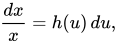
Failed to parse (MathML with SVG or PNG fallback (recommended for modern browsers and accessibility tools): Invalid response ("Math extension cannot connect to Restbase.") from server "https://wikimedia.org/api/rest_v1/":): {\displaystyle \frac{dx}{x} = h(u) \, du,}

which is easy to solve by integration of the two members.

Otherwise, a differential equation is homogeneous if it is a homogeneous function of the unknown function and its derivatives. In the case of linear differential equations, this means that there are no constant terms. The solutions of any linear ordinary differential equation of any order may be deduced by integration from the solution of the homogeneous equation obtained by removing the constant term.

Homogeneous first-order differential equations

Template:Differential equations

A first-order ordinary differential equation in the form:

Failed to parse (MathML with SVG or PNG fallback (recommended for modern browsers and accessibility tools): Invalid response ("Math extension cannot connect to Restbase.") from server "https://wikimedia.org/api/rest_v1/":): {\displaystyle M(x,y)\,dx + N(x,y)\,dy = 0 }

is a homogeneous type if both functions M(x, y) and N(x, y) are homogeneous functions of the same degree n.[2] That is, multiplying each variable by a parameter λ, we find

Failed to parse (MathML with SVG or PNG fallback (recommended for modern browsers and accessibility tools): Invalid response ("Math extension cannot connect to Restbase.") from server "https://wikimedia.org/api/rest_v1/":): {\displaystyle M(\lambda x, \lambda y) = \lambda^n M(x,y) \quad \text{and} \quad N(\lambda x, \lambda y) = \lambda^n N(x,y)\,. }

Thus,

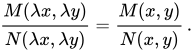
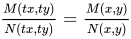
Failed to parse (MathML with SVG or PNG fallback (recommended for modern browsers and accessibility tools): Invalid response ("Math extension cannot connect to Restbase.") from server "https://wikimedia.org/api/rest_v1/":): {\displaystyle \frac{M(\lambda x, \lambda y)}{N(\lambda x, \lambda y)} = \frac{M(x,y)}{N(x,y)}\,. }

Solution method

In the quotient Failed to parse (MathML with SVG or PNG fallback (recommended for modern browsers and accessibility tools): Invalid response ("Math extension cannot connect to Restbase.") from server "https://wikimedia.org/api/rest_v1/":): {\textstyle \frac{M(tx,ty)}{N(tx,ty)} = \frac{M(x,y)}{N(x,y)}} , we can let t = Template:Sfrac to simplify this quotient to a function f of the single variable Template:Sfrac:

Failed to parse (MathML with SVG or PNG fallback (recommended for modern browsers and accessibility tools): Invalid response ("Math extension cannot connect to Restbase.") from server "https://wikimedia.org/api/rest_v1/":): {\displaystyle \frac{M(x,y)}{N(x,y)} = \frac{M(tx,ty)}{N(tx,ty)} = \frac{M(1,y/x)}{N(1,y/x)}=f(y/x)\,. }

That is

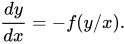
Failed to parse (MathML with SVG or PNG fallback (recommended for modern browsers and accessibility tools): Invalid response ("Math extension cannot connect to Restbase.") from server "https://wikimedia.org/api/rest_v1/":): {\displaystyle \frac{dy}{dx} = -f(y/x).}

Introduce the change of variables y = ux; differentiate using the product rule:

Failed to parse (MathML with SVG or PNG fallback (recommended for modern browsers and accessibility tools): Invalid response ("Math extension cannot connect to Restbase.") from server "https://wikimedia.org/api/rest_v1/":): {\displaystyle \frac{dy}{dx}=\frac{d(ux)}{dx} = x\frac{du}{dx} + u\frac{dx}{dx} = x\frac{du}{dx} + u.}

This transforms the original differential equation into the separable form
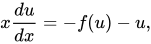
Failed to parse (MathML with SVG or PNG fallback (recommended for modern browsers and accessibility tools): Invalid response ("Math extension cannot connect to Restbase.") from server "https://wikimedia.org/api/rest_v1/":): {\displaystyle x\frac{du}{dx} = -f(u) - u, }

or

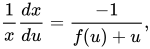
Failed to parse (MathML with SVG or PNG fallback (recommended for modern browsers and accessibility tools): Invalid response ("Math extension cannot connect to Restbase.") from server "https://wikimedia.org/api/rest_v1/":): {\displaystyle \frac 1x\frac{dx}{du} = \frac {-1}{f(u) + u}, }

which can now be integrated directly: ln x equals the antiderivative of the right-hand side (see ordinary differential equation).

Special case

A first order differential equation of the form (a, b, c, e, f, g are all constants)

Failed to parse (MathML with SVG or PNG fallback (recommended for modern browsers and accessibility tools): Invalid response ("Math extension cannot connect to Restbase.") from server "https://wikimedia.org/api/rest_v1/":): {\displaystyle \left(ax + by + c\right) dx + \left(ex + fy + g\right) dy = 0}

where afbe can be transformed into a homogeneous type by a linear transformation of both variables (α and β are constants):

Failed to parse (MathML with SVG or PNG fallback (recommended for modern browsers and accessibility tools): Invalid response ("Math extension cannot connect to Restbase.") from server "https://wikimedia.org/api/rest_v1/":): {\displaystyle t = x + \alpha; \;\; z = y + \beta \,. }

Homogeneous linear differential equations

Template:See also A linear differential equation is homogeneous if it is a homogeneous linear equation in the unknown function and its derivatives. It follows that, if φ(x) is a solution, so is (x), for any (non-zero) constant c. In order for this condition to hold, each nonzero term of the linear differential equation must depend on the unknown function or any derivative of it. A linear differential equation that fails this condition is called inhomogeneous.

A linear differential equation can be represented as a linear operator acting on y(x) where x is usually the independent variable and y is the dependent variable. Therefore, the general form of a linear homogeneous differential equation is

Failed to parse (MathML with SVG or PNG fallback (recommended for modern browsers and accessibility tools): Invalid response ("Math extension cannot connect to Restbase.") from server "https://wikimedia.org/api/rest_v1/":): {\displaystyle L(y) = 0}

where L is a differential operator, a sum of derivatives (defining the "0th derivative" as the original, non-differentiated function), each multiplied by a function fi of x:
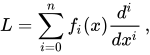
Failed to parse (MathML with SVG or PNG fallback (recommended for modern browsers and accessibility tools): Invalid response ("Math extension cannot connect to Restbase.") from server "https://wikimedia.org/api/rest_v1/":): {\displaystyle L = \sum_{i=0}^n f_i(x)\frac{d^i}{dx^i} \, ,}

where fi may be constants, but not all fi may be zero.

For example, the following linear differential equation is homogeneous:
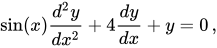
Failed to parse (MathML with SVG or PNG fallback (recommended for modern browsers and accessibility tools): Invalid response ("Math extension cannot connect to Restbase.") from server "https://wikimedia.org/api/rest_v1/":): {\displaystyle \sin(x) \frac{d^2y}{dx^2} + 4 \frac{dy}{dx} + y = 0 \,, }

whereas the following two are inhomogeneous:

Failed to parse (MathML with SVG or PNG fallback (recommended for modern browsers and accessibility tools): Invalid response ("Math extension cannot connect to Restbase.") from server "https://wikimedia.org/api/rest_v1/":): {\displaystyle 2 x^2 \frac{d^2y}{dx^2} + 4 x \frac{dy}{dx} + y = \cos(x) \,; }
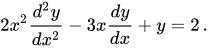
Failed to parse (MathML with SVG or PNG fallback (recommended for modern browsers and accessibility tools): Invalid response ("Math extension cannot connect to Restbase.") from server "https://wikimedia.org/api/rest_v1/":): {\displaystyle 2 x^2 \frac{d^2y}{dx^2} - 3 x \frac{dy}{dx} + y = 2 \,. }

The existence of a constant term is a sufficient condition for an equation to be inhomogeneous, as in the above example.

Characteristic equation

If the equation is linear homogeneous and further Failed to parse (MathML with SVG or PNG fallback (recommended for modern browsers and accessibility tools): Invalid response ("Math extension cannot connect to Restbase.") from server "https://wikimedia.org/api/rest_v1/":): {\displaystyle p(t),q(t)} are constant, then the equation is referred to as a constant-coefficients equation: Failed to parse (MathML with SVG or PNG fallback (recommended for modern browsers and accessibility tools): Invalid response ("Math extension cannot connect to Restbase.") from server "https://wikimedia.org/api/rest_v1/":): {\displaystyle ay''+by'+cy=0} and we can apply the method of characteristic equations to solve such an equation. Note that Failed to parse (MathML with SVG or PNG fallback (recommended for modern browsers and accessibility tools): Invalid response ("Math extension cannot connect to Restbase.") from server "https://wikimedia.org/api/rest_v1/":): {\displaystyle a} is assumed to be non-zero since we are working with a second order equation.

Method formal steps

  1. We assume that the solution is of the form Failed to parse (MathML with SVG or PNG fallback (recommended for modern browsers and accessibility tools): Invalid response ("Math extension cannot connect to Restbase.") from server "https://wikimedia.org/api/rest_v1/":): {\displaystyle y(t)=e^{rt}} (this is called making an ansatz). This gives Failed to parse (MathML with SVG or PNG fallback (recommended for modern browsers and accessibility tools): Invalid response ("Math extension cannot connect to Restbase.") from server "https://wikimedia.org/api/rest_v1/":): {\displaystyle (ar^{2}+br+c)e^{rt}=0\Longrightarrow\,ar^{2}+br+c=0,} which equation is called the characteristic equation.
  2. So to solve the above ODE, it suffices to find the two roots Failed to parse (MathML with SVG or PNG fallback (recommended for modern browsers and accessibility tools): Invalid response ("Math extension cannot connect to Restbase.") from server "https://wikimedia.org/api/rest_v1/":): {\displaystyle r_{1},r_{2}} .
  3. Then the general solution is of the form:Failed to parse (MathML with SVG or PNG fallback (recommended for modern browsers and accessibility tools): Invalid response ("Math extension cannot connect to Restbase.") from server "https://wikimedia.org/api/rest_v1/":): {\displaystyle y(t)=c_{1}e^{r_{1}t}+c_{2}e^{r_{2}t}. }

Example-presenting the method

Consider a mass Failed to parse (MathML with SVG or PNG fallback (recommended for modern browsers and accessibility tools): Invalid response ("Math extension cannot connect to Restbase.") from server "https://wikimedia.org/api/rest_v1/":): {\displaystyle m} hanging at rest on the end of a vertical spring of length Failed to parse (MathML with SVG or PNG fallback (recommended for modern browsers and accessibility tools): Invalid response ("Math extension cannot connect to Restbase.") from server "https://wikimedia.org/api/rest_v1/":): {\displaystyle l} , spring constant Failed to parse (MathML with SVG or PNG fallback (recommended for modern browsers and accessibility tools): Invalid response ("Math extension cannot connect to Restbase.") from server "https://wikimedia.org/api/rest_v1/":): {\displaystyle k} and damping constant Failed to parse (MathML with SVG or PNG fallback (recommended for modern browsers and accessibility tools): Invalid response ("Math extension cannot connect to Restbase.") from server "https://wikimedia.org/api/rest_v1/":): {\displaystyle \gamma} . Let Failed to parse (MathML with SVG or PNG fallback (recommended for modern browsers and accessibility tools): Invalid response ("Math extension cannot connect to Restbase.") from server "https://wikimedia.org/api/rest_v1/":): {\displaystyle u\left(t\right)} denote the displacement, in units of feet, from the equilibrium position. Note that since Failed to parse (MathML with SVG or PNG fallback (recommended for modern browsers and accessibility tools): Invalid response ("Math extension cannot connect to Restbase.") from server "https://wikimedia.org/api/rest_v1/":): {\displaystyle u(t)} represents the amount of displacement from the spring's equilibrium position (the position obtained when the downward force of gravity is matched by the will of the spring to not allow the mass to stretch the spring further) then Failed to parse (MathML with SVG or PNG fallback (recommended for modern browsers and accessibility tools): Invalid response ("Math extension cannot connect to Restbase.") from server "https://wikimedia.org/api/rest_v1/":): {\displaystyle u(t)} should increase downward. Then by Newton's Third Law one can obtain the equation Failed to parse (MathML with SVG or PNG fallback (recommended for modern browsers and accessibility tools): Invalid response ("Math extension cannot connect to Restbase.") from server "https://wikimedia.org/api/rest_v1/":): {\displaystyle mu'' (t )+\gamma u' (t )+ku (t )=F (t),}

where Failed to parse (MathML with SVG or PNG fallback (recommended for modern browsers and accessibility tools): Invalid response ("Math extension cannot connect to Restbase.") from server "https://wikimedia.org/api/rest_v1/":): {\displaystyle F\left (t\right )} is any external force, which for simplicity we will assume to be zero.

  1. First we obtain the characteristic equation:Failed to parse (MathML with SVG or PNG fallback (recommended for modern browsers and accessibility tools): Invalid response ("Math extension cannot connect to Restbase.") from server "https://wikimedia.org/api/rest_v1/":): {\displaystyle mr^{2}+\gamma r+k=0.}
  2. Suppose that Failed to parse (MathML with SVG or PNG fallback (recommended for modern browsers and accessibility tools): Invalid response ("Math extension cannot connect to Restbase.") from server "https://wikimedia.org/api/rest_v1/":): {\displaystyle m=1\text{lb},\gamma=5 \text{lb}/\text{ft}/\text{s}} and Failed to parse (MathML with SVG or PNG fallback (recommended for modern browsers and accessibility tools): Invalid response ("Math extension cannot connect to Restbase.") from server "https://wikimedia.org/api/rest_v1/":): {\displaystyle k=6 \text{lb}/\text{ft}} then we obtain the roots Failed to parse (MathML with SVG or PNG fallback (recommended for modern browsers and accessibility tools): Invalid response ("Math extension cannot connect to Restbase.") from server "https://wikimedia.org/api/rest_v1/":): {\displaystyle r_{1}=-2} , Failed to parse (MathML with SVG or PNG fallback (recommended for modern browsers and accessibility tools): Invalid response ("Math extension cannot connect to Restbase.") from server "https://wikimedia.org/api/rest_v1/":): {\displaystyle r_{2}=-3} .
  3. Therefore, the general solution will beFailed to parse (MathML with SVG or PNG fallback (recommended for modern browsers and accessibility tools): Invalid response ("Math extension cannot connect to Restbase.") from server "https://wikimedia.org/api/rest_v1/":): {\displaystyle u (t )=c_{1}e^{-2t}+c_{2}e^{-3t}.}
  4. Further if Failed to parse (MathML with SVG or PNG fallback (recommended for modern browsers and accessibility tools): Invalid response ("Math extension cannot connect to Restbase.") from server "https://wikimedia.org/api/rest_v1/":): {\displaystyle u(0)=0,\,u'(0)=1} we obtain Failed to parse (MathML with SVG or PNG fallback (recommended for modern browsers and accessibility tools): Invalid response ("Math extension cannot connect to Restbase.") from server "https://wikimedia.org/api/rest_v1/":): {\displaystyle c_{1}=1,c_{2}=-1} :Failed to parse (MathML with SVG or PNG fallback (recommended for modern browsers and accessibility tools): Invalid response ("Math extension cannot connect to Restbase.") from server "https://wikimedia.org/api/rest_v1/":): {\displaystyle u (t )=e^{-2t}-e^{-3t}.}


Examples

  • Consider the IVP

Failed to parse (MathML with SVG or PNG fallback (recommended for modern browsers and accessibility tools): Invalid response ("Math extension cannot connect to Restbase.") from server "https://wikimedia.org/api/rest_v1/":): {\displaystyle 4y''-y=0,\,\,y (-2 )=1,\,\,y' (-2 )=-1.}

  1. We obtain the characteristic equation Failed to parse (MathML with SVG or PNG fallback (recommended for modern browsers and accessibility tools): Invalid response ("Math extension cannot connect to Restbase.") from server "https://wikimedia.org/api/rest_v1/":): {\displaystyle 4r^{2}-1=0\Rightarrow r=\pm \frac{1}{2}} and so the general solution will beFailed to parse (MathML with SVG or PNG fallback (recommended for modern browsers and accessibility tools): Invalid response ("Math extension cannot connect to Restbase.") from server "https://wikimedia.org/api/rest_v1/":): {\displaystyle y (t )=c_{1}e^{\frac{t}{2}}+c_{2}e^{-\frac{t}{2}}. }
  2. Using the initial conditions we obtain:Failed to parse (MathML with SVG or PNG fallback (recommended for modern browsers and accessibility tools): Invalid response ("Math extension cannot connect to Restbase.") from server "https://wikimedia.org/api/rest_v1/":): {\displaystyle 1=c_{1}e^{-1}+c_{2}e\,\text{ and }\,-1=\frac{1}{2} (c_{1}e^{-1}-c_{2}e ).}
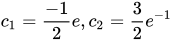
  3. Solving these two equations gives: Failed to parse (MathML with SVG or PNG fallback (recommended for modern browsers and accessibility tools): Invalid response ("Math extension cannot connect to Restbase.") from server "https://wikimedia.org/api/rest_v1/":): {\displaystyle c_{1}=\frac{-1}{2}e,c_{2}=\frac{3}{2}e^{-1}} and so the solution for our IVP is:Failed to parse (MathML with SVG or PNG fallback (recommended for modern browsers and accessibility tools): Invalid response ("Math extension cannot connect to Restbase.") from server "https://wikimedia.org/api/rest_v1/":): {\displaystyle y\left (t\right )=-\frac{1}{2}e^{1+\frac{t}{2}}+\frac{3}{2}e^{-\frac{t}{2}-1}. }
  4. Therefore, as Failed to parse (MathML with SVG or PNG fallback (recommended for modern browsers and accessibility tools): Invalid response ("Math extension cannot connect to Restbase.") from server "https://wikimedia.org/api/rest_v1/":): {\displaystyle t\to +\infty} we obtain Failed to parse (MathML with SVG or PNG fallback (recommended for modern browsers and accessibility tools): Invalid response ("Math extension cannot connect to Restbase.") from server "https://wikimedia.org/api/rest_v1/":): {\displaystyle y\to -\infty} .
  • Consider the IVP

Failed to parse (MathML with SVG or PNG fallback (recommended for modern browsers and accessibility tools): Invalid response ("Math extension cannot connect to Restbase.") from server "https://wikimedia.org/api/rest_v1/":): {\displaystyle y''+5y'+6y=0,\,\,y\left (0\right )=2,\,\,y'\left (0\right )=\beta }

  1. The characteristic equation is Failed to parse (MathML with SVG or PNG fallback (recommended for modern browsers and accessibility tools): Invalid response ("Math extension cannot connect to Restbase.") from server "https://wikimedia.org/api/rest_v1/":): {\displaystyle r^{2}+5r+6=0\Rightarrow r=-2,-3} and so the general solution will be:Failed to parse (MathML with SVG or PNG fallback (recommended for modern browsers and accessibility tools): Invalid response ("Math extension cannot connect to Restbase.") from server "https://wikimedia.org/api/rest_v1/":): {\displaystyle y (t )=c_{1}e^{-2t}+c_{2}e^{-3t}}
  2. Using the initial conditions we obtain:Failed to parse (MathML with SVG or PNG fallback (recommended for modern browsers and accessibility tools): Invalid response ("Math extension cannot connect to Restbase.") from server "https://wikimedia.org/api/rest_v1/":): {\displaystyle 2=c_{1}+c_{2}\,\text{ and } \,\beta=-2c_{1}-3c_{2}.}
  3. Solving these two equations gives: Failed to parse (MathML with SVG or PNG fallback (recommended for modern browsers and accessibility tools): Invalid response ("Math extension cannot connect to Restbase.") from server "https://wikimedia.org/api/rest_v1/":): {\displaystyle c_{1}= (6+\beta),\,c_{2}=-\left (4+\beta\right )} and so the solution for our IVP is:Failed to parse (MathML with SVG or PNG fallback (recommended for modern browsers and accessibility tools): Invalid response ("Math extension cannot connect to Restbase.") from server "https://wikimedia.org/api/rest_v1/":): {\displaystyle y (t )= (6+\beta )e^{-2t}- (4+\beta )e^{-3t}. }
  4. Therefore, as Failed to parse (MathML with SVG or PNG fallback (recommended for modern browsers and accessibility tools): Invalid response ("Math extension cannot connect to Restbase.") from server "https://wikimedia.org/api/rest_v1/":): {\displaystyle t\to +\infty} we obtain Failed to parse (MathML with SVG or PNG fallback (recommended for modern browsers and accessibility tools): Invalid response ("Math extension cannot connect to Restbase.") from server "https://wikimedia.org/api/rest_v1/":): {\displaystyle y\to 0} .


Licensing

Content obtained and/or adapted from:

  • Template:Cite book
  • Template:Harvnb