Homogeneous Differential Equations
A differential equation can be homogeneous in either of two respects.
A first order differential equation is said to be homogeneous if it may be written
- Failed to parse (MathML with SVG or PNG fallback (recommended for modern browsers and accessibility tools): Invalid response ("Math extension cannot connect to Restbase.") from server "https://wikimedia.org/api/rest_v1/":): {\displaystyle f(x,y) \, dy = g(x,y) \, dx,}
where f and g are homogeneous functions of the same degree of x and y.[1] In this case, the change of variable y = ux leads to an equation of the form
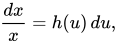
which is easy to solve by integration of the two members.
Otherwise, a differential equation is homogeneous if it is a homogeneous function of the unknown function and its derivatives. In the case of linear differential equations, this means that there are no constant terms. The solutions of any linear ordinary differential equation of any order may be deduced by integration from the solution of the homogeneous equation obtained by removing the constant term.
Contents
- 1 Homogeneous first-order differential equations
- 2 Homogeneous linear differential equations
- 3 Characteristic equation
- 4 Second order equations
- 5 Licensing
Homogeneous first-order differential equations
Template:Differential equations
A first-order ordinary differential equation in the form:

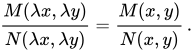
is a homogeneous type if both functions M(x, y) and N(x, y) are homogeneous functions of the same degree n.[2] That is, multiplying each variable by a parameter λ, we find

Thus,
Solution method
In the quotient , we can let t = Template:Sfrac to simplify this quotient to a function f of the single variable Template:Sfrac:
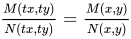

That is
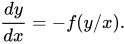
Introduce the change of variables y = ux; differentiate using the product rule:

This transforms the original differential equation into the separable form
- Failed to parse (MathML with SVG or PNG fallback (recommended for modern browsers and accessibility tools): Invalid response ("Math extension cannot connect to Restbase.") from server "https://wikimedia.org/api/rest_v1/":): {\displaystyle x\frac{du}{dx} = -f(u) - u, }
or
- Failed to parse (MathML with SVG or PNG fallback (recommended for modern browsers and accessibility tools): Invalid response ("Math extension cannot connect to Restbase.") from server "https://wikimedia.org/api/rest_v1/":): {\displaystyle \frac 1x\frac{dx}{du} = \frac {-1}{f(u) + u}, }
which can now be integrated directly: ln x equals the antiderivative of the right-hand side (see ordinary differential equation).
Special case
A first order differential equation of the form (a, b, c, e, f, g are all constants)
- Failed to parse (MathML with SVG or PNG fallback (recommended for modern browsers and accessibility tools): Invalid response ("Math extension cannot connect to Restbase.") from server "https://wikimedia.org/api/rest_v1/":): {\displaystyle \left(ax + by + c\right) dx + \left(ex + fy + g\right) dy = 0}
where af ≠ be can be transformed into a homogeneous type by a linear transformation of both variables (α and β are constants):
- Failed to parse (MathML with SVG or PNG fallback (recommended for modern browsers and accessibility tools): Invalid response ("Math extension cannot connect to Restbase.") from server "https://wikimedia.org/api/rest_v1/":): {\displaystyle t = x + \alpha; \;\; z = y + \beta \,. }
Homogeneous linear differential equations
Template:See also A linear differential equation is homogeneous if it is a homogeneous linear equation in the unknown function and its derivatives. It follows that, if φ(x) is a solution, so is cφ(x), for any (non-zero) constant c. In order for this condition to hold, each nonzero term of the linear differential equation must depend on the unknown function or any derivative of it. A linear differential equation that fails this condition is called inhomogeneous.
A linear differential equation can be represented as a linear operator acting on y(x) where x is usually the independent variable and y is the dependent variable. Therefore, the general form of a linear homogeneous differential equation is
- Failed to parse (MathML with SVG or PNG fallback (recommended for modern browsers and accessibility tools): Invalid response ("Math extension cannot connect to Restbase.") from server "https://wikimedia.org/api/rest_v1/":): {\displaystyle L(y) = 0}
where L is a differential operator, a sum of derivatives (defining the "0th derivative" as the original, non-differentiated function), each multiplied by a function fi of x:
- Failed to parse (MathML with SVG or PNG fallback (recommended for modern browsers and accessibility tools): Invalid response ("Math extension cannot connect to Restbase.") from server "https://wikimedia.org/api/rest_v1/":): {\displaystyle L = \sum_{i=0}^n f_i(x)\frac{d^i}{dx^i} \, ,}
where fi may be constants, but not all fi may be zero.
For example, the following linear differential equation is homogeneous:
- Failed to parse (MathML with SVG or PNG fallback (recommended for modern browsers and accessibility tools): Invalid response ("Math extension cannot connect to Restbase.") from server "https://wikimedia.org/api/rest_v1/":): {\displaystyle \sin(x) \frac{d^2y}{dx^2} + 4 \frac{dy}{dx} + y = 0 \,, }
whereas the following two are inhomogeneous:
- Failed to parse (MathML with SVG or PNG fallback (recommended for modern browsers and accessibility tools): Invalid response ("Math extension cannot connect to Restbase.") from server "https://wikimedia.org/api/rest_v1/":): {\displaystyle 2 x^2 \frac{d^2y}{dx^2} + 4 x \frac{dy}{dx} + y = \cos(x) \,; }
- Failed to parse (MathML with SVG or PNG fallback (recommended for modern browsers and accessibility tools): Invalid response ("Math extension cannot connect to Restbase.") from server "https://wikimedia.org/api/rest_v1/":): {\displaystyle 2 x^2 \frac{d^2y}{dx^2} - 3 x \frac{dy}{dx} + y = 2 \,. }
The existence of a constant term is a sufficient condition for an equation to be inhomogeneous, as in the above example.
Characteristic equation
If the equation is linear homogeneous and further Failed to parse (MathML with SVG or PNG fallback (recommended for modern browsers and accessibility tools): Invalid response ("Math extension cannot connect to Restbase.") from server "https://wikimedia.org/api/rest_v1/":): {\displaystyle p(t),q(t)} are constant, then the equation is referred to as a constant-coefficients equation: Failed to parse (MathML with SVG or PNG fallback (recommended for modern browsers and accessibility tools): Invalid response ("Math extension cannot connect to Restbase.") from server "https://wikimedia.org/api/rest_v1/":): {\displaystyle ay''+by'+cy=0} and we can apply the method of characteristic equations to solve such an equation. Note that Failed to parse (MathML with SVG or PNG fallback (recommended for modern browsers and accessibility tools): Invalid response ("Math extension cannot connect to Restbase.") from server "https://wikimedia.org/api/rest_v1/":): {\displaystyle a} is assumed to be non-zero since we are working with a second order equation.
Method formal steps
- We assume that the solution is of the form Failed to parse (MathML with SVG or PNG fallback (recommended for modern browsers and accessibility tools): Invalid response ("Math extension cannot connect to Restbase.") from server "https://wikimedia.org/api/rest_v1/":): {\displaystyle y(t)=e^{rt}} (this is called making an ansatz). This gives Failed to parse (MathML with SVG or PNG fallback (recommended for modern browsers and accessibility tools): Invalid response ("Math extension cannot connect to Restbase.") from server "https://wikimedia.org/api/rest_v1/":): {\displaystyle (ar^{2}+br+c)e^{rt}=0\Longrightarrow\,ar^{2}+br+c=0,} which equation is called the characteristic equation.
- So to solve the above ODE, it suffices to find the two roots Failed to parse (MathML with SVG or PNG fallback (recommended for modern browsers and accessibility tools): Invalid response ("Math extension cannot connect to Restbase.") from server "https://wikimedia.org/api/rest_v1/":): {\displaystyle r_{1},r_{2}} .
- Then the general solution is of the form:Failed to parse (MathML with SVG or PNG fallback (recommended for modern browsers and accessibility tools): Invalid response ("Math extension cannot connect to Restbase.") from server "https://wikimedia.org/api/rest_v1/":): {\displaystyle y(t)=c_{1}e^{r_{1}t}+c_{2}e^{r_{2}t}. }
Example-presenting the method
Consider a mass Failed to parse (MathML with SVG or PNG fallback (recommended for modern browsers and accessibility tools): Invalid response ("Math extension cannot connect to Restbase.") from server "https://wikimedia.org/api/rest_v1/":): {\displaystyle m} hanging at rest on the end of a vertical spring of length Failed to parse (MathML with SVG or PNG fallback (recommended for modern browsers and accessibility tools): Invalid response ("Math extension cannot connect to Restbase.") from server "https://wikimedia.org/api/rest_v1/":): {\displaystyle l} , spring constant Failed to parse (MathML with SVG or PNG fallback (recommended for modern browsers and accessibility tools): Invalid response ("Math extension cannot connect to Restbase.") from server "https://wikimedia.org/api/rest_v1/":): {\displaystyle k} and damping constant Failed to parse (MathML with SVG or PNG fallback (recommended for modern browsers and accessibility tools): Invalid response ("Math extension cannot connect to Restbase.") from server "https://wikimedia.org/api/rest_v1/":): {\displaystyle \gamma} . Let Failed to parse (MathML with SVG or PNG fallback (recommended for modern browsers and accessibility tools): Invalid response ("Math extension cannot connect to Restbase.") from server "https://wikimedia.org/api/rest_v1/":): {\displaystyle u\left(t\right)} denote the displacement, in units of feet, from the equilibrium position. Note that since Failed to parse (MathML with SVG or PNG fallback (recommended for modern browsers and accessibility tools): Invalid response ("Math extension cannot connect to Restbase.") from server "https://wikimedia.org/api/rest_v1/":): {\displaystyle u(t)} represents the amount of displacement from the spring's equilibrium position (the position obtained when the downward force of gravity is matched by the will of the spring to not allow the mass to stretch the spring further) then Failed to parse (MathML with SVG or PNG fallback (recommended for modern browsers and accessibility tools): Invalid response ("Math extension cannot connect to Restbase.") from server "https://wikimedia.org/api/rest_v1/":): {\displaystyle u(t)} should increase downward. Then by Newton's Third Law one can obtain the equation Failed to parse (MathML with SVG or PNG fallback (recommended for modern browsers and accessibility tools): Invalid response ("Math extension cannot connect to Restbase.") from server "https://wikimedia.org/api/rest_v1/":): {\displaystyle mu'' (t )+\gamma u' (t )+ku (t )=F (t),}
where Failed to parse (MathML with SVG or PNG fallback (recommended for modern browsers and accessibility tools): Invalid response ("Math extension cannot connect to Restbase.") from server "https://wikimedia.org/api/rest_v1/":): {\displaystyle F\left (t\right )} is any external force, which for simplicity we will assume to be zero.
- First we obtain the characteristic equation:Failed to parse (MathML with SVG or PNG fallback (recommended for modern browsers and accessibility tools): Invalid response ("Math extension cannot connect to Restbase.") from server "https://wikimedia.org/api/rest_v1/":): {\displaystyle mr^{2}+\gamma r+k=0.}
- Suppose that Failed to parse (MathML with SVG or PNG fallback (recommended for modern browsers and accessibility tools): Invalid response ("Math extension cannot connect to Restbase.") from server "https://wikimedia.org/api/rest_v1/":): {\displaystyle m=1\text{lb},\gamma=5 \text{lb}/\text{ft}/\text{s}} and Failed to parse (MathML with SVG or PNG fallback (recommended for modern browsers and accessibility tools): Invalid response ("Math extension cannot connect to Restbase.") from server "https://wikimedia.org/api/rest_v1/":): {\displaystyle k=6 \text{lb}/\text{ft}} then we obtain the roots Failed to parse (MathML with SVG or PNG fallback (recommended for modern browsers and accessibility tools): Invalid response ("Math extension cannot connect to Restbase.") from server "https://wikimedia.org/api/rest_v1/":): {\displaystyle r_{1}=-2} , Failed to parse (MathML with SVG or PNG fallback (recommended for modern browsers and accessibility tools): Invalid response ("Math extension cannot connect to Restbase.") from server "https://wikimedia.org/api/rest_v1/":): {\displaystyle r_{2}=-3} .
- Therefore, the general solution will beFailed to parse (MathML with SVG or PNG fallback (recommended for modern browsers and accessibility tools): Invalid response ("Math extension cannot connect to Restbase.") from server "https://wikimedia.org/api/rest_v1/":): {\displaystyle u (t )=c_{1}e^{-2t}+c_{2}e^{-3t}.}
- Further if Failed to parse (MathML with SVG or PNG fallback (recommended for modern browsers and accessibility tools): Invalid response ("Math extension cannot connect to Restbase.") from server "https://wikimedia.org/api/rest_v1/":): {\displaystyle u(0)=0,\,u'(0)=1} we obtain Failed to parse (MathML with SVG or PNG fallback (recommended for modern browsers and accessibility tools): Invalid response ("Math extension cannot connect to Restbase.") from server "https://wikimedia.org/api/rest_v1/":): {\displaystyle c_{1}=1,c_{2}=-1} :Failed to parse (MathML with SVG or PNG fallback (recommended for modern browsers and accessibility tools): Invalid response ("Math extension cannot connect to Restbase.") from server "https://wikimedia.org/api/rest_v1/":): {\displaystyle u (t )=e^{-2t}-e^{-3t}.}
Examples
- Consider the IVP
Failed to parse (MathML with SVG or PNG fallback (recommended for modern browsers and accessibility tools): Invalid response ("Math extension cannot connect to Restbase.") from server "https://wikimedia.org/api/rest_v1/":): {\displaystyle 4y''-y=0,\,\,y (-2 )=1,\,\,y' (-2 )=-1.}
- We obtain the characteristic equation Failed to parse (MathML with SVG or PNG fallback (recommended for modern browsers and accessibility tools): Invalid response ("Math extension cannot connect to Restbase.") from server "https://wikimedia.org/api/rest_v1/":): {\displaystyle 4r^{2}-1=0\Rightarrow r=\pm \frac{1}{2}} and so the general solution will beFailed to parse (MathML with SVG or PNG fallback (recommended for modern browsers and accessibility tools): Invalid response ("Math extension cannot connect to Restbase.") from server "https://wikimedia.org/api/rest_v1/":): {\displaystyle y (t )=c_{1}e^{\frac{t}{2}}+c_{2}e^{-\frac{t}{2}}. }
- Using the initial conditions we obtain:Failed to parse (MathML with SVG or PNG fallback (recommended for modern browsers and accessibility tools): Invalid response ("Math extension cannot connect to Restbase.") from server "https://wikimedia.org/api/rest_v1/":): {\displaystyle 1=c_{1}e^{-1}+c_{2}e\,\text{ and }\,-1=\frac{1}{2} (c_{1}e^{-1}-c_{2}e ).}
- Solving these two equations gives: Failed to parse (MathML with SVG or PNG fallback (recommended for modern browsers and accessibility tools): Invalid response ("Math extension cannot connect to Restbase.") from server "https://wikimedia.org/api/rest_v1/":): {\displaystyle c_{1}=\frac{-1}{2}e,c_{2}=\frac{3}{2}e^{-1}} and so the solution for our IVP is:Failed to parse (MathML with SVG or PNG fallback (recommended for modern browsers and accessibility tools): Invalid response ("Math extension cannot connect to Restbase.") from server "https://wikimedia.org/api/rest_v1/":): {\displaystyle y\left (t\right )=-\frac{1}{2}e^{1+\frac{t}{2}}+\frac{3}{2}e^{-\frac{t}{2}-1}. }
- Therefore, as Failed to parse (MathML with SVG or PNG fallback (recommended for modern browsers and accessibility tools): Invalid response ("Math extension cannot connect to Restbase.") from server "https://wikimedia.org/api/rest_v1/":): {\displaystyle t\to +\infty} we obtain .

- Consider the IVP

- The characteristic equation is and so the general solution will be:Failed to parse (MathML with SVG or PNG fallback (recommended for modern browsers and accessibility tools): Invalid response ("Math extension cannot connect to Restbase.") from server "https://wikimedia.org/api/rest_v1/":): {\displaystyle y (t )=c_{1}e^{-2t}+c_{2}e^{-3t}}
- Using the initial conditions we obtain:Failed to parse (MathML with SVG or PNG fallback (recommended for modern browsers and accessibility tools): Invalid response ("Math extension cannot connect to Restbase.") from server "https://wikimedia.org/api/rest_v1/":): {\displaystyle 2=c_{1}+c_{2}\,\text{ and } \,\beta=-2c_{1}-3c_{2}.}
- Solving these two equations gives: Failed to parse (MathML with SVG or PNG fallback (recommended for modern browsers and accessibility tools): Invalid response ("Math extension cannot connect to Restbase.") from server "https://wikimedia.org/api/rest_v1/":): {\displaystyle c_{1}= (6+\beta),\,c_{2}=-\left (4+\beta\right )} and so the solution for our IVP is:Failed to parse (MathML with SVG or PNG fallback (recommended for modern browsers and accessibility tools): Invalid response ("Math extension cannot connect to Restbase.") from server "https://wikimedia.org/api/rest_v1/":): {\displaystyle y (t )= (6+\beta )e^{-2t}- (4+\beta )e^{-3t}. }
- Therefore, as Failed to parse (MathML with SVG or PNG fallback (recommended for modern browsers and accessibility tools): Invalid response ("Math extension cannot connect to Restbase.") from server "https://wikimedia.org/api/rest_v1/":): {\displaystyle t\to +\infty} we obtain Failed to parse (MathML with SVG or PNG fallback (recommended for modern browsers and accessibility tools): Invalid response ("Math extension cannot connect to Restbase.") from server "https://wikimedia.org/api/rest_v1/":): {\displaystyle y\to 0} .

Second order equations
In order to show how these equations are solved, lets start with the most basic case - a second order equation
- Failed to parse (MathML with SVG or PNG fallback (recommended for modern browsers and accessibility tools): Invalid response ("Math extension cannot connect to Restbase.") from server "https://wikimedia.org/api/rest_v1/":): {\displaystyle A\frac{d^2y}{dx^2}+B\frac{dy}{dx}+Cy=0}
where A, B, and C are constants.
The Auxiliary Quadratic
For a DE
- Failed to parse (MathML with SVG or PNG fallback (recommended for modern browsers and accessibility tools): Invalid response ("Math extension cannot connect to Restbase.") from server "https://wikimedia.org/api/rest_v1/":): {\displaystyle a\frac{d^2y}{dx^2}+b\frac{dy}{dx}+cy=0,}
Make the following substitution:
- Failed to parse (MathML with SVG or PNG fallback (recommended for modern browsers and accessibility tools): Invalid response ("Math extension cannot connect to Restbase.") from server "https://wikimedia.org/api/rest_v1/":): {\displaystyle y=e^{mx}\,}
This gives also
- Failed to parse (MathML with SVG or PNG fallback (recommended for modern browsers and accessibility tools): Invalid response ("Math extension cannot connect to Restbase.") from server "https://wikimedia.org/api/rest_v1/":): {\displaystyle \frac{dy}{dx}=me^{mx}\,}
- Failed to parse (MathML with SVG or PNG fallback (recommended for modern browsers and accessibility tools): Invalid response ("Math extension cannot connect to Restbase.") from server "https://wikimedia.org/api/rest_v1/":): {\displaystyle \frac{d^2y}{dx^2}=m^2e^{mx}\,}
The DE is now
- Failed to parse (MathML with SVG or PNG fallback (recommended for modern browsers and accessibility tools): Invalid response ("Math extension cannot connect to Restbase.") from server "https://wikimedia.org/api/rest_v1/":): {\displaystyle am^2e^{mx}+bme^{mx}+ce^{mx}=0 \,}
Dividing by Failed to parse (MathML with SVG or PNG fallback (recommended for modern browsers and accessibility tools): Invalid response ("Math extension cannot connect to Restbase.") from server "https://wikimedia.org/api/rest_v1/":): {\displaystyle e^{mx}} gives (note:Failed to parse (MathML with SVG or PNG fallback (recommended for modern browsers and accessibility tools): Invalid response ("Math extension cannot connect to Restbase.") from server "https://wikimedia.org/api/rest_v1/":): {\displaystyle e^{mx}} can never equal zero)
- Failed to parse (MathML with SVG or PNG fallback (recommended for modern browsers and accessibility tools): Invalid response ("Math extension cannot connect to Restbase.") from server "https://wikimedia.org/api/rest_v1/":): {\displaystyle am^2+bm+c=0 \,}
This is the auxiliary quadratic (AQ) of the DE. There are four classes of outcomes to the auxiliary quadratic:
- Failed to parse (MathML with SVG or PNG fallback (recommended for modern browsers and accessibility tools): Invalid response ("Math extension cannot connect to Restbase.") from server "https://wikimedia.org/api/rest_v1/":): {\displaystyle b^2-4ac > 0, \,} , giving two distinct, real, roots.
- Failed to parse (MathML with SVG or PNG fallback (recommended for modern browsers and accessibility tools): Invalid response ("Math extension cannot connect to Restbase.") from server "https://wikimedia.org/api/rest_v1/":): {\displaystyle b^2-4ac = 0, \,} , giving two coincident real, roots.
- Failed to parse (MathML with SVG or PNG fallback (recommended for modern browsers and accessibility tools): Invalid response ("Math extension cannot connect to Restbase.") from server "https://wikimedia.org/api/rest_v1/":): {\displaystyle b^2-4ac < 0, \,} , giving complex roots.
- a: Purely imaginary roots.
- b: Complex-conjugate pair.
The method of solution of the DE depends on the class of AQ.
Class 1: Distinct, Real Roots
Consider the DE
- Failed to parse (MathML with SVG or PNG fallback (recommended for modern browsers and accessibility tools): Invalid response ("Math extension cannot connect to Restbase.") from server "https://wikimedia.org/api/rest_v1/":): {\displaystyle \frac{d^2y}{dx^2}+\frac{dy}{dx}-6y=0 }
The AQ is
- Failed to parse (MathML with SVG or PNG fallback (recommended for modern browsers and accessibility tools): Invalid response ("Math extension cannot connect to Restbase.") from server "https://wikimedia.org/api/rest_v1/":): {\displaystyle m^2+m-6=0 \,}
- Failed to parse (MathML with SVG or PNG fallback (recommended for modern browsers and accessibility tools): Invalid response ("Math extension cannot connect to Restbase.") from server "https://wikimedia.org/api/rest_v1/":): {\displaystyle (m+3)(m-2)=0 \,}
This gives us the following roots:
- Failed to parse (MathML with SVG or PNG fallback (recommended for modern browsers and accessibility tools): Invalid response ("Math extension cannot connect to Restbase.") from server "https://wikimedia.org/api/rest_v1/":): {\displaystyle m=2, \ m=-3}
Going back to the substitution we made to obtain the AQ, we have
- Failed to parse (MathML with SVG or PNG fallback (recommended for modern browsers and accessibility tools): Invalid response ("Math extension cannot connect to Restbase.") from server "https://wikimedia.org/api/rest_v1/":): {\displaystyle y=e^{2x},\ y=e^{-3x}}
as two distinct solutions to the DE. According to the [[../Higher 1#Superposition_principle|superposition principle]], the general solution is therefore
- Failed to parse (MathML with SVG or PNG fallback (recommended for modern browsers and accessibility tools): Invalid response ("Math extension cannot connect to Restbase.") from server "https://wikimedia.org/api/rest_v1/":): {\displaystyle y=Ae^{2x}+Be^{-3x} \,}
General Solution to Class 1 DEs
- Generalizing, for the Second Order DE
- Failed to parse (MathML with SVG or PNG fallback (recommended for modern browsers and accessibility tools): Invalid response ("Math extension cannot connect to Restbase.") from server "https://wikimedia.org/api/rest_v1/":): {\displaystyle a\frac{d^2y}{dx^2}+b\frac{dy}{dx}+cy=0}
- with the auxiliary quadratic given by
- Failed to parse (MathML with SVG or PNG fallback (recommended for modern browsers and accessibility tools): Invalid response ("Math extension cannot connect to Restbase.") from server "https://wikimedia.org/api/rest_v1/":): {\displaystyle am^2+bm+c=0 \,}
- with roots α and β, the general solution is
- Failed to parse (MathML with SVG or PNG fallback (recommended for modern browsers and accessibility tools): Invalid response ("Math extension cannot connect to Restbase.") from server "https://wikimedia.org/api/rest_v1/":): {\displaystyle y=Ae^{\alpha x}+Be^{\beta x} \,}
Class 2: Coincident, Real Roots
Consider the DE
- Failed to parse (MathML with SVG or PNG fallback (recommended for modern browsers and accessibility tools): Invalid response ("Math extension cannot connect to Restbase.") from server "https://wikimedia.org/api/rest_v1/":): {\displaystyle \frac{d^2y}{dx^2}-4\frac{dy}{dx}+4y=0 }
The AQ is
- Failed to parse (MathML with SVG or PNG fallback (recommended for modern browsers and accessibility tools): Invalid response ("Math extension cannot connect to Restbase.") from server "https://wikimedia.org/api/rest_v1/":): {\displaystyle m^2-4m+4=0 \,}
- Failed to parse (MathML with SVG or PNG fallback (recommended for modern browsers and accessibility tools): Invalid response ("Math extension cannot connect to Restbase.") from server "https://wikimedia.org/api/rest_v1/":): {\displaystyle (m-2)(m-2)=0 \,}
so, Failed to parse (MathML with SVG or PNG fallback (recommended for modern browsers and accessibility tools): Invalid response ("Math extension cannot connect to Restbase.") from server "https://wikimedia.org/api/rest_v1/":): {\displaystyle e^{2x}\,} is a solution. However, we cannot have it as both solutions as the factor of two produced will be absorbed into the constant, leaving us with only one constant, and therefore a DE without a full solution.
For the other solution we will use the Method of Reduction of Order. To do so we assume that it is in the form of:
- Failed to parse (MathML with SVG or PNG fallback (recommended for modern browsers and accessibility tools): Invalid response ("Math extension cannot connect to Restbase.") from server "https://wikimedia.org/api/rest_v1/":): {\displaystyle y_2=u(x)y_1=u(x)e^{2x}\,}
At the end we will check if our assumption is correct. We will now substitute this equation and solve for u(x)
- Failed to parse (MathML with SVG or PNG fallback (recommended for modern browsers and accessibility tools): Invalid response ("Math extension cannot connect to Restbase.") from server "https://wikimedia.org/api/rest_v1/":): {\displaystyle y_2''-4y_2'+4y_2=0\,}
- Failed to parse (MathML with SVG or PNG fallback (recommended for modern browsers and accessibility tools): Invalid response ("Math extension cannot connect to Restbase.") from server "https://wikimedia.org/api/rest_v1/":): {\displaystyle u''(x)e^{2x}+2u'(x)e^{2x}+2u'(x)e^{2x}+4u(x)e^{2x}-4(u'(x)e^{2x}+2u(x)e^{2x})+4u(x)e^{2x}=0\,}
- Failed to parse (MathML with SVG or PNG fallback (recommended for modern browsers and accessibility tools): Invalid response ("Math extension cannot connect to Restbase.") from server "https://wikimedia.org/api/rest_v1/":): {\displaystyle u''(x)e^{2x}=0\,}
- Failed to parse (MathML with SVG or PNG fallback (recommended for modern browsers and accessibility tools): Invalid response ("Math extension cannot connect to Restbase.") from server "https://wikimedia.org/api/rest_v1/":): {\displaystyle e^{2x}\,} is always non-zero so the only way the product can equal zero is if:
- Failed to parse (MathML with SVG or PNG fallback (recommended for modern browsers and accessibility tools): Invalid response ("Math extension cannot connect to Restbase.") from server "https://wikimedia.org/api/rest_v1/":): {\displaystyle u''(x)=0\,}
Integrating twice offers
- Failed to parse (MathML with SVG or PNG fallback (recommended for modern browsers and accessibility tools): Invalid response ("Math extension cannot connect to Restbase.") from server "https://wikimedia.org/api/rest_v1/":): {\displaystyle u(x)=a_1x + a_2\,}
Therefore
- Failed to parse (MathML with SVG or PNG fallback (recommended for modern browsers and accessibility tools): Invalid response ("Math extension cannot connect to Restbase.") from server "https://wikimedia.org/api/rest_v1/":): {\displaystyle y_2=(a_1x+a_2)y_1\,}
- Failed to parse (MathML with SVG or PNG fallback (recommended for modern browsers and accessibility tools): Invalid response ("Math extension cannot connect to Restbase.") from server "https://wikimedia.org/api/rest_v1/":): {\displaystyle y_2=(a_1x+a_2)e^{2x}\,}
Our general solution is:
- Failed to parse (MathML with SVG or PNG fallback (recommended for modern browsers and accessibility tools): Invalid response ("Math extension cannot connect to Restbase.") from server "https://wikimedia.org/api/rest_v1/":): {\displaystyle y=C_1y_1+C_2y_2\,}
- Failed to parse (MathML with SVG or PNG fallback (recommended for modern browsers and accessibility tools): Invalid response ("Math extension cannot connect to Restbase.") from server "https://wikimedia.org/api/rest_v1/":): {\displaystyle y=C_1e^{2x}+C_2(a_1x+a_2)e^{2x}\,}
- Failed to parse (MathML with SVG or PNG fallback (recommended for modern browsers and accessibility tools): Invalid response ("Math extension cannot connect to Restbase.") from server "https://wikimedia.org/api/rest_v1/":): {\displaystyle y=(C_1+a_2)e^{2x}+C_2a_1xe^{2x}\,}
Because each constant is arbitrary we can simply write
- Failed to parse (MathML with SVG or PNG fallback (recommended for modern browsers and accessibility tools): Invalid response ("Math extension cannot connect to Restbase.") from server "https://wikimedia.org/api/rest_v1/":): {\displaystyle y=C_1e^{2x}+C_2xe^{2x}\,}
The Method of Reduction of Order can be used on different equations and u(x) does not always equal x. You can see below that Failed to parse (MathML with SVG or PNG fallback (recommended for modern browsers and accessibility tools): Invalid response ("Math extension cannot connect to Restbase.") from server "https://wikimedia.org/api/rest_v1/":): {\displaystyle y=xe^{x}} is a valid solution.
- Failed to parse (MathML with SVG or PNG fallback (recommended for modern browsers and accessibility tools): Invalid response ("Math extension cannot connect to Restbase.") from server "https://wikimedia.org/api/rest_v1/":): {\displaystyle y=xe^{2x}\,}
- Failed to parse (MathML with SVG or PNG fallback (recommended for modern browsers and accessibility tools): Invalid response ("Math extension cannot connect to Restbase.") from server "https://wikimedia.org/api/rest_v1/":): {\displaystyle \frac{dy}{dx}=2xe^{2x}+e^{2x}=e^{2x}(2x+1)\,}
- Failed to parse (MathML with SVG or PNG fallback (recommended for modern browsers and accessibility tools): Invalid response ("Math extension cannot connect to Restbase.") from server "https://wikimedia.org/api/rest_v1/":): {\displaystyle \frac{d^2y}{dx^2}=2e^{2x}+2e^{2x}(2x+1)=e^{2x}(4x+4)\,}
To check substitute these into the original DE:



Therefore, Failed to parse (MathML with SVG or PNG fallback (recommended for modern browsers and accessibility tools): Invalid response ("Math extension cannot connect to Restbase.") from server "https://wikimedia.org/api/rest_v1/":): {\displaystyle y=xe^{2x}\,} is a solution as well.
General Solution to Class 2 DEs
- Generalizing, for the Second Order DE
- Failed to parse (MathML with SVG or PNG fallback (recommended for modern browsers and accessibility tools): Invalid response ("Math extension cannot connect to Restbase.") from server "https://wikimedia.org/api/rest_v1/":): {\displaystyle a\frac{d^2y}{dx^2}+b\frac{dy}{dx}+cy=0}
- with the coincident root α of the AQ, the general solution is
- Failed to parse (MathML with SVG or PNG fallback (recommended for modern browsers and accessibility tools): Invalid response ("Math extension cannot connect to Restbase.") from server "https://wikimedia.org/api/rest_v1/":): {\displaystyle y=(A+Bx)e^{\alpha x} \,}
Class 3a: Purely Imaginary Roots
To have complex roots, the AQ must have a discriminant less than zero, so
- Failed to parse (MathML with SVG or PNG fallback (recommended for modern browsers and accessibility tools): Invalid response ("Math extension cannot connect to Restbase.") from server "https://wikimedia.org/api/rest_v1/":): {\displaystyle b^2-4ac < 0 \,}
Also, for the solution to be purely imaginary, the value of b must be exactly zero.
Therefore,
- Failed to parse (MathML with SVG or PNG fallback (recommended for modern browsers and accessibility tools): Invalid response ("Math extension cannot connect to Restbase.") from server "https://wikimedia.org/api/rest_v1/":): {\displaystyle 4ac>0\,}
This means that a and c have to have the same signs: either a and c are both positive or they are both negative. If we consider our general second-order DE:
- Failed to parse (MathML with SVG or PNG fallback (recommended for modern browsers and accessibility tools): Invalid response ("Math extension cannot connect to Restbase.") from server "https://wikimedia.org/api/rest_v1/":): {\displaystyle a\frac{d^2y}{dx^2}+b\frac{dy}{dx}+cy=0}
Setting b to zero gives
- Failed to parse (MathML with SVG or PNG fallback (recommended for modern browsers and accessibility tools): Invalid response ("Math extension cannot connect to Restbase.") from server "https://wikimedia.org/api/rest_v1/":): {\displaystyle a\frac{d^2y}{dx^2}+cy=0}
Dividing through by a gives
- Failed to parse (MathML with SVG or PNG fallback (recommended for modern browsers and accessibility tools): Invalid response ("Math extension cannot connect to Restbase.") from server "https://wikimedia.org/api/rest_v1/":): {\displaystyle \frac{d^2y}{dx^2}+\frac{c}{a}y=0} .
Therefore, the y term is always positive, and this can be represented by
- Failed to parse (MathML with SVG or PNG fallback (recommended for modern browsers and accessibility tools): Invalid response ("Math extension cannot connect to Restbase.") from server "https://wikimedia.org/api/rest_v1/":): {\displaystyle \frac{d^2y}{dx^2}+\omega^2y=0} .
(I'm using ω here as it is used for simple harmonic motion, which is the primary use of this DE). There are now two paths to the solution of the DE. The first relies on us spotting that we can use the cyclical nature of trig. functions when derived. Substitute the following
- Failed to parse (MathML with SVG or PNG fallback (recommended for modern browsers and accessibility tools): Invalid response ("Math extension cannot connect to Restbase.") from server "https://wikimedia.org/api/rest_v1/":): {\displaystyle y=\cos \omega x \,}
- Failed to parse (MathML with SVG or PNG fallback (recommended for modern browsers and accessibility tools): Invalid response ("Math extension cannot connect to Restbase.") from server "https://wikimedia.org/api/rest_v1/":): {\displaystyle \frac{dy}{dx}=-\omega \sin \omega x\,}
- Failed to parse (MathML with SVG or PNG fallback (recommended for modern browsers and accessibility tools): Invalid response ("Math extension cannot connect to Restbase.") from server "https://wikimedia.org/api/rest_v1/":): {\displaystyle \frac{d^2y}{dx^2}=-\omega^2 \cos \omega x\,}
And check in our DE:
- Failed to parse (MathML with SVG or PNG fallback (recommended for modern browsers and accessibility tools): Invalid response ("Math extension cannot connect to Restbase.") from server "https://wikimedia.org/api/rest_v1/":): {\displaystyle \frac{d^2y}{dx^2}+\omega^2 y=-\omega^2 \cos \omega x+\omega^2 \cos \omega x=0}
This checks out, so Failed to parse (MathML with SVG or PNG fallback (recommended for modern browsers and accessibility tools): Invalid response ("Math extension cannot connect to Restbase.") from server "https://wikimedia.org/api/rest_v1/":): {\displaystyle \cos \omega x\,} is a solution. A similar result holds true for the substitution using Failed to parse (MathML with SVG or PNG fallback (recommended for modern browsers and accessibility tools): Invalid response ("Math extension cannot connect to Restbase.") from server "https://wikimedia.org/api/rest_v1/":): {\displaystyle y=\sin \omega x \,} .
Our solutions are therefore
- Failed to parse (MathML with SVG or PNG fallback (recommended for modern browsers and accessibility tools): Invalid response ("Math extension cannot connect to Restbase.") from server "https://wikimedia.org/api/rest_v1/":): {\displaystyle y=\cos \omega x \,}
- Failed to parse (MathML with SVG or PNG fallback (recommended for modern browsers and accessibility tools): Invalid response ("Math extension cannot connect to Restbase.") from server "https://wikimedia.org/api/rest_v1/":): {\displaystyle y=\sin \omega x \,}
So the general solution is
- Failed to parse (MathML with SVG or PNG fallback (recommended for modern browsers and accessibility tools): Invalid response ("Math extension cannot connect to Restbase.") from server "https://wikimedia.org/api/rest_v1/":): {\displaystyle y=A\cos \omega x+B\sin \omega x. \,}
The other method of solving this equation is to use Euler's Formula:
- Failed to parse (MathML with SVG or PNG fallback (recommended for modern browsers and accessibility tools): Invalid response ("Math extension cannot connect to Restbase.") from server "https://wikimedia.org/api/rest_v1/":): {\displaystyle e^{\omega ix}=\cos \omega x +i \sin x \,}
- and
- Failed to parse (MathML with SVG or PNG fallback (recommended for modern browsers and accessibility tools): Invalid response ("Math extension cannot connect to Restbase.") from server "https://wikimedia.org/api/rest_v1/":): {\displaystyle e^{-\omega ix}=\cos \omega x -i \sin x \,}
From our original DE, we have an AQ of
- Failed to parse (MathML with SVG or PNG fallback (recommended for modern browsers and accessibility tools): Invalid response ("Math extension cannot connect to Restbase.") from server "https://wikimedia.org/api/rest_v1/":): {\displaystyle m^2+\omega^2=0 \,}
giving us roots of
- Failed to parse (MathML with SVG or PNG fallback (recommended for modern browsers and accessibility tools): Invalid response ("Math extension cannot connect to Restbase.") from server "https://wikimedia.org/api/rest_v1/":): {\displaystyle m=\pm i \omega \,}
so the general solution, similar to the Class 1 DEs, is
- Failed to parse (MathML with SVG or PNG fallback (recommended for modern browsers and accessibility tools): Invalid response ("Math extension cannot connect to Restbase.") from server "https://wikimedia.org/api/rest_v1/":): {\displaystyle y=Ae^{\omega ix}+Be^{-\omega ix} \,}
- Failed to parse (MathML with SVG or PNG fallback (recommended for modern browsers and accessibility tools): Invalid response ("Math extension cannot connect to Restbase.") from server "https://wikimedia.org/api/rest_v1/":): {\displaystyle y=A(\cos \omega x +i \sin \omega x)+B(\cos \omega x -i \sin \omega x)\,}
- Failed to parse (MathML with SVG or PNG fallback (recommended for modern browsers and accessibility tools): Invalid response ("Math extension cannot connect to Restbase.") from server "https://wikimedia.org/api/rest_v1/":): {\displaystyle y=(A+B)\cos \omega x+i(A-B)\sin \omega x \,}
Since A and B are arbitrary, we can set new constants for convenience, letting our new A equal A+B and our new B equal i(A-B).
Thus we have as our general solution
- Failed to parse (MathML with SVG or PNG fallback (recommended for modern browsers and accessibility tools): Invalid response ("Math extension cannot connect to Restbase.") from server "https://wikimedia.org/api/rest_v1/":): {\displaystyle y=A\cos \omega x+B\sin \omega x \,}
General Solution to Class 3a DEs
- Generalizing, for the Second Order DE
- Failed to parse (MathML with SVG or PNG fallback (recommended for modern browsers and accessibility tools): Invalid response ("Math extension cannot connect to Restbase.") from server "https://wikimedia.org/api/rest_v1/":): {\displaystyle \frac{d^2y}{dx^2}+\omega^2 y=0}
- the general solution is
- Failed to parse (MathML with SVG or PNG fallback (recommended for modern browsers and accessibility tools): Invalid response ("Math extension cannot connect to Restbase.") from server "https://wikimedia.org/api/rest_v1/":): {\displaystyle y=A\cos \omega x+B\sin \omega x \,}
Class 3b: Complex Conjugate Roots
Since it is a proven theorem that complex roots of polynomials always occur in conjugate pairs, the only remaining class of AQ is the one with complex conjugates for solutions.
Given that the solutions are complex, we know that in the AQ
- Failed to parse (MathML with SVG or PNG fallback (recommended for modern browsers and accessibility tools): Invalid response ("Math extension cannot connect to Restbase.") from server "https://wikimedia.org/api/rest_v1/":): {\displaystyle am^2+bm+c=0 \,}
- Failed to parse (MathML with SVG or PNG fallback (recommended for modern browsers and accessibility tools): Invalid response ("Math extension cannot connect to Restbase.") from server "https://wikimedia.org/api/rest_v1/":): {\displaystyle b^2-4ac,<0,\ b \ne 0 \,} (see Class 3a).
The roots of this are in the form
- Failed to parse (MathML with SVG or PNG fallback (recommended for modern browsers and accessibility tools): Invalid response ("Math extension cannot connect to Restbase.") from server "https://wikimedia.org/api/rest_v1/":): {\displaystyle (p \pm iq)\,}
The general solution is then
- Failed to parse (MathML with SVG or PNG fallback (recommended for modern browsers and accessibility tools): Invalid response ("Math extension cannot connect to Restbase.") from server "https://wikimedia.org/api/rest_v1/":): {\displaystyle y=Ae^{(p+iq)x}+Be^{(p-iq)x}\,}
- Failed to parse (MathML with SVG or PNG fallback (recommended for modern browsers and accessibility tools): Invalid response ("Math extension cannot connect to Restbase.") from server "https://wikimedia.org/api/rest_v1/":): {\displaystyle y=e^{px} \left( Ae^{iqx}+Be^{-iqx}\right)\,}
From Euler's Formulas, we can now get
- Failed to parse (MathML with SVG or PNG fallback (recommended for modern browsers and accessibility tools): Invalid response ("Math extension cannot connect to Restbase.") from server "https://wikimedia.org/api/rest_v1/":): {\displaystyle y=e^{px}\left( A\left(\cos q x + i \sin q x \right)+B\left(\cos q x - i \sin q x \right) \right)\,}
- Failed to parse (MathML with SVG or PNG fallback (recommended for modern browsers and accessibility tools): Invalid response ("Math extension cannot connect to Restbase.") from server "https://wikimedia.org/api/rest_v1/":): {\displaystyle y=e^{px}\left( (A+B)\cos q x+i(A-B)\sin q x \right)\,}
As A and B are arbitrary, we can collapse them as in Class 3a, so that we have the general solution
- Failed to parse (MathML with SVG or PNG fallback (recommended for modern browsers and accessibility tools): Invalid response ("Math extension cannot connect to Restbase.") from server "https://wikimedia.org/api/rest_v1/":): {\displaystyle y=e^{px}\left( A\cos q x+B\sin q x \right)\,}
General Solution to Class 3b DEs
- Generalizing, for the Second Order DE
- Failed to parse (MathML with SVG or PNG fallback (recommended for modern browsers and accessibility tools): Invalid response ("Math extension cannot connect to Restbase.") from server "https://wikimedia.org/api/rest_v1/":): {\displaystyle a\frac{d^2y}{dx^2}+b\frac{dy}{dx}+cy=0}
- with an AQ with roots
- Failed to parse (MathML with SVG or PNG fallback (recommended for modern browsers and accessibility tools): Invalid response ("Math extension cannot connect to Restbase.") from server "https://wikimedia.org/api/rest_v1/":): {\displaystyle m=p \pm iq,}
- The general solution is
- Failed to parse (MathML with SVG or PNG fallback (recommended for modern browsers and accessibility tools): Invalid response ("Math extension cannot connect to Restbase.") from server "https://wikimedia.org/api/rest_v1/":): {\displaystyle y=e^{px}\left( A\cos q x+B\sin q x \right)\,}
We have now covered all possible types of homogeneous second-order differential equation, and we didn't even have to integrate anything! We will now have a look at higher order equivalents.
Licensing
Content obtained and/or adapted from:
- Homogeneous differential equation, Wikipedia under a CC BY-SA license
- Homogeneous second order equations, Wikibooks: Ordinary Differential Equations under a CC BY-SA license

