The Fundamental Theorem
The fundamental theorem of calculus is a theorem that links the concept of differentiating a function (calculating the gradient) with the concept of integrating a function (calculating the area under the curve). The two operations are inverses of each other apart from a constant value which depends where one starts to compute area.
The first part of the theorem, sometimes called the first fundamental theorem of calculus, states that one of the antiderivatives (also known as an indefinite integral), say F, of some function f may be obtained as the integral of f with a variable bound of integration. This implies the existence of antiderivatives for continuous functions.
Conversely, the second part of the theorem, sometimes called the second fundamental theorem of calculus, states that the integral of a function f over some interval can be computed by using any one, say F, of its infinitely many antiderivatives. This part of the theorem has key practical applications, because explicitly finding the antiderivative of a function by symbolic integration avoids numerical integration to compute integrals.
Contents
Geometric meaning

For a continuous function whose graph is plotted as a curve, each value of x has a corresponding area function A(x), representing the area beneath the curve between 0 and x. The function A(x) may not be known, but it is given that it represents the area under the curve.

The area under the curve between x and x + h could be computed by finding the area between 0 and x + h, then subtracting the area between 0 and x. In other words, the area of this “strip” would be A(x + h) − A(x).
There is another way to estimate the area of this same strip. As shown in the accompanying figure, h is multiplied by f(x) to find the area of a rectangle that is approximately the same size as this strip. So:

In fact, this estimate becomes a perfect equality if we add the red portion of the "excess" area shown in the diagram. So:

Rearranging terms:
- .

As h approaches 0 in the limit, the last fraction can be shown to go to zero. This is true because the area of the red portion of excess region is less than or equal to the area of the tiny black-bordered rectangle. More precisely,

where Failed to parse (MathML with SVG or PNG fallback (recommended for modern browsers and accessibility tools): Invalid response ("Math extension cannot connect to Restbase.") from server "https://wikimedia.org/api/rest_v1/":): {\displaystyle x+h_1} and Failed to parse (MathML with SVG or PNG fallback (recommended for modern browsers and accessibility tools): Invalid response ("Math extension cannot connect to Restbase.") from server "https://wikimedia.org/api/rest_v1/":): {\displaystyle x+h_2} are points where f reaches its maximum and its minimum, respectively, in the interval [x, x + h]. By the continuity of f, the latter expression tends to zero as h does. Therefore, the left-hand side tends to zero as h does, which implies
- Failed to parse (MathML with SVG or PNG fallback (recommended for modern browsers and accessibility tools): Invalid response ("Math extension cannot connect to Restbase.") from server "https://wikimedia.org/api/rest_v1/":): {\displaystyle f(x) = \lim_{h\to 0}\frac{A(x+h)-A(x)}{h}.}
This implies Failed to parse (MathML with SVG or PNG fallback (recommended for modern browsers and accessibility tools): Invalid response ("Math extension cannot connect to Restbase.") from server "https://wikimedia.org/api/rest_v1/":): {\displaystyle f(x) = A'(x)} . That is, the derivative of the area function A(x) exists and is the original function f(x); so, the area function is simply an antiderivative of the original function. Computing the derivative of a function and finding the area under its curve are "opposite" operations. This is the crux of the Fundamental Theorem of Calculus.
Physical intuition
Intuitively, the theorem states that the sum of infinitesimal changes in a quantity over time (or over some other variable) adds up to the net change in the quantity.
Imagine for example using a stopwatch to mark-off tiny increments of time as a car travels down a highway. Imagine also looking at the car's speedometer as it travels, so that at every moment you know the velocity of the car. To understand the power of this theorem, imagine also that you are not allowed to look out of the window of the car, so that you have no direct evidence of how far the car has traveled.
For any tiny interval of time in the car, you could calculate how far the car has traveled in that interval by multiplying the current speed of the car times the length of that tiny interval of time. (This is because distance = speed Failed to parse (MathML with SVG or PNG fallback (recommended for modern browsers and accessibility tools): Invalid response ("Math extension cannot connect to Restbase.") from server "https://wikimedia.org/api/rest_v1/":): {\displaystyle \times} time.)
Now imagine doing this instant after instant, so that for every tiny interval of time you know how far the car has traveled. In principle, you could then calculate the total distance traveled in the car (even though you've never looked out of the window) by summing-up all those tiny distances.
- distance traveled = Failed to parse (MathML with SVG or PNG fallback (recommended for modern browsers and accessibility tools): Invalid response ("Math extension cannot connect to Restbase.") from server "https://wikimedia.org/api/rest_v1/":): {\displaystyle \sum} the velocity at any instant Failed to parse (MathML with SVG or PNG fallback (recommended for modern browsers and accessibility tools): Invalid response ("Math extension cannot connect to Restbase.") from server "https://wikimedia.org/api/rest_v1/":): {\displaystyle \times} a tiny interval of time
In other words,
- distance traveled = Failed to parse (MathML with SVG or PNG fallback (recommended for modern browsers and accessibility tools): Invalid response ("Math extension cannot connect to Restbase.") from server "https://wikimedia.org/api/rest_v1/":): {\displaystyle \sum v(t) \times \Delta t}
On the right hand side of this equation, as Failed to parse (MathML with SVG or PNG fallback (recommended for modern browsers and accessibility tools): Invalid response ("Math extension cannot connect to Restbase.") from server "https://wikimedia.org/api/rest_v1/":): {\displaystyle \Delta t} becomes infinitesimally small, the operation of "summing up" corresponds to integration. So what we've shown is that the integral of the velocity function can be used to compute how far the car has traveled.
Now remember that the velocity function is the derivative of the position function. So what we have really shown is that integrating the velocity recovers the original position function. This is the basic idea of the theorem: that integration and differentiation are closely related operations, each essentially being the inverse of the other.
In other words, in terms of one's physical intuition, the theorem states that the sum of the changes in a quantity over time (such as position, as calculated by multiplying velocity times time) adds up to the total net change in the quantity. Or to put this more generally:
- Given a quantity Failed to parse (MathML with SVG or PNG fallback (recommended for modern browsers and accessibility tools): Invalid response ("Math extension cannot connect to Restbase.") from server "https://wikimedia.org/api/rest_v1/":): {\displaystyle x} that changes over some variable Failed to parse (MathML with SVG or PNG fallback (recommended for modern browsers and accessibility tools): Invalid response ("Math extension cannot connect to Restbase.") from server "https://wikimedia.org/api/rest_v1/":): {\displaystyle t} , and
- Given the velocity Failed to parse (MathML with SVG or PNG fallback (recommended for modern browsers and accessibility tools): Invalid response ("Math extension cannot connect to Restbase.") from server "https://wikimedia.org/api/rest_v1/":): {\displaystyle v(t)} with which that quantity changes over that variable
then the idea that "distance equals speed times time" corresponds to the statement
- Failed to parse (MathML with SVG or PNG fallback (recommended for modern browsers and accessibility tools): Invalid response ("Math extension cannot connect to Restbase.") from server "https://wikimedia.org/api/rest_v1/":): {\displaystyle dx = v(t) dt}
meaning that one can recover the original function Failed to parse (MathML with SVG or PNG fallback (recommended for modern browsers and accessibility tools): Invalid response ("Math extension cannot connect to Restbase.") from server "https://wikimedia.org/api/rest_v1/":): {\displaystyle x(t)} by integrating its derivative, the velocity Failed to parse (MathML with SVG or PNG fallback (recommended for modern browsers and accessibility tools): Invalid response ("Math extension cannot connect to Restbase.") from server "https://wikimedia.org/api/rest_v1/":): {\displaystyle v(t)} , over Failed to parse (MathML with SVG or PNG fallback (recommended for modern browsers and accessibility tools): Invalid response ("Math extension cannot connect to Restbase.") from server "https://wikimedia.org/api/rest_v1/":): {\displaystyle t} .
Formal statements
There are two parts to the theorem. The first part deals with the derivative of an antiderivative, while the second part deals with the relationship between antiderivatives and definite integrals.
First part
This part is sometimes referred to as the first fundamental theorem of calculus.
Let f be a continuous real-valued function defined on a closed interval [a, b]. Let F be the function defined, for all x in [a, b], by
- Failed to parse (MathML with SVG or PNG fallback (recommended for modern browsers and accessibility tools): Invalid response ("Math extension cannot connect to Restbase.") from server "https://wikimedia.org/api/rest_v1/":): {\displaystyle F(x) = \int_a^x f(t)\, dt.}
Then F is uniformly continuous on [a, b] and differentiable on the open interval (a, b), and
- Failed to parse (MathML with SVG or PNG fallback (recommended for modern browsers and accessibility tools): Invalid response ("Math extension cannot connect to Restbase.") from server "https://wikimedia.org/api/rest_v1/":): {\displaystyle F'(x) = f(x)}
for all x in (a, b).
Corollary
.gif)
The fundamental theorem is often employed to compute the definite integral of a function Failed to parse (MathML with SVG or PNG fallback (recommended for modern browsers and accessibility tools): Invalid response ("Math extension cannot connect to Restbase.") from server "https://wikimedia.org/api/rest_v1/":): {\displaystyle f} for which an antiderivative Failed to parse (MathML with SVG or PNG fallback (recommended for modern browsers and accessibility tools): Invalid response ("Math extension cannot connect to Restbase.") from server "https://wikimedia.org/api/rest_v1/":): {\displaystyle F} is known. Specifically, if Failed to parse (MathML with SVG or PNG fallback (recommended for modern browsers and accessibility tools): Invalid response ("Math extension cannot connect to Restbase.") from server "https://wikimedia.org/api/rest_v1/":): {\displaystyle f} is a real-valued continuous function on Failed to parse (MathML with SVG or PNG fallback (recommended for modern browsers and accessibility tools): Invalid response ("Math extension cannot connect to Restbase.") from server "https://wikimedia.org/api/rest_v1/":): {\displaystyle [a,b]} and Failed to parse (MathML with SVG or PNG fallback (recommended for modern browsers and accessibility tools): Invalid response ("Math extension cannot connect to Restbase.") from server "https://wikimedia.org/api/rest_v1/":): {\displaystyle F} is an antiderivative of Failed to parse (MathML with SVG or PNG fallback (recommended for modern browsers and accessibility tools): Invalid response ("Math extension cannot connect to Restbase.") from server "https://wikimedia.org/api/rest_v1/":): {\displaystyle f} in Failed to parse (MathML with SVG or PNG fallback (recommended for modern browsers and accessibility tools): Invalid response ("Math extension cannot connect to Restbase.") from server "https://wikimedia.org/api/rest_v1/":): {\displaystyle [a,b]} then
- Failed to parse (MathML with SVG or PNG fallback (recommended for modern browsers and accessibility tools): Invalid response ("Math extension cannot connect to Restbase.") from server "https://wikimedia.org/api/rest_v1/":): {\displaystyle \int_a^b f(t)\, dt = F(b)-F(a).}
The corollary assumes continuity on the whole interval. This result is strengthened slightly in the following part of the theorem.
Second part
This part is sometimes referred to as the second fundamental theorem of calculus or the Newton–Leibniz axiom.
Let Failed to parse (MathML with SVG or PNG fallback (recommended for modern browsers and accessibility tools): Invalid response ("Math extension cannot connect to Restbase.") from server "https://wikimedia.org/api/rest_v1/":): {\displaystyle f} be a real-valued function on a closed interval Failed to parse (MathML with SVG or PNG fallback (recommended for modern browsers and accessibility tools): Invalid response ("Math extension cannot connect to Restbase.") from server "https://wikimedia.org/api/rest_v1/":): {\displaystyle [a,b]} and Failed to parse (MathML with SVG or PNG fallback (recommended for modern browsers and accessibility tools): Invalid response ("Math extension cannot connect to Restbase.") from server "https://wikimedia.org/api/rest_v1/":): {\displaystyle F} an antiderivative of Failed to parse (MathML with SVG or PNG fallback (recommended for modern browsers and accessibility tools): Invalid response ("Math extension cannot connect to Restbase.") from server "https://wikimedia.org/api/rest_v1/":): {\displaystyle f} in Failed to parse (MathML with SVG or PNG fallback (recommended for modern browsers and accessibility tools): Invalid response ("Math extension cannot connect to Restbase.") from server "https://wikimedia.org/api/rest_v1/":): {\displaystyle (a,b)} :
- Failed to parse (MathML with SVG or PNG fallback (recommended for modern browsers and accessibility tools): Invalid response ("Math extension cannot connect to Restbase.") from server "https://wikimedia.org/api/rest_v1/":): {\displaystyle F'(x) = f(x).}
If Failed to parse (MathML with SVG or PNG fallback (recommended for modern browsers and accessibility tools): Invalid response ("Math extension cannot connect to Restbase.") from server "https://wikimedia.org/api/rest_v1/":): {\displaystyle f} is Riemann integrable on Failed to parse (MathML with SVG or PNG fallback (recommended for modern browsers and accessibility tools): Invalid response ("Math extension cannot connect to Restbase.") from server "https://wikimedia.org/api/rest_v1/":): {\displaystyle [a,b]} then
- Failed to parse (MathML with SVG or PNG fallback (recommended for modern browsers and accessibility tools): Invalid response ("Math extension cannot connect to Restbase.") from server "https://wikimedia.org/api/rest_v1/":): {\displaystyle \int_a^b f(x)\,dx = F(b) - F(a).}
The second part is somewhat stronger than the corollary because it does not assume that Failed to parse (MathML with SVG or PNG fallback (recommended for modern browsers and accessibility tools): Invalid response ("Math extension cannot connect to Restbase.") from server "https://wikimedia.org/api/rest_v1/":): {\displaystyle f} is continuous.
When an antiderivative Failed to parse (MathML with SVG or PNG fallback (recommended for modern browsers and accessibility tools): Invalid response ("Math extension cannot connect to Restbase.") from server "https://wikimedia.org/api/rest_v1/":): {\displaystyle F} exists, then there are infinitely many antiderivatives for Failed to parse (MathML with SVG or PNG fallback (recommended for modern browsers and accessibility tools): Invalid response ("Math extension cannot connect to Restbase.") from server "https://wikimedia.org/api/rest_v1/":): {\displaystyle f} , obtained by adding an arbitrary constant to Failed to parse (MathML with SVG or PNG fallback (recommended for modern browsers and accessibility tools): Invalid response ("Math extension cannot connect to Restbase.") from server "https://wikimedia.org/api/rest_v1/":): {\displaystyle F} . Also, by the first part of the theorem, antiderivatives of Failed to parse (MathML with SVG or PNG fallback (recommended for modern browsers and accessibility tools): Invalid response ("Math extension cannot connect to Restbase.") from server "https://wikimedia.org/api/rest_v1/":): {\displaystyle f} always exist when Failed to parse (MathML with SVG or PNG fallback (recommended for modern browsers and accessibility tools): Invalid response ("Math extension cannot connect to Restbase.") from server "https://wikimedia.org/api/rest_v1/":): {\displaystyle f} is continuous.
Proof of the first part
For a given f(t), define the function F(x) as
- Failed to parse (MathML with SVG or PNG fallback (recommended for modern browsers and accessibility tools): Invalid response ("Math extension cannot connect to Restbase.") from server "https://wikimedia.org/api/rest_v1/":): {\displaystyle F(x) = \int_a^x f(t) \,dt.}
For any two numbers x1 and x1 + Δx in [a, b], we have
- Failed to parse (MathML with SVG or PNG fallback (recommended for modern browsers and accessibility tools): Invalid response ("Math extension cannot connect to Restbase.") from server "https://wikimedia.org/api/rest_v1/":): {\displaystyle F(x_1) = \int_{a}^{x_1} f(t) \,dt}
and
- Failed to parse (MathML with SVG or PNG fallback (recommended for modern browsers and accessibility tools): Invalid response ("Math extension cannot connect to Restbase.") from server "https://wikimedia.org/api/rest_v1/":): {\displaystyle F(x_1 + \Delta x) = \int_a^{x_1 + \Delta x} f(t) \,dt.}
Subtracting the two equalities gives
- Failed to parse (MathML with SVG or PNG fallback (recommended for modern browsers and accessibility tools): Invalid response ("Math extension cannot connect to Restbase.") from server "https://wikimedia.org/api/rest_v1/":): {\displaystyle F(x_1 + \Delta x) - F(x_1) = \int_a^{x_1 + \Delta x} f(t) \,dt - \int_a^{x_1} f(t) \,dt. \qquad (1)}
It can be shown that
- Failed to parse (MathML with SVG or PNG fallback (recommended for modern browsers and accessibility tools): Invalid response ("Math extension cannot connect to Restbase.") from server "https://wikimedia.org/api/rest_v1/":): {\displaystyle \int_{a}^{x_1} f(t) \,dt + \int_{x_1}^{x_1 + \Delta x} f(t) \,dt = \int_a^{x_1 + \Delta x} f(t) \,dt. }
- (The sum of the areas of two adjacent regions is equal to the area of both regions combined.)
Manipulating this equation gives
- Failed to parse (MathML with SVG or PNG fallback (recommended for modern browsers and accessibility tools): Invalid response ("Math extension cannot connect to Restbase.") from server "https://wikimedia.org/api/rest_v1/":): {\displaystyle \int_{a}^{x_1 + \Delta x} f(t) \,dt - \int_{a}^{x_1} f(t) \,dt = \int_{x_1}^{x_1 + \Delta x} f(t) \,dt. }
Substituting the above into (1) results in

According to the mean value theorem for integration, there exists a real number such that
![{\displaystyle c\in [x_{1},x_{1}+\Delta x]}](https://wikimedia.org/api/rest_v1/media/math/render/svg/734554629a2c09f13968c19d7bc12548de243fa2)
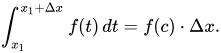
To keep the notation simple, we write just Failed to parse (MathML with SVG or PNG fallback (recommended for modern browsers and accessibility tools): Invalid response ("Math extension cannot connect to Restbase.") from server "https://wikimedia.org/api/rest_v1/":): {\displaystyle c} , but one should keep in mind that, for a given function Failed to parse (MathML with SVG or PNG fallback (recommended for modern browsers and accessibility tools): Invalid response ("Math extension cannot connect to Restbase.") from server "https://wikimedia.org/api/rest_v1/":): {\displaystyle f} , the value of Failed to parse (MathML with SVG or PNG fallback (recommended for modern browsers and accessibility tools): Invalid response ("Math extension cannot connect to Restbase.") from server "https://wikimedia.org/api/rest_v1/":): {\displaystyle c} depends on Failed to parse (MathML with SVG or PNG fallback (recommended for modern browsers and accessibility tools): Invalid response ("Math extension cannot connect to Restbase.") from server "https://wikimedia.org/api/rest_v1/":): {\displaystyle x_1} and on Failed to parse (MathML with SVG or PNG fallback (recommended for modern browsers and accessibility tools): Invalid response ("Math extension cannot connect to Restbase.") from server "https://wikimedia.org/api/rest_v1/":): {\displaystyle \Delta x,} but is always confined to the interval Failed to parse (MathML with SVG or PNG fallback (recommended for modern browsers and accessibility tools): Invalid response ("Math extension cannot connect to Restbase.") from server "https://wikimedia.org/api/rest_v1/":): {\displaystyle [x_1, x_1 + \Delta x]} . Substituting the above into (2) we get
- Failed to parse (MathML with SVG or PNG fallback (recommended for modern browsers and accessibility tools): Invalid response ("Math extension cannot connect to Restbase.") from server "https://wikimedia.org/api/rest_v1/":): {\displaystyle F(x_1 + \Delta x) - F(x_1) = f(c)\cdot \Delta x.}
Dividing both sides by Failed to parse (MathML with SVG or PNG fallback (recommended for modern browsers and accessibility tools): Invalid response ("Math extension cannot connect to Restbase.") from server "https://wikimedia.org/api/rest_v1/":): {\displaystyle \Delta x} gives
- Failed to parse (MathML with SVG or PNG fallback (recommended for modern browsers and accessibility tools): Invalid response ("Math extension cannot connect to Restbase.") from server "https://wikimedia.org/api/rest_v1/":): {\displaystyle \frac{F(x_1 + \Delta x) - F(x_1)}{\Delta x} = f(c).}
- The expression on the left side of the equation is Newton's difference quotient for F at x1.
Take the limit as Failed to parse (MathML with SVG or PNG fallback (recommended for modern browsers and accessibility tools): Invalid response ("Math extension cannot connect to Restbase.") from server "https://wikimedia.org/api/rest_v1/":): {\displaystyle \Delta x} → 0 on both sides of the equation.
- Failed to parse (MathML with SVG or PNG fallback (recommended for modern browsers and accessibility tools): Invalid response ("Math extension cannot connect to Restbase.") from server "https://wikimedia.org/api/rest_v1/":): {\displaystyle \lim_{\Delta x \to 0} \frac{F(x_1 + \Delta x) - F(x_1)}{\Delta x} = \lim_{\Delta x \to 0} f(c). }
The expression on the left side of the equation is the definition of the derivative of F at x1.
- Failed to parse (MathML with SVG or PNG fallback (recommended for modern browsers and accessibility tools): Invalid response ("Math extension cannot connect to Restbase.") from server "https://wikimedia.org/api/rest_v1/":): {\displaystyle F'(x_1) = \lim_{\Delta x \to 0} f(c). \qquad (3) }
To find the other limit, we use the squeeze theorem. The number c is in the interval [x1, x1 + Δx], so x1 ≤ c ≤ x1 + Δx.
Also, Failed to parse (MathML with SVG or PNG fallback (recommended for modern browsers and accessibility tools): Invalid response ("Math extension cannot connect to Restbase.") from server "https://wikimedia.org/api/rest_v1/":): {\displaystyle \lim_{\Delta x \to 0} x_1 = x_1} and Failed to parse (MathML with SVG or PNG fallback (recommended for modern browsers and accessibility tools): Invalid response ("Math extension cannot connect to Restbase.") from server "https://wikimedia.org/api/rest_v1/":): {\displaystyle \lim_{\Delta x \to 0} x_1 + \Delta x = x_1.}
Therefore, according to the squeeze theorem,
- Failed to parse (MathML with SVG or PNG fallback (recommended for modern browsers and accessibility tools): Invalid response ("Math extension cannot connect to Restbase.") from server "https://wikimedia.org/api/rest_v1/":): {\displaystyle \lim_{\Delta x \to 0} c = x_1.}
The function f is continuous at x1, the limit can be taken inside the function:
- Failed to parse (MathML with SVG or PNG fallback (recommended for modern browsers and accessibility tools): Invalid response ("Math extension cannot connect to Restbase.") from server "https://wikimedia.org/api/rest_v1/":): {\displaystyle \lim_{\Delta x \to 0} f(c) = f(x_1).}
Substituting into (3), we get
- Failed to parse (MathML with SVG or PNG fallback (recommended for modern browsers and accessibility tools): Invalid response ("Math extension cannot connect to Restbase.") from server "https://wikimedia.org/api/rest_v1/":): {\displaystyle F'(x_1) = f(x_1).}
which completes the proof.
Proof of the corollary
Suppose F is an antiderivative of f, with f continuous on [a, b]. Let
- Failed to parse (MathML with SVG or PNG fallback (recommended for modern browsers and accessibility tools): Invalid response ("Math extension cannot connect to Restbase.") from server "https://wikimedia.org/api/rest_v1/":): {\displaystyle G(x) = \int_a^x f(t)\, dt} .
By the first part of the theorem, we know G is also an antiderivative of f. Since F′ − G′ = 0 the mean value theorem implies that F − G is a constant function, that is, there is a number c such that Failed to parse (MathML with SVG or PNG fallback (recommended for modern browsers and accessibility tools): Invalid response ("Math extension cannot connect to Restbase.") from server "https://wikimedia.org/api/rest_v1/":): {\displaystyle G(x) = F(x) + c} for all x in [a, b]. Letting x = a, we have
- Failed to parse (MathML with SVG or PNG fallback (recommended for modern browsers and accessibility tools): Invalid response ("Math extension cannot connect to Restbase.") from server "https://wikimedia.org/api/rest_v1/":): {\displaystyle F(a) + c = G(a) = \int_a^a f(t)\, dt = 0,}
which means Failed to parse (MathML with SVG or PNG fallback (recommended for modern browsers and accessibility tools): Invalid response ("Math extension cannot connect to Restbase.") from server "https://wikimedia.org/api/rest_v1/":): {\displaystyle c = -F(a)} . In other words, Failed to parse (MathML with SVG or PNG fallback (recommended for modern browsers and accessibility tools): Invalid response ("Math extension cannot connect to Restbase.") from server "https://wikimedia.org/api/rest_v1/":): {\displaystyle G(x) = F(x) - F(a)} , and so
- Failed to parse (MathML with SVG or PNG fallback (recommended for modern browsers and accessibility tools): Invalid response ("Math extension cannot connect to Restbase.") from server "https://wikimedia.org/api/rest_v1/":): {\displaystyle \int_a^b f(x)\, dx = G(b) = F(b) - F(a).}
Proof of the second part
This is a limit proof by Riemann sums. Let f be (Riemann) integrable on the interval [a, b], and let f admit an antiderivative F on [a, b]. Begin with the quantity F(b) − F(a). Let there be numbers x1, ..., xn such that
- Failed to parse (MathML with SVG or PNG fallback (recommended for modern browsers and accessibility tools): Invalid response ("Math extension cannot connect to Restbase.") from server "https://wikimedia.org/api/rest_v1/":): {\displaystyle a = x_0 < x_1 < x_2 < \cdots < x_{n-1} < x_n = b. }
It follows that
- Failed to parse (MathML with SVG or PNG fallback (recommended for modern browsers and accessibility tools): Invalid response ("Math extension cannot connect to Restbase.") from server "https://wikimedia.org/api/rest_v1/":): {\displaystyle F(b) - F(a) = F(x_n) - F(x_0). }
Now, we add each F(xi) along with its additive inverse, so that the resulting quantity is equal:
- Failed to parse (MathML with SVG or PNG fallback (recommended for modern browsers and accessibility tools): Invalid response ("Math extension cannot connect to Restbase.") from server "https://wikimedia.org/api/rest_v1/":): {\displaystyle \begin{align} F(b) - F(a) &= F(x_n) + [-F(x_{n-1}) + F(x_{n-1})] + \cdots + [-F(x_1) + F(x_1)] - F(x_0) \\ &= [F(x_n) - F(x_{n-1})] + [F(x_{n-1}) - F(x_{n-2})] + \cdots + [F(x_2) - F(x_1)] + [F(x_1) - F(x_0)]. \end{align}}
The above quantity can be written as the following sum:
- Failed to parse (MathML with SVG or PNG fallback (recommended for modern browsers and accessibility tools): Invalid response ("Math extension cannot connect to Restbase.") from server "https://wikimedia.org/api/rest_v1/":): {\displaystyle F(b) - F(a) = \sum_{i=1}^n [F(x_i) - F(x_{i-1})]. \qquad (1)}
Next, we employ the mean value theorem. Stated briefly,
Let F be continuous on the closed interval [a, b] and differentiable on the open interval (a, b). Then there exists some c in (a, b) such that
- Failed to parse (MathML with SVG or PNG fallback (recommended for modern browsers and accessibility tools): Invalid response ("Math extension cannot connect to Restbase.") from server "https://wikimedia.org/api/rest_v1/":): {\displaystyle F'(c) = \frac{F(b) - F(a)}{b - a}.}
It follows that
- Failed to parse (MathML with SVG or PNG fallback (recommended for modern browsers and accessibility tools): Invalid response ("Math extension cannot connect to Restbase.") from server "https://wikimedia.org/api/rest_v1/":): {\displaystyle F'(c)(b - a) = F(b) - F(a). }
The function F is differentiable on the interval [a, b]; therefore, it is also differentiable and continuous on each interval [xi−1, xi]. According to the mean value theorem (above),
- Failed to parse (MathML with SVG or PNG fallback (recommended for modern browsers and accessibility tools): Invalid response ("Math extension cannot connect to Restbase.") from server "https://wikimedia.org/api/rest_v1/":): {\displaystyle F(x_i) - F(x_{i-1}) = F'(c_i)(x_i - x_{i-1}). }
Substituting the above into (1), we get
- Failed to parse (MathML with SVG or PNG fallback (recommended for modern browsers and accessibility tools): Invalid response ("Math extension cannot connect to Restbase.") from server "https://wikimedia.org/api/rest_v1/":): {\displaystyle F(b) - F(a) = \sum_{i=1}^n [F'(c_i)(x_i - x_{i-1})].}
The assumption implies Failed to parse (MathML with SVG or PNG fallback (recommended for modern browsers and accessibility tools): Invalid response ("Math extension cannot connect to Restbase.") from server "https://wikimedia.org/api/rest_v1/":): {\displaystyle F'(c_i) = f(c_i).} Also, Failed to parse (MathML with SVG or PNG fallback (recommended for modern browsers and accessibility tools): Invalid response ("Math extension cannot connect to Restbase.") from server "https://wikimedia.org/api/rest_v1/":): {\displaystyle x_i - x_{i-1}} can be expressed as Failed to parse (MathML with SVG or PNG fallback (recommended for modern browsers and accessibility tools): Invalid response ("Math extension cannot connect to Restbase.") from server "https://wikimedia.org/api/rest_v1/":): {\displaystyle \Delta x} of partition Failed to parse (MathML with SVG or PNG fallback (recommended for modern browsers and accessibility tools): Invalid response ("Math extension cannot connect to Restbase.") from server "https://wikimedia.org/api/rest_v1/":): {\displaystyle i} .
- Failed to parse (MathML with SVG or PNG fallback (recommended for modern browsers and accessibility tools): Invalid response ("Math extension cannot connect to Restbase.") from server "https://wikimedia.org/api/rest_v1/":): {\displaystyle F(b) - F(a) = \sum_{i=1}^n [f(c_i)(\Delta x_i)]. \qquad (2)}

We are describing the area of a rectangle, with the width times the height, and we are adding the areas together. Each rectangle, by virtue of the mean value theorem, describes an approximation of the curve section it is drawn over. Also Failed to parse (MathML with SVG or PNG fallback (recommended for modern browsers and accessibility tools): Invalid response ("Math extension cannot connect to Restbase.") from server "https://wikimedia.org/api/rest_v1/":): {\displaystyle \Delta x_i} need not be the same for all values of i, or in other words that the width of the rectangles can differ. What we have to do is approximate the curve with n rectangles. Now, as the size of the partitions get smaller and n increases, resulting in more partitions to cover the space, we get closer and closer to the actual area of the curve.
By taking the limit of the expression as the norm of the partitions approaches zero, we arrive at the Riemann integral. We know that this limit exists because f was assumed to be integrable. That is, we take the limit as the largest of the partitions approaches zero in size, so that all other partitions are smaller and the number of partitions approaches infinity.
So, we take the limit on both sides of (2). This gives us
- Failed to parse (MathML with SVG or PNG fallback (recommended for modern browsers and accessibility tools): Invalid response ("Math extension cannot connect to Restbase.") from server "https://wikimedia.org/api/rest_v1/":): {\displaystyle \lim_{\| \Delta x_i \| \to 0} F(b) - F(a) = \lim_{\| \Delta x_i \| \to 0} \sum_{i=1}^n [f(c_i)(\Delta x_i)].}
Neither F(b) nor F(a) is dependent on Failed to parse (MathML with SVG or PNG fallback (recommended for modern browsers and accessibility tools): Invalid response ("Math extension cannot connect to Restbase.") from server "https://wikimedia.org/api/rest_v1/":): {\displaystyle \|\Delta x_i\|} , so the limit on the left side remains F(b) − F(a).
- Failed to parse (MathML with SVG or PNG fallback (recommended for modern browsers and accessibility tools): Invalid response ("Math extension cannot connect to Restbase.") from server "https://wikimedia.org/api/rest_v1/":): {\displaystyle F(b) - F(a) = \lim_{\| \Delta x_i \| \to 0} \sum_{i=1}^n [f(c_i)(\Delta x_i)].}
The expression on the right side of the equation defines the integral over f from a to b. Therefore, we obtain
- Failed to parse (MathML with SVG or PNG fallback (recommended for modern browsers and accessibility tools): Invalid response ("Math extension cannot connect to Restbase.") from server "https://wikimedia.org/api/rest_v1/":): {\displaystyle F(b) - F(a) = \int_a^b f(x)\,dx,}
which completes the proof.
It almost looks like the first part of the theorem follows directly from the second. That is, suppose G is an antiderivative of f. Then by the second theorem, Failed to parse (MathML with SVG or PNG fallback (recommended for modern browsers and accessibility tools): Invalid response ("Math extension cannot connect to Restbase.") from server "https://wikimedia.org/api/rest_v1/":): {\displaystyle G(x) - G(a) = \int_a^x f(t) \, dt} . Now, suppose Failed to parse (MathML with SVG or PNG fallback (recommended for modern browsers and accessibility tools): Invalid response ("Math extension cannot connect to Restbase.") from server "https://wikimedia.org/api/rest_v1/":): {\displaystyle F(x) = \int_a^x f(t)\, dt = G(x) - G(a)} . Then F has the same derivative as G, and therefore F′ = f. This argument only works, however, if we already know that f has an antiderivative, and the only way we know that all continuous functions have antiderivatives is by the first part of the Fundamental Theorem. For example, if f(x) = e−x2, then f has an antiderivative, namely
- Failed to parse (MathML with SVG or PNG fallback (recommended for modern browsers and accessibility tools): Invalid response ("Math extension cannot connect to Restbase.") from server "https://wikimedia.org/api/rest_v1/":): {\displaystyle G(x) = \int_0^x f(t) \, dt}
and there is no simpler expression for this function. It is therefore important not to interpret the second part of the theorem as the definition of the integral. Indeed, there are many functions that are integrable but lack elementary antiderivatives, and discontinuous functions can be integrable but lack any antiderivatives at all. Conversely, many functions that have antiderivatives are not Riemann integrable (see Volterra's function).
Examples
As an example, suppose the following is to be calculated:
- Failed to parse (MathML with SVG or PNG fallback (recommended for modern browsers and accessibility tools): Invalid response ("Math extension cannot connect to Restbase.") from server "https://wikimedia.org/api/rest_v1/":): {\displaystyle \int_2^5 x^2\, dx. }
Here, Failed to parse (MathML with SVG or PNG fallback (recommended for modern browsers and accessibility tools): Invalid response ("Math extension cannot connect to Restbase.") from server "https://wikimedia.org/api/rest_v1/":): {\displaystyle f(x) = x^2 } and we can use Failed to parse (MathML with SVG or PNG fallback (recommended for modern browsers and accessibility tools): Invalid response ("Math extension cannot connect to Restbase.") from server "https://wikimedia.org/api/rest_v1/":): {\displaystyle F(x) = \frac{x^3}{3} } as the antiderivative. Therefore:

Or, more generally, suppose that
- Failed to parse (MathML with SVG or PNG fallback (recommended for modern browsers and accessibility tools): Invalid response ("Math extension cannot connect to Restbase.") from server "https://wikimedia.org/api/rest_v1/":): {\displaystyle \frac{d}{dx} \int_0^x t^3\, dt }
is to be calculated. Here, Failed to parse (MathML with SVG or PNG fallback (recommended for modern browsers and accessibility tools): Invalid response ("Math extension cannot connect to Restbase.") from server "https://wikimedia.org/api/rest_v1/":): {\displaystyle f(t) = t^3 } and Failed to parse (MathML with SVG or PNG fallback (recommended for modern browsers and accessibility tools): Invalid response ("Math extension cannot connect to Restbase.") from server "https://wikimedia.org/api/rest_v1/":): {\displaystyle F(t) = \frac{t^4}{4} } can be used as the antiderivative. Therefore:
- Failed to parse (MathML with SVG or PNG fallback (recommended for modern browsers and accessibility tools): Invalid response ("Math extension cannot connect to Restbase.") from server "https://wikimedia.org/api/rest_v1/":): {\displaystyle \frac{d}{dx} \int_0^x t^3\, dt = \frac{d}{dx} F(x) - \frac{d}{dx} F(0) = \frac{d}{dx} \frac{x^4}{4} = x^3.}
Or, equivalently,
- Failed to parse (MathML with SVG or PNG fallback (recommended for modern browsers and accessibility tools): Invalid response ("Math extension cannot connect to Restbase.") from server "https://wikimedia.org/api/rest_v1/":): {\displaystyle \frac{d}{dx} \int_0^x t^3\, dt = f(x) \frac{dx}{dx} - f(0) \frac{d0}{dx} = x^3.}
As a theoretical example, the theorem can be used to prove that
- Failed to parse (MathML with SVG or PNG fallback (recommended for modern browsers and accessibility tools): Invalid response ("Math extension cannot connect to Restbase.") from server "https://wikimedia.org/api/rest_v1/":): {\displaystyle \int_a^b f(x) dx=\int_a^c f(x) dx+\int_c^b f(x) dx.}
Since,
- Failed to parse (MathML with SVG or PNG fallback (recommended for modern browsers and accessibility tools): Invalid response ("Math extension cannot connect to Restbase.") from server "https://wikimedia.org/api/rest_v1/":): {\displaystyle \begin{align} \int_a^b f(x) dx &= F(b)-F(a), \\ \int_a^c f(x) dx &=F(c)-F(a), \text{ and } \\ \int_c^b f(x) dx &=F(b)-F(c), \end{align}}
the result follows from,
- Failed to parse (MathML with SVG or PNG fallback (recommended for modern browsers and accessibility tools): Invalid response ("Math extension cannot connect to Restbase.") from server "https://wikimedia.org/api/rest_v1/":): {\displaystyle F(b)-F(a)=F(c)-F(a)+F(b)-F(c).}
Licensing
Content obtained and/or adapted from:
- Fundamental theorem of calculus, Wikipedia under a CC BY-SA license

