Cauchy-Schwarz Formula
Contents
Statement of the inequality
The Cauchy–Schwarz inequality states that for all vectors '"`UNIQ--postMath-00000001-QINU`"' and '"`UNIQ--postMath-00000002-QINU`"' of an inner product space it is true that
'"`UNIQ--postMath-00000003-QINU`"'
where '"`UNIQ--postMath-00000004-QINU`"' is the inner product. Examples of inner products include the real and complex dot product; see the examples in inner product. Every inner product gives rise to a norm, called the Template:Em or [[inner product space#Norm|Template:Em Template:Em]], where the norm of a vector '"`UNIQ--postMath-00000005-QINU`"' is denoted and defined by: '"`UNIQ--postMath-00000006-QINU`"' so that this norm and the inner product are related by the defining condition '"`UNIQ--postMath-00000007-QINU`"' where '"`UNIQ--postMath-00000008-QINU`"' is always a non-negative real number (even if the inner product is complex-valued). By taking the square root of both sides of the above inequality, the Cauchy–Schwarz inequality can be written in its more familiar form:[1][2]
Moreover, the two sides are equal if and only if '"`UNIQ--postMath-00000009-QINU`"' and '"`UNIQ--postMath-0000000A-QINU`"' are linearly dependent.[3][4][5]
Special cases
Sedrakyan's lemma - Positive real numbers
Sedrakyan's inequality, also called Engel's form, the T2 lemma, or Titu's lemma, states that for positive reals: '"`UNIQ--postMath-0000000B-QINU`"'
It is a direct consequence of the Cauchy–Schwarz inequality, obtained by using the dot product on '"`UNIQ--postMath-0000000C-QINU`"' upon substituting '"`UNIQ--postMath-0000000D-QINU`"' This form is especially helpful when the inequality involves fractions where the numerator is a perfect square.
ℝ2 - The plane

The real vector space '"`UNIQ--postMath-0000000E-QINU`"' denotes the 2-dimensional plane. It is also the 2-dimensional Euclidean space where the inner product is the dot product. If '"`UNIQ--postMath-0000000F-QINU`"' and '"`UNIQ--postMath-00000010-QINU`"' then the Cauchy–Schwarz inequality becomes: '"`UNIQ--postMath-00000011-QINU`"' where '"`UNIQ--postMath-00000012-QINU`"' is the angle between '"`UNIQ--postMath-00000013-QINU`"' and '"`UNIQ--postMath-00000014-QINU`"'
The form above is perhaps the easiest in which to understand the inequality, since the square of the cosine can be at most 1, which occurs when the vectors are in the same or opposite directions. It can also be restated in terms of the vector coordinates '"`UNIQ--postMath-00000015-QINU`"' as '"`UNIQ--postMath-00000016-QINU`"' where equality holds if and only if the vector '"`UNIQ--postMath-00000017-QINU`"' is in the same or opposite direction as the vector '"`UNIQ--postMath-00000018-QINU`"' or if one of them is the zero vector.
ℝn - n-dimensional Euclidean space
Template:AnchorIn Euclidean space '"`UNIQ--postMath-00000019-QINU`"' with the standard inner product, which is the dot product, the Cauchy–Schwarz inequality becomes: '"`UNIQ--postMath-0000001A-QINU`"'
The Cauchy–Schwarz inequality can be proved using only ideas from elementary algebra in this case. Consider the following quadratic polynomial in '"`UNIQ--postMath-0000001B-QINU`"' '"`UNIQ--postMath-0000001C-QINU`"'
Since it is nonnegative, it has at most one real root for '"`UNIQ--postMath-0000001D-QINU`"' hence its discriminant is less than or equal to zero. That is, '"`UNIQ--postMath-0000001E-QINU`"'
which yields the Cauchy–Schwarz inequality.
ℂn - n-dimensional Complex space
If '"`UNIQ--postMath-0000001F-QINU`"' with '"`UNIQ--postMath-00000020-QINU`"' and '"`UNIQ--postMath-00000021-QINU`"' (where '"`UNIQ--postMath-00000022-QINU`"' and '"`UNIQ--postMath-00000023-QINU`"') and if the inner product on the vector space '"`UNIQ--postMath-00000024-QINU`"' is the canonical complex inner product (defined by '"`UNIQ--postMath-00000025-QINU`"' where the bar notation is used for complex conjugation), then the inequality may be restated more explicitly as follows: '"`UNIQ--postMath-00000026-QINU`"'
That is, '"`UNIQ--postMath-00000027-QINU`"'
L2
For the inner product space of square-integrable complex-valued functions, the following inequality: '"`UNIQ--postMath-00000028-QINU`"'
The Hölder inequality is a generalization of this.
Applications
Analysis
In any inner product space, the triangle inequality is a consequence of the Cauchy–Schwarz inequality, as is now shown: '"`UNIQ--postMath-00000029-QINU`"'
Taking square roots gives the triangle inequality: '"`UNIQ--postMath-0000002A-QINU`"'
The Cauchy–Schwarz inequality is used to prove that the inner product is a continuous function with respect to the topology induced by the inner product itself.[6][7]
Geometry
The Cauchy–Schwarz inequality allows one to extend the notion of "angle between two vectors" to any real inner-product space by defining:[8][9] '"`UNIQ--postMath-0000002B-QINU`"'
The Cauchy–Schwarz inequality proves that this definition is sensible, by showing that the right-hand side lies in the interval [−1, 1] and justifies the notion that (real) Hilbert spaces are simply generalizations of the Euclidean space. It can also be used to define an angle in complex inner-product spaces, by taking the absolute value or the real part of the right-hand side,[10][11] as is done when extracting a metric from quantum fidelity.
Probability theory
Let '"`UNIQ--postMath-0000002C-QINU`"' and '"`UNIQ--postMath-0000002D-QINU`"' be random variables, then the covariance inequality:[12][13] is given by '"`UNIQ--postMath-0000002E-QINU`"'
After defining an inner product on the set of random variables using the expectation of their product, '"`UNIQ--postMath-0000002F-QINU`"' the Cauchy–Schwarz inequality becomes '"`UNIQ--postMath-00000030-QINU`"'
To prove the covariance inequality using the Cauchy–Schwarz inequality, let '"`UNIQ--postMath-00000031-QINU`"' and '"`UNIQ--postMath-00000032-QINU`"' then '"`UNIQ--postMath-00000033-QINU`"' where '"`UNIQ--postMath-00000034-QINU`"' denotes variance and '"`UNIQ--postMath-00000035-QINU`"' denotes covariance.
Proofs
There are many different proofs[14] of the Cauchy–Schwarz inequality other than those given below.[15][2] When consulting other sources, there are often two sources of confusion. First, some authors define ⟨⋅,⋅⟩ to be linear in the second argument rather than the first. Second, some proofs are only valid when the field is '"`UNIQ--postMath-00000036-QINU`"' and not '"`UNIQ--postMath-00000037-QINU`"'[16]
This section gives proofs of the following theorem:
Moreover, if this equality holds and if '"`UNIQ--postMath-00000038-QINU`"' then '"`UNIQ--postMath-00000039-QINU`"'
In all of the proofs given below, the proof in the trivial case where at least one of the vectors is zero (or equivalently, in the case where '"`UNIQ--postMath-0000003A-QINU`"') is the same. It is presented immediately below only once to reduce repetition. It also includes the easy part of the proof the above Template:EquationNote; that is, it proves that if '"`UNIQ--postMath-0000003B-QINU`"' and '"`UNIQ--postMath-0000003C-QINU`"' are linearly dependent then '"`UNIQ--postMath-0000003D-QINU`"'
Template:Collapse top By definition, '"`UNIQ--postMath-0000003E-QINU`"' and '"`UNIQ--postMath-0000003F-QINU`"' are linearly dependent if and only if one is a scalar multiple of the other. If '"`UNIQ--postMath-00000040-QINU`"' where '"`UNIQ--postMath-00000041-QINU`"' is some scalar then '"`UNIQ--postMath-00000042-QINU`"'
which shows that equality holds in the Template:EquationNote. The case where '"`UNIQ--postMath-00000043-QINU`"' for some scalar '"`UNIQ--postMath-00000044-QINU`"' is very similar, with the main difference between the complex conjugation of Template:Nowrap '"`UNIQ--postMath-00000045-QINU`"'
If at least one of '"`UNIQ--postMath-00000046-QINU`"' and '"`UNIQ--postMath-00000047-QINU`"' is the zero vector then '"`UNIQ--postMath-00000048-QINU`"' and '"`UNIQ--postMath-00000049-QINU`"' are necessarily linearly dependent (just scalar multiply the non-zero vector by the number '"`UNIQ--postMath-0000004A-QINU`"' to get the zero vector; e.g. if '"`UNIQ--postMath-0000004B-QINU`"' then let '"`UNIQ--postMath-0000004C-QINU`"' so that '"`UNIQ--postMath-0000004D-QINU`"'), which proves the converse of this characterization in this special case; that is, this shows that if at least one of '"`UNIQ--postMath-0000004E-QINU`"' and '"`UNIQ--postMath-0000004F-QINU`"' is '"`UNIQ--postMath-00000050-QINU`"' then the Template:EquationNote holds.
If '"`UNIQ--postMath-00000051-QINU`"' which happens if and only if '"`UNIQ--postMath-00000052-QINU`"' then '"`UNIQ--postMath-00000053-QINU`"' and '"`UNIQ--postMath-00000054-QINU`"' so that in particular, the Cauchy-Schwarz inequality holds because both sides of it are '"`UNIQ--postMath-00000055-QINU`"' The proof in the case of '"`UNIQ--postMath-00000056-QINU`"' is identical. Template:Collapse bottom
Consequently, the Cauchy-Schwarz inequality only needs to be proven only for non-zero vectors and also only the non-trivial direction of the Template:EquationNote must be shown.
For real inner products spaces
Let '"`UNIQ--postMath-00000057-QINU`"' be an real inner product space. Consider an arbitrary pair '"`UNIQ--postMath-00000058-QINU`"' and the function '"`UNIQ--postMath-00000059-QINU`"' defined by '"`UNIQ--postMath-0000005A-QINU`"' Since the inner product is positive-definite, '"`UNIQ--postMath-0000005B-QINU`"' only takes non-negative values. On the other hand, '"`UNIQ--postMath-0000005C-QINU`"' can be expanded using the bilinearity of the inner product and using the fact that '"`UNIQ--postMath-0000005D-QINU`"' for real inner products: '"`UNIQ--postMath-0000005E-QINU`"' Thus, '"`UNIQ--postMath-0000005F-QINU`"' is a polynomial of degree '"`UNIQ--postMath-00000060-QINU`"' (unless '"`UNIQ--postMath-00000061-QINU`"' which is a case that can be independently verified). Since the sign of '"`UNIQ--postMath-00000062-QINU`"' does not change, the discriminant of this polynomial must be non-positive: '"`UNIQ--postMath-00000063-QINU`"' The conclusion follows.
For the equality case, notice that '"`UNIQ--postMath-00000064-QINU`"' happens if and only if '"`UNIQ--postMath-00000065-QINU`"' If '"`UNIQ--postMath-00000066-QINU`"' then '"`UNIQ--postMath-00000067-QINU`"' and hence '"`UNIQ--postMath-00000068-QINU`"'
Proof for the dot product
The Cauchy-Schwarz inequality in the case where the inner product is the dot product on '"`UNIQ--postMath-00000069-QINU`"' is now proven. The Cauchy-Schwarz inequality may be rewritten as '"`UNIQ--postMath-0000006A-QINU`"' or equivalently, '"`UNIQ--postMath-0000006B-QINU`"' for '"`UNIQ--postMath-0000006C-QINU`"' which expands to: '"`UNIQ--postMath-0000006D-QINU`"'
To simplify, let '"`UNIQ--postMath-0000006E-QINU`"' so that the statement that remains to be to proven can be written as '"`UNIQ--postMath-0000006F-QINU`"' which can be rearranged to '"`UNIQ--postMath-00000070-QINU`"' The discriminant of the quadratic equation '"`UNIQ--postMath-00000071-QINU`"' is '"`UNIQ--postMath-00000072-QINU`"'
Therefore, to complete the proof it is sufficient to prove that this quadratic either has no real roots or exactly one real root, because this will imply: '"`UNIQ--postMath-00000073-QINU`"'
Substituting the values of '"`UNIQ--postMath-00000074-QINU`"' into '"`UNIQ--postMath-00000075-QINU`"' gives: '"`UNIQ--postMath-00000076-QINU`"' which is a sum of terms that are each '"`UNIQ--postMath-00000077-QINU`"' by the trivial inequality: '"`UNIQ--postMath-00000078-QINU`"' for all '"`UNIQ--postMath-00000079-QINU`"' This proves the inequality and so to finish the proof, it remains to show that equality is achievable. The equality '"`UNIQ--postMath-0000007A-QINU`"' is the equality case for Cauchy-Schwarz after inspecting '"`UNIQ--postMath-0000007B-QINU`"' which proves that equality is achievable. '"`UNIQ--postMath-0000007C-QINU`"'
For arbitrary vector spaces
Proof 1
The special case of '"`UNIQ--postMath-0000007D-QINU`"' was proven above so it is henceforth assumed that '"`UNIQ--postMath-0000007E-QINU`"' As is now shown, the Cauchy–Schwarz Template:Emequality (and the rest of the theorem) is an almost immediate corollary of the following Template:Em:Lua error in package.lua at line 80: module 'Module:No globals' not found.
which is readily verified by elementarily expanding '"`UNIQ--postMath-0000007F-QINU`"' (via the definition of the norm) and then simplifying.
Observing that the left hand side of Template:EquationNote is non-negative (which makes this also true of the right hand side) proves that '"`UNIQ--postMath-00000080-QINU`"' from which the Template:EquationNote follows (by taking the square root of both sides). If '"`UNIQ--postMath-00000081-QINU`"' then the right hand side (and thus also the left hand side) of Template:EquationNote is '"`UNIQ--postMath-00000082-QINU`"' which is only possible if Template:Nowrap[note 1] thus '"`UNIQ--postMath-00000083-QINU`"' which shows that '"`UNIQ--postMath-00000084-QINU`"' and '"`UNIQ--postMath-00000085-QINU`"' are linearly dependent.Lua error in package.lua at line 80: module 'Module:No globals' not found. Since the (trivial) converse was proved above, the proof of the theorem is complete. Failed to parse (MathML with SVG or PNG fallback (recommended for modern browsers and accessibility tools): Invalid response ("Math extension cannot connect to Restbase.") from server "https://wikimedia.org/api/rest_v1/":): {\displaystyle \blacksquare}
Details of 's elementary expansion are now given for the interested reader. Let and Failed to parse (MathML with SVG or PNG fallback (recommended for modern browsers and accessibility tools): Invalid response ("Math extension cannot connect to Restbase.") from server "https://wikimedia.org/api/rest_v1/":): {\displaystyle c = \langle \mathbf{u}, \mathbf{v} \rangle}
so that Failed to parse (MathML with SVG or PNG fallback (recommended for modern browsers and accessibility tools): Invalid response ("Math extension cannot connect to Restbase.") from server "https://wikimedia.org/api/rest_v1/":): {\displaystyle \overline{c} c = \left|c\right|^2 = \left|\langle \mathbf{u}, \mathbf{v} \rangle\right|^2}
and Failed to parse (MathML with SVG or PNG fallback (recommended for modern browsers and accessibility tools): Invalid response ("Math extension cannot connect to Restbase.") from server "https://wikimedia.org/api/rest_v1/":): {\displaystyle \overline{c} = \overline{\langle \mathbf{u}, \mathbf{v} \rangle} = \langle \mathbf{v}, \mathbf{u} \rangle.}
Then
Failed to parse (MathML with SVG or PNG fallback (recommended for modern browsers and accessibility tools): Invalid response ("Math extension cannot connect to Restbase.") from server "https://wikimedia.org/api/rest_v1/":): {\displaystyle \begin{alignat}{4} \left\|\|\mathbf{v}\|^2 \mathbf{u} - \langle \mathbf{u}, \mathbf{v} \rangle \mathbf{v}\right\|^{2} &= \left\|V \mathbf{u} - c \mathbf{v}\right\|^{2} = \left\langle V \mathbf{u} - c \mathbf{v}, V \mathbf{u} - c \mathbf{v} \right\rangle && ~\text{ By definition of the norm } \\ &= \left\langle V \mathbf{u}, V \mathbf{u} \right\rangle - \left\langle V \mathbf{u}, c \mathbf{v} \right\rangle - \left\langle c \mathbf{v}, V \mathbf{u} \right\rangle + \left\langle c \mathbf{v}, c \mathbf{v} \right\rangle && ~\text{ Expand } \\ &= V^2 \left\langle \mathbf{u}, \mathbf{u} \right\rangle - V \overline{c} \left\langle \mathbf{u}, \mathbf{v} \right\rangle - c V \left\langle \mathbf{v}, \mathbf{u} \right\rangle + c \overline{c} \left\langle \mathbf{v}, \mathbf{v} \right\rangle && ~\text{ Pull out scalars (note that } V := \|\mathbf{v}\|^2 \text{ is real) } \\ &= V^2\|\mathbf{u}\|^2 ~~- V \overline{c} c ~~~~~~~~~- c V \overline{c} ~~~~~~~~~+ c \overline{c} V && ~\text{ Use definitions of } c := \langle \mathbf{u}, \mathbf{v} \rangle \text{ and } V \\ &= V^2\|\mathbf{u}\|^2 ~~- V \overline{c} c ~=~ V \left[V\|\mathbf{u}\|^2 - \overline{c} c\right] && ~\text{ Simplify } \\ &=\|\mathbf{v}\|^2 \left[\|\mathbf{u}\|^2\|\mathbf{v}\|^2 - \left|\langle \mathbf{u}, \mathbf{v} \rangle\right|^2\right] && ~\text{ Rewrite in terms of } \mathbf{u} \text{ and } \mathbf{v}. \\ \end{alignat} }
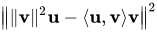

This expansion does not require Failed to parse (MathML with SVG or PNG fallback (recommended for modern browsers and accessibility tools): Invalid response ("Math extension cannot connect to Restbase.") from server "https://wikimedia.org/api/rest_v1/":): {\displaystyle \mathbf{v}} to be non-zero; however, Failed to parse (MathML with SVG or PNG fallback (recommended for modern browsers and accessibility tools): Invalid response ("Math extension cannot connect to Restbase.") from server "https://wikimedia.org/api/rest_v1/":): {\displaystyle \mathbf{v}} must be non-zero in order to divide both sides by Failed to parse (MathML with SVG or PNG fallback (recommended for modern browsers and accessibility tools): Invalid response ("Math extension cannot connect to Restbase.") from server "https://wikimedia.org/api/rest_v1/":): {\displaystyle \|\mathbf{v}\|^2} and to deduce the Cauchy-Schwarz inequality from it. Swapping Failed to parse (MathML with SVG or PNG fallback (recommended for modern browsers and accessibility tools): Invalid response ("Math extension cannot connect to Restbase.") from server "https://wikimedia.org/api/rest_v1/":): {\displaystyle \mathbf{u}} and Failed to parse (MathML with SVG or PNG fallback (recommended for modern browsers and accessibility tools): Invalid response ("Math extension cannot connect to Restbase.") from server "https://wikimedia.org/api/rest_v1/":): {\displaystyle \mathbf{v}} gives rise to: Failed to parse (MathML with SVG or PNG fallback (recommended for modern browsers and accessibility tools): Invalid response ("Math extension cannot connect to Restbase.") from server "https://wikimedia.org/api/rest_v1/":): {\displaystyle \left\|\|\mathbf{u}\|^2 \mathbf{v} - \overline{\langle \mathbf{u}, \mathbf{v} \rangle} \mathbf{u}\right\|^{2} =\|\mathbf{u}\|^2 \left[\|\mathbf{u}\|^2\|\mathbf{v}\|^2 - \left|\langle \mathbf{u}, \mathbf{v} \rangle\right|^2\right]} and thus Failed to parse (MathML with SVG or PNG fallback (recommended for modern browsers and accessibility tools): Invalid response ("Math extension cannot connect to Restbase.") from server "https://wikimedia.org/api/rest_v1/":): {\displaystyle \begin{alignat}{4} \|\mathbf{u}\|^2\|\mathbf{v}\|^2 \left[\|\mathbf{u}\|^2 \|\mathbf{v}\|^2 - \left|\langle \mathbf{u}, \mathbf{v} \rangle\right|^2\right] &=\|\mathbf{u}\|^2 \left\|\|\mathbf{v}\|^2 \mathbf{u} - \langle \mathbf{u}, \mathbf{v} \rangle \mathbf{v}\right\|^{2} \\ &=\|\mathbf{v}\|^2 \left\|\|\mathbf{u}\|^2 \mathbf{v} - \overline{\langle \mathbf{u}, \mathbf{v} \rangle} \mathbf{u}\right\|^{2}. \blacksquare \\ \end{alignat} }
Proof 2
The special case of Failed to parse (MathML with SVG or PNG fallback (recommended for modern browsers and accessibility tools): Invalid response ("Math extension cannot connect to Restbase.") from server "https://wikimedia.org/api/rest_v1/":): {\displaystyle \mathbf{v} = \mathbf{0}} was proven above so it is henceforth assumed that Failed to parse (MathML with SVG or PNG fallback (recommended for modern browsers and accessibility tools): Invalid response ("Math extension cannot connect to Restbase.") from server "https://wikimedia.org/api/rest_v1/":): {\displaystyle \mathbf{v} \neq \mathbf{0}.} Let Failed to parse (MathML with SVG or PNG fallback (recommended for modern browsers and accessibility tools): Invalid response ("Math extension cannot connect to Restbase.") from server "https://wikimedia.org/api/rest_v1/":): {\displaystyle \mathbf{z} := \mathbf{u} - \frac {\langle \mathbf{u}, \mathbf{v} \rangle} {\langle \mathbf{v}, \mathbf{v} \rangle} \mathbf{v}.}
It follows from the linearity of the inner product in its first argument that: Failed to parse (MathML with SVG or PNG fallback (recommended for modern browsers and accessibility tools): Invalid response ("Math extension cannot connect to Restbase.") from server "https://wikimedia.org/api/rest_v1/":): {\displaystyle \langle \mathbf{z}, \mathbf{v} \rangle = \left\langle \mathbf{u} - \frac{\langle \mathbf{u}, \mathbf{v} \rangle} {\langle \mathbf{v}, \mathbf{v} \rangle} \mathbf{v}, \mathbf{v} \right\rangle = \langle \mathbf{u}, \mathbf{v} \rangle - \frac{\langle \mathbf{u}, \mathbf{v} \rangle} {\langle \mathbf{v}, \mathbf{v} \rangle} \langle \mathbf{v}, \mathbf{v} \rangle = 0.}
Therefore, Failed to parse (MathML with SVG or PNG fallback (recommended for modern browsers and accessibility tools): Invalid response ("Math extension cannot connect to Restbase.") from server "https://wikimedia.org/api/rest_v1/":): {\displaystyle \mathbf{z}} is a vector orthogonal to the vector Failed to parse (MathML with SVG or PNG fallback (recommended for modern browsers and accessibility tools): Invalid response ("Math extension cannot connect to Restbase.") from server "https://wikimedia.org/api/rest_v1/":): {\displaystyle \mathbf{v}} (Indeed, Failed to parse (MathML with SVG or PNG fallback (recommended for modern browsers and accessibility tools): Invalid response ("Math extension cannot connect to Restbase.") from server "https://wikimedia.org/api/rest_v1/":): {\displaystyle \mathbf{z}} is the projection of Failed to parse (MathML with SVG or PNG fallback (recommended for modern browsers and accessibility tools): Invalid response ("Math extension cannot connect to Restbase.") from server "https://wikimedia.org/api/rest_v1/":): {\displaystyle \mathbf{u}} onto the plane orthogonal to Failed to parse (MathML with SVG or PNG fallback (recommended for modern browsers and accessibility tools): Invalid response ("Math extension cannot connect to Restbase.") from server "https://wikimedia.org/api/rest_v1/":): {\displaystyle \mathbf{v}.} ) We can thus apply the Pythagorean theorem to Failed to parse (MathML with SVG or PNG fallback (recommended for modern browsers and accessibility tools): Invalid response ("Math extension cannot connect to Restbase.") from server "https://wikimedia.org/api/rest_v1/":): {\displaystyle \mathbf{u}= \frac{\langle \mathbf{u}, \mathbf{v} \rangle} {\langle \mathbf{v}, \mathbf{v} \rangle} \mathbf{v} + \mathbf{z}} which gives Failed to parse (MathML with SVG or PNG fallback (recommended for modern browsers and accessibility tools): Invalid response ("Math extension cannot connect to Restbase.") from server "https://wikimedia.org/api/rest_v1/":): {\displaystyle \|\mathbf{u}\|^2 = \left|\frac{\langle \mathbf{u}, \mathbf{v} \rangle}{\langle \mathbf{v}, \mathbf{v} \rangle}\right|^2 \|\mathbf{v}\|^2 + \|\mathbf{z}\|^2 = \frac{|\langle \mathbf{u}, \mathbf{v} \rangle|^2}{(\|\mathbf{v}\|^2 )^2} \,\|\mathbf{v}\|^2 + \|\mathbf{z}\|^2 = \frac{|\langle \mathbf{u}, \mathbf{v} \rangle|^2}{\|\mathbf{v}\|^2} + \|\mathbf{z}\|^2 \geq \frac{|\langle \mathbf{u}, \mathbf{v} \rangle|^2}{\|\mathbf{v}\|^2}.}
The Cauchy–Schwarz inequality follows by multiplying by Failed to parse (MathML with SVG or PNG fallback (recommended for modern browsers and accessibility tools): Invalid response ("Math extension cannot connect to Restbase.") from server "https://wikimedia.org/api/rest_v1/":): {\displaystyle \|\mathbf{v}\|^2} and then taking the square root. Moreover, if the relation Failed to parse (MathML with SVG or PNG fallback (recommended for modern browsers and accessibility tools): Invalid response ("Math extension cannot connect to Restbase.") from server "https://wikimedia.org/api/rest_v1/":): {\displaystyle \geq} in the above expression is actually an equality, then Failed to parse (MathML with SVG or PNG fallback (recommended for modern browsers and accessibility tools): Invalid response ("Math extension cannot connect to Restbase.") from server "https://wikimedia.org/api/rest_v1/":): {\displaystyle \|\mathbf{z}\|^2 = 0} and hence Failed to parse (MathML with SVG or PNG fallback (recommended for modern browsers and accessibility tools): Invalid response ("Math extension cannot connect to Restbase.") from server "https://wikimedia.org/api/rest_v1/":): {\displaystyle \mathbf{z} = \mathbf{0};} the definition of Failed to parse (MathML with SVG or PNG fallback (recommended for modern browsers and accessibility tools): Invalid response ("Math extension cannot connect to Restbase.") from server "https://wikimedia.org/api/rest_v1/":): {\displaystyle \mathbf{z}} then establishes a relation of linear dependence between Failed to parse (MathML with SVG or PNG fallback (recommended for modern browsers and accessibility tools): Invalid response ("Math extension cannot connect to Restbase.") from server "https://wikimedia.org/api/rest_v1/":): {\displaystyle \mathbf{u}} and Failed to parse (MathML with SVG or PNG fallback (recommended for modern browsers and accessibility tools): Invalid response ("Math extension cannot connect to Restbase.") from server "https://wikimedia.org/api/rest_v1/":): {\displaystyle \mathbf{v}.} The converse was proved at the beginning of this section, so the proof is complete. Failed to parse (MathML with SVG or PNG fallback (recommended for modern browsers and accessibility tools): Invalid response ("Math extension cannot connect to Restbase.") from server "https://wikimedia.org/api/rest_v1/":): {\displaystyle \blacksquare}
Generalizations
Various generalizations of the Cauchy–Schwarz inequality exist. Hölder's inequality generalizes it to Failed to parse (MathML with SVG or PNG fallback (recommended for modern browsers and accessibility tools): Invalid response ("Math extension cannot connect to Restbase.") from server "https://wikimedia.org/api/rest_v1/":): {\displaystyle L^p} norms. More generally, it can be interpreted as a special case of the definition of the norm of a linear operator on a Banach space (Namely, when the space is a Hilbert space). Further generalizations are in the context of operator theory, e.g. for operator-convex functions and operator algebras, where the domain and/or range are replaced by a C*-algebra or W*-algebra.
An inner product can be used to define a positive linear functional. For example, given a Hilbert space Failed to parse (MathML with SVG or PNG fallback (recommended for modern browsers and accessibility tools): Invalid response ("Math extension cannot connect to Restbase.") from server "https://wikimedia.org/api/rest_v1/":): {\displaystyle L^2(m), m} being a finite measure, the standard inner product gives rise to a positive functional Failed to parse (MathML with SVG or PNG fallback (recommended for modern browsers and accessibility tools): Invalid response ("Math extension cannot connect to Restbase.") from server "https://wikimedia.org/api/rest_v1/":): {\displaystyle \varphi} by Failed to parse (MathML with SVG or PNG fallback (recommended for modern browsers and accessibility tools): Invalid response ("Math extension cannot connect to Restbase.") from server "https://wikimedia.org/api/rest_v1/":): {\displaystyle \varphi (g) = \langle g, 1 \rangle.} Conversely, every positive linear functional Failed to parse (MathML with SVG or PNG fallback (recommended for modern browsers and accessibility tools): Invalid response ("Math extension cannot connect to Restbase.") from server "https://wikimedia.org/api/rest_v1/":): {\displaystyle \varphi} on Failed to parse (MathML with SVG or PNG fallback (recommended for modern browsers and accessibility tools): Invalid response ("Math extension cannot connect to Restbase.") from server "https://wikimedia.org/api/rest_v1/":): {\displaystyle L^2(m)} can be used to define an inner product Failed to parse (MathML with SVG or PNG fallback (recommended for modern browsers and accessibility tools): Invalid response ("Math extension cannot connect to Restbase.") from server "https://wikimedia.org/api/rest_v1/":): {\displaystyle \langle f, g \rangle _\varphi := \varphi\left(g^* f\right),} where Failed to parse (MathML with SVG or PNG fallback (recommended for modern browsers and accessibility tools): Invalid response ("Math extension cannot connect to Restbase.") from server "https://wikimedia.org/api/rest_v1/":): {\displaystyle g^*} is the pointwise complex conjugate of Failed to parse (MathML with SVG or PNG fallback (recommended for modern browsers and accessibility tools): Invalid response ("Math extension cannot connect to Restbase.") from server "https://wikimedia.org/api/rest_v1/":): {\displaystyle g.} In this language, the Cauchy–Schwarz inequality becomes[17] Failed to parse (MathML with SVG or PNG fallback (recommended for modern browsers and accessibility tools): Invalid response ("Math extension cannot connect to Restbase.") from server "https://wikimedia.org/api/rest_v1/":): {\displaystyle \left|\varphi\left(g^* f\right)\right|^2 \leq \varphi\left(f^* f\right) \varphi\left(g^* g\right),}
which extends verbatim to positive functionals on C*-algebras:
The next two theorems are further examples in operator algebra.
This extends the fact Failed to parse (MathML with SVG or PNG fallback (recommended for modern browsers and accessibility tools): Invalid response ("Math extension cannot connect to Restbase.") from server "https://wikimedia.org/api/rest_v1/":): {\displaystyle \varphi\left(a^*a\right) \cdot 1 \geq \varphi(a)^* \varphi(a) = |\varphi(a)|^2,} when Failed to parse (MathML with SVG or PNG fallback (recommended for modern browsers and accessibility tools): Invalid response ("Math extension cannot connect to Restbase.") from server "https://wikimedia.org/api/rest_v1/":): {\displaystyle \varphi} is a linear functional. The case when Failed to parse (MathML with SVG or PNG fallback (recommended for modern browsers and accessibility tools): Invalid response ("Math extension cannot connect to Restbase.") from server "https://wikimedia.org/api/rest_v1/":): {\displaystyle a} is self-adjoint, that is, Failed to parse (MathML with SVG or PNG fallback (recommended for modern browsers and accessibility tools): Invalid response ("Math extension cannot connect to Restbase.") from server "https://wikimedia.org/api/rest_v1/":): {\displaystyle a = a^*,} is sometimes known as Kadison's inequality.
Another generalization is a refinement obtained by interpolating between both sides of the Cauchy-Schwarz inequality:
This theorem can be deduced from Hölder's inequality.
Licensing
Content obtained and/or adapted from:
- Cauchy-Schwarz inequality, Wikipedia under a CC BY-SA license
<ref> tag;
no text was provided for refs named Steele
Cite error: <ref> tags exist for a group named "note", but no corresponding <references group="note"/> tag was found, or a closing </ref> is missing

