Green's Theorem
In vector calculus, Green's theorem relates a line integral around a simple closed curve C to a double integral over the plane region D bounded by C. It is the two-dimensional special case of Stokes' theorem.
Contents
Theorem
Let C be a positively oriented, piecewise smooth, simple closed curve in a plane, and let D be the region bounded by C. If L and M are functions of (x, y) defined on an open region containing D and having continuous partial derivatives there, then
Failed to parse (MathML with SVG or PNG fallback (recommended for modern browsers and accessibility tools): Invalid response ("Math extension cannot connect to Restbase.") from server "https://wikimedia.org/api/rest_v1/":): {\displaystyle \oint_{\scriptstyle C} (L\, dx + M\, dy) = \iint_{D} \left(\frac{\partial M}{\partial x} - \frac{\partial L}{\partial y}\right) dx\, dy}
where the path of integration along C is anticlockwise.
In physics, Green's theorem finds many applications. One is solving two-dimensional flow integrals, stating that the sum of fluid outflowing from a volume is equal to the total outflow summed about an enclosing area. In plane geometry, and in particular, area surveying, Green's theorem can be used to determine the area and centroid of plane figures solely by integrating over the perimeter.
Proof when D is a simple region

The following is a proof of half of the theorem for the simplified area D, a type I region where C1 and C3 are curves connected by vertical lines (possibly of zero length). A similar proof exists for the other half of the theorem when D is a type II region where C2 and C4 are curves connected by horizontal lines (again, possibly of zero length). Putting these two parts together, the theorem is thus proven for regions of type III (defined as regions which are both type I and type II). The general case can then be deduced from this special case by decomposing D into a set of type III regions.
If it can be shown that if
(1)

and
(2)

are true, then Green's theorem follows immediately for the region D. We can prove the first equation easily for regions of type I, and the second equation for regions of type II. Green's theorem then follows for regions of type III.
Assume region D is a type I region and can thus be characterized, as pictured on the right, by

where g1 and g2 are continuous functions on [a, b]. Compute the double integral in (1):
Now compute the line integral in (Template:EquationNote). C can be rewritten as the union of four curves: C1, C2, C3, C4.
With C1, use the parametric equations: x = x, y = g1(x), a ≤ x ≤ b. Then

With C3, use the parametric equations: x = x, y = g2(x), a ≤ x ≤ b. Then

The integral over C3 is negated because it goes in the negative direction from b to a, as C is oriented positively (anticlockwise). On C2 and C4, x remains constant, meaning

Therefore,
Combining (Template:EquationNote) with (Template:EquationNote), we get (Template:EquationNote) for regions of type I. A similar treatment yields (Template:EquationNote) for regions of type II. Putting the two together, we get the result for regions of type III.
Proof for rectifiable Jordan curves
We are going to prove the following
Theorem. Let be a rectifiable, positively oriented Jordan curve in and let denote its inner region. Suppose that are continuous functions with the property that has second partial derivative at every point of , has first partial derivative at every point of and that the functions are Riemann-integrable over . Then


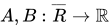



Failed to parse (MathML with SVG or PNG fallback (recommended for modern browsers and accessibility tools): Invalid response ("Math extension cannot connect to Restbase.") from server "https://wikimedia.org/api/rest_v1/":): {\displaystyle \int_{\Gamma}A\,dx+B\,dy = \int_R \left(D_1 B(x,y)-D_2 A(x,y)\right)\,d(x,y).}
We need the following lemmas whose proofs can be found in:
Lemma 1 (Decomposition Lemma). Assume Failed to parse (MathML with SVG or PNG fallback (recommended for modern browsers and accessibility tools): Invalid response ("Math extension cannot connect to Restbase.") from server "https://wikimedia.org/api/rest_v1/":): {\displaystyle \Gamma} is a rectifiable, positively oriented Jordan curve in the plane and let Failed to parse (MathML with SVG or PNG fallback (recommended for modern browsers and accessibility tools): Invalid response ("Math extension cannot connect to Restbase.") from server "https://wikimedia.org/api/rest_v1/":): {\displaystyle R} be its inner region. For every positive real Failed to parse (MathML with SVG or PNG fallback (recommended for modern browsers and accessibility tools): Invalid response ("Math extension cannot connect to Restbase.") from server "https://wikimedia.org/api/rest_v1/":): {\displaystyle \delta} , let Failed to parse (MathML with SVG or PNG fallback (recommended for modern browsers and accessibility tools): Invalid response ("Math extension cannot connect to Restbase.") from server "https://wikimedia.org/api/rest_v1/":): {\displaystyle \mathcal{F}(\delta)} denote the collection of squares in the plane bounded by the lines Failed to parse (MathML with SVG or PNG fallback (recommended for modern browsers and accessibility tools): Invalid response ("Math extension cannot connect to Restbase.") from server "https://wikimedia.org/api/rest_v1/":): {\displaystyle x=m\delta, y=m\delta} , where Failed to parse (MathML with SVG or PNG fallback (recommended for modern browsers and accessibility tools): Invalid response ("Math extension cannot connect to Restbase.") from server "https://wikimedia.org/api/rest_v1/":): {\displaystyle m} runs through the set of integers. Then, for this Failed to parse (MathML with SVG or PNG fallback (recommended for modern browsers and accessibility tools): Invalid response ("Math extension cannot connect to Restbase.") from server "https://wikimedia.org/api/rest_v1/":): {\displaystyle \delta} , there exists a decomposition of Failed to parse (MathML with SVG or PNG fallback (recommended for modern browsers and accessibility tools): Invalid response ("Math extension cannot connect to Restbase.") from server "https://wikimedia.org/api/rest_v1/":): {\displaystyle \overline{R}} into a finite number of non-overlapping subregions in such a manner that
- Each one of the subregions contained in Failed to parse (MathML with SVG or PNG fallback (recommended for modern browsers and accessibility tools): Invalid response ("Math extension cannot connect to Restbase.") from server "https://wikimedia.org/api/rest_v1/":): {\displaystyle R} , say Failed to parse (MathML with SVG or PNG fallback (recommended for modern browsers and accessibility tools): Invalid response ("Math extension cannot connect to Restbase.") from server "https://wikimedia.org/api/rest_v1/":): {\displaystyle R_1, R_2,\ldots, R_k} , is a square from Failed to parse (MathML with SVG or PNG fallback (recommended for modern browsers and accessibility tools): Invalid response ("Math extension cannot connect to Restbase.") from server "https://wikimedia.org/api/rest_v1/":): {\displaystyle \mathcal{F}(\delta)} .
- Each one of the remaining subregions, say Failed to parse (MathML with SVG or PNG fallback (recommended for modern browsers and accessibility tools): Invalid response ("Math extension cannot connect to Restbase.") from server "https://wikimedia.org/api/rest_v1/":): {\displaystyle R_{k+1},\ldots,R_s} , has as boundary a rectifiable Jordan curve formed by a finite number of arcs of Failed to parse (MathML with SVG or PNG fallback (recommended for modern browsers and accessibility tools): Invalid response ("Math extension cannot connect to Restbase.") from server "https://wikimedia.org/api/rest_v1/":): {\displaystyle \Gamma} and parts of the sides of some square from Failed to parse (MathML with SVG or PNG fallback (recommended for modern browsers and accessibility tools): Invalid response ("Math extension cannot connect to Restbase.") from server "https://wikimedia.org/api/rest_v1/":): {\displaystyle \mathcal{F}(\delta)} .
- Each one of the border regions Failed to parse (MathML with SVG or PNG fallback (recommended for modern browsers and accessibility tools): Invalid response ("Math extension cannot connect to Restbase.") from server "https://wikimedia.org/api/rest_v1/":): {\displaystyle R_{k+1},\ldots,R_s} can be enclosed in a square of edge-length Failed to parse (MathML with SVG or PNG fallback (recommended for modern browsers and accessibility tools): Invalid response ("Math extension cannot connect to Restbase.") from server "https://wikimedia.org/api/rest_v1/":): {\displaystyle 2\delta} .
- If Failed to parse (MathML with SVG or PNG fallback (recommended for modern browsers and accessibility tools): Invalid response ("Math extension cannot connect to Restbase.") from server "https://wikimedia.org/api/rest_v1/":): {\displaystyle \Gamma_i} is the positively oriented boundary curve of Failed to parse (MathML with SVG or PNG fallback (recommended for modern browsers and accessibility tools): Invalid response ("Math extension cannot connect to Restbase.") from server "https://wikimedia.org/api/rest_v1/":): {\displaystyle R_i} , then Failed to parse (MathML with SVG or PNG fallback (recommended for modern browsers and accessibility tools): Invalid response ("Math extension cannot connect to Restbase.") from server "https://wikimedia.org/api/rest_v1/":): {\displaystyle \Gamma=\Gamma_1+\Gamma_2+\cdots+\Gamma_s.}
- The number Failed to parse (MathML with SVG or PNG fallback (recommended for modern browsers and accessibility tools): Invalid response ("Math extension cannot connect to Restbase.") from server "https://wikimedia.org/api/rest_v1/":): {\displaystyle s-k} of border regions is no greater than Failed to parse (MathML with SVG or PNG fallback (recommended for modern browsers and accessibility tools): Invalid response ("Math extension cannot connect to Restbase.") from server "https://wikimedia.org/api/rest_v1/":): {\displaystyle 4\!\left(\frac{\Lambda}{\delta} + 1\right)} , where Failed to parse (MathML with SVG or PNG fallback (recommended for modern browsers and accessibility tools): Invalid response ("Math extension cannot connect to Restbase.") from server "https://wikimedia.org/api/rest_v1/":): {\displaystyle \Lambda} is the length of Failed to parse (MathML with SVG or PNG fallback (recommended for modern browsers and accessibility tools): Invalid response ("Math extension cannot connect to Restbase.") from server "https://wikimedia.org/api/rest_v1/":): {\displaystyle \Gamma} .
Lemma 2. Let Failed to parse (MathML with SVG or PNG fallback (recommended for modern browsers and accessibility tools): Invalid response ("Math extension cannot connect to Restbase.") from server "https://wikimedia.org/api/rest_v1/":): {\displaystyle \Gamma} be a rectifiable curve in the plane and let Failed to parse (MathML with SVG or PNG fallback (recommended for modern browsers and accessibility tools): Invalid response ("Math extension cannot connect to Restbase.") from server "https://wikimedia.org/api/rest_v1/":): {\displaystyle \Delta_\Gamma(h)} be the set of points in the plane whose distance from (the range of) Failed to parse (MathML with SVG or PNG fallback (recommended for modern browsers and accessibility tools): Invalid response ("Math extension cannot connect to Restbase.") from server "https://wikimedia.org/api/rest_v1/":): {\displaystyle \Gamma} is at most Failed to parse (MathML with SVG or PNG fallback (recommended for modern browsers and accessibility tools): Invalid response ("Math extension cannot connect to Restbase.") from server "https://wikimedia.org/api/rest_v1/":): {\displaystyle h} . The outer Jordan content of this set satisfies Failed to parse (MathML with SVG or PNG fallback (recommended for modern browsers and accessibility tools): Invalid response ("Math extension cannot connect to Restbase.") from server "https://wikimedia.org/api/rest_v1/":): {\displaystyle \overline{c}\,\,\Delta_\Gamma(h)\le2h\Lambda +\pi h^2} .
Lemma 3. Let Failed to parse (MathML with SVG or PNG fallback (recommended for modern browsers and accessibility tools): Invalid response ("Math extension cannot connect to Restbase.") from server "https://wikimedia.org/api/rest_v1/":): {\displaystyle \Gamma} be a rectifiable curve in Failed to parse (MathML with SVG or PNG fallback (recommended for modern browsers and accessibility tools): Invalid response ("Math extension cannot connect to Restbase.") from server "https://wikimedia.org/api/rest_v1/":): {\displaystyle \R^2} and let Failed to parse (MathML with SVG or PNG fallback (recommended for modern browsers and accessibility tools): Invalid response ("Math extension cannot connect to Restbase.") from server "https://wikimedia.org/api/rest_v1/":): {\displaystyle f:\text{range of }\Gamma \to \R} be a continuous function. Then
- Failed to parse (MathML with SVG or PNG fallback (recommended for modern browsers and accessibility tools): Invalid response ("Math extension cannot connect to Restbase.") from server "https://wikimedia.org/api/rest_v1/":): {\displaystyle \left\vert\int_\Gamma f(x,y)\,dy\right\vert} and
- Failed to parse (MathML with SVG or PNG fallback (recommended for modern browsers and accessibility tools): Invalid response ("Math extension cannot connect to Restbase.") from server "https://wikimedia.org/api/rest_v1/":): {\displaystyle \left\vert\int_\Gamma f(x,y)\,dx\right\vert} are Failed to parse (MathML with SVG or PNG fallback (recommended for modern browsers and accessibility tools): Invalid response ("Math extension cannot connect to Restbase.") from server "https://wikimedia.org/api/rest_v1/":): {\displaystyle \le\frac{1}{2} \Lambda\Omega_f,} where Failed to parse (MathML with SVG or PNG fallback (recommended for modern browsers and accessibility tools): Invalid response ("Math extension cannot connect to Restbase.") from server "https://wikimedia.org/api/rest_v1/":): {\displaystyle \Omega_f} is the oscillation of on the range of .

Now we are in position to prove the Theorem:
Proof of Theorem. Let be an arbitrary positive real number. By continuity of Failed to parse (MathML with SVG or PNG fallback (recommended for modern browsers and accessibility tools): Invalid response ("Math extension cannot connect to Restbase.") from server "https://wikimedia.org/api/rest_v1/":): {\displaystyle A} , Failed to parse (MathML with SVG or PNG fallback (recommended for modern browsers and accessibility tools): Invalid response ("Math extension cannot connect to Restbase.") from server "https://wikimedia.org/api/rest_v1/":): {\displaystyle B} and compactness of Failed to parse (MathML with SVG or PNG fallback (recommended for modern browsers and accessibility tools): Invalid response ("Math extension cannot connect to Restbase.") from server "https://wikimedia.org/api/rest_v1/":): {\displaystyle \overline{R}} , given Failed to parse (MathML with SVG or PNG fallback (recommended for modern browsers and accessibility tools): Invalid response ("Math extension cannot connect to Restbase.") from server "https://wikimedia.org/api/rest_v1/":): {\displaystyle \varepsilon>0} , there exists Failed to parse (MathML with SVG or PNG fallback (recommended for modern browsers and accessibility tools): Invalid response ("Math extension cannot connect to Restbase.") from server "https://wikimedia.org/api/rest_v1/":): {\displaystyle 0<\delta<1} such that whenever two points of Failed to parse (MathML with SVG or PNG fallback (recommended for modern browsers and accessibility tools): Invalid response ("Math extension cannot connect to Restbase.") from server "https://wikimedia.org/api/rest_v1/":): {\displaystyle \overline{R}} are less than Failed to parse (MathML with SVG or PNG fallback (recommended for modern browsers and accessibility tools): Invalid response ("Math extension cannot connect to Restbase.") from server "https://wikimedia.org/api/rest_v1/":): {\displaystyle 2\sqrt{2}\,\delta} apart, their images under Failed to parse (MathML with SVG or PNG fallback (recommended for modern browsers and accessibility tools): Invalid response ("Math extension cannot connect to Restbase.") from server "https://wikimedia.org/api/rest_v1/":): {\displaystyle A, B} are less than Failed to parse (MathML with SVG or PNG fallback (recommended for modern browsers and accessibility tools): Invalid response ("Math extension cannot connect to Restbase.") from server "https://wikimedia.org/api/rest_v1/":): {\displaystyle \varepsilon} apart. For this Failed to parse (MathML with SVG or PNG fallback (recommended for modern browsers and accessibility tools): Invalid response ("Math extension cannot connect to Restbase.") from server "https://wikimedia.org/api/rest_v1/":): {\displaystyle \delta} , consider the decomposition given by the previous Lemma. We have

- Failed to parse (MathML with SVG or PNG fallback (recommended for modern browsers and accessibility tools): Invalid response ("Math extension cannot connect to Restbase.") from server "https://wikimedia.org/api/rest_v1/":): {\displaystyle \int_\Gamma A\,dx+B\,dy=\sum_{i=1}^k \int_{\Gamma_i} A\,dx+B\,dy\quad +\sum_{i=k+1}^s \int_{\Gamma_i}A\,dx+B\,dy.}
Put Failed to parse (MathML with SVG or PNG fallback (recommended for modern browsers and accessibility tools): Invalid response ("Math extension cannot connect to Restbase.") from server "https://wikimedia.org/api/rest_v1/":): {\displaystyle \varphi := D_1 B - D_2 A} .
For each Failed to parse (MathML with SVG or PNG fallback (recommended for modern browsers and accessibility tools): Invalid response ("Math extension cannot connect to Restbase.") from server "https://wikimedia.org/api/rest_v1/":): {\displaystyle i\in\{1,\ldots,k\}} , the curve Failed to parse (MathML with SVG or PNG fallback (recommended for modern browsers and accessibility tools): Invalid response ("Math extension cannot connect to Restbase.") from server "https://wikimedia.org/api/rest_v1/":): {\displaystyle \Gamma_i} is a positively oriented square, for which Green's formula holds. Hence
- Failed to parse (MathML with SVG or PNG fallback (recommended for modern browsers and accessibility tools): Invalid response ("Math extension cannot connect to Restbase.") from server "https://wikimedia.org/api/rest_v1/":): {\displaystyle \sum_{i=1}^k \int_{\Gamma_i}A\,dx + B\,dy =\sum_{i=1}^k \int_{R_i} \varphi = \int_{\bigcup_{i=1}^k R_i}\,\varphi.}
Every point of a border region is at a distance no greater than Failed to parse (MathML with SVG or PNG fallback (recommended for modern browsers and accessibility tools): Invalid response ("Math extension cannot connect to Restbase.") from server "https://wikimedia.org/api/rest_v1/":): {\displaystyle 2\sqrt{2}\,\delta} from Failed to parse (MathML with SVG or PNG fallback (recommended for modern browsers and accessibility tools): Invalid response ("Math extension cannot connect to Restbase.") from server "https://wikimedia.org/api/rest_v1/":): {\displaystyle \Gamma} . Thus, if Failed to parse (MathML with SVG or PNG fallback (recommended for modern browsers and accessibility tools): Invalid response ("Math extension cannot connect to Restbase.") from server "https://wikimedia.org/api/rest_v1/":): {\displaystyle K} is the union of all border regions, then Failed to parse (MathML with SVG or PNG fallback (recommended for modern browsers and accessibility tools): Invalid response ("Math extension cannot connect to Restbase.") from server "https://wikimedia.org/api/rest_v1/":): {\displaystyle K\subset \Delta_{\Gamma}(2\sqrt{2}\,\delta)} ; hence Failed to parse (MathML with SVG or PNG fallback (recommended for modern browsers and accessibility tools): Invalid response ("Math extension cannot connect to Restbase.") from server "https://wikimedia.org/api/rest_v1/":): {\displaystyle c(K)\le\overline{c}\,\Delta_{\Gamma}(2\sqrt{2}\,\delta)\le 4\sqrt{2}\,\delta+8\pi\delta^2} , by Lemma 2. Notice that
- Failed to parse (MathML with SVG or PNG fallback (recommended for modern browsers and accessibility tools): Invalid response ("Math extension cannot connect to Restbase.") from server "https://wikimedia.org/api/rest_v1/":): {\displaystyle \int_R \varphi\,\,-\int_{\bigcup_{i=1}^k R_i} \varphi=\int_K \varphi.}
This yields
- Failed to parse (MathML with SVG or PNG fallback (recommended for modern browsers and accessibility tools): Invalid response ("Math extension cannot connect to Restbase.") from server "https://wikimedia.org/api/rest_v1/":): {\displaystyle \left\vert\sum_{i=1}^k \int_{\Gamma_i} A\,dx+B\,dy\quad-\int_R\varphi \right\vert \le M \delta(1+\pi\sqrt{2}\,\delta) \text{ for some } M > 0.}
We may as well choose Failed to parse (MathML with SVG or PNG fallback (recommended for modern browsers and accessibility tools): Invalid response ("Math extension cannot connect to Restbase.") from server "https://wikimedia.org/api/rest_v1/":): {\displaystyle \delta} so that the RHS of the last inequality is Failed to parse (MathML with SVG or PNG fallback (recommended for modern browsers and accessibility tools): Invalid response ("Math extension cannot connect to Restbase.") from server "https://wikimedia.org/api/rest_v1/":): {\displaystyle <\varepsilon.}
The remark in the beginning of this proof implies that the oscillations of Failed to parse (MathML with SVG or PNG fallback (recommended for modern browsers and accessibility tools): Invalid response ("Math extension cannot connect to Restbase.") from server "https://wikimedia.org/api/rest_v1/":): {\displaystyle A} and Failed to parse (MathML with SVG or PNG fallback (recommended for modern browsers and accessibility tools): Invalid response ("Math extension cannot connect to Restbase.") from server "https://wikimedia.org/api/rest_v1/":): {\displaystyle B} on every border region is at most Failed to parse (MathML with SVG or PNG fallback (recommended for modern browsers and accessibility tools): Invalid response ("Math extension cannot connect to Restbase.") from server "https://wikimedia.org/api/rest_v1/":): {\displaystyle \varepsilon} . We have
- Failed to parse (MathML with SVG or PNG fallback (recommended for modern browsers and accessibility tools): Invalid response ("Math extension cannot connect to Restbase.") from server "https://wikimedia.org/api/rest_v1/":): {\displaystyle \left\vert\sum_{i=k+1}^s \int_{\Gamma_i}A\,dx+B\,dy\right\vert\le\frac{1}{2} \varepsilon\sum_{i=k+1}^s \Lambda_i.}
By Lemma 1(iii),
- Failed to parse (MathML with SVG or PNG fallback (recommended for modern browsers and accessibility tools): Invalid response ("Math extension cannot connect to Restbase.") from server "https://wikimedia.org/api/rest_v1/":): {\displaystyle \sum_{i=k+1}^s \Lambda_i \le\Lambda + (4\delta)\,4\!\left(\frac{\Lambda}{\delta}+1\right)\le17\Lambda+16.}
Combining these, we finally get
- Failed to parse (MathML with SVG or PNG fallback (recommended for modern browsers and accessibility tools): Invalid response ("Math extension cannot connect to Restbase.") from server "https://wikimedia.org/api/rest_v1/":): {\displaystyle \left\vert\int_\Gamma A\,dx+B\,dy\quad-\int_R \varphi\right\vert< C \varepsilon,}
for some Failed to parse (MathML with SVG or PNG fallback (recommended for modern browsers and accessibility tools): Invalid response ("Math extension cannot connect to Restbase.") from server "https://wikimedia.org/api/rest_v1/":): {\displaystyle C > 0} . Since this is true for every Failed to parse (MathML with SVG or PNG fallback (recommended for modern browsers and accessibility tools): Invalid response ("Math extension cannot connect to Restbase.") from server "https://wikimedia.org/api/rest_v1/":): {\displaystyle \varepsilon > 0} , we are done.
Validity under different hypotheses
The hypothesis of the last theorem are not the only ones under which Green's formula is true. Another common set of conditions is the following:
The functions Failed to parse (MathML with SVG or PNG fallback (recommended for modern browsers and accessibility tools): Invalid response ("Math extension cannot connect to Restbase.") from server "https://wikimedia.org/api/rest_v1/":): {\displaystyle A, B:\overline{R} \to \R} are still assumed to be continuous. However, we now require them to be Fréchet-differentiable at every point of Failed to parse (MathML with SVG or PNG fallback (recommended for modern browsers and accessibility tools): Invalid response ("Math extension cannot connect to Restbase.") from server "https://wikimedia.org/api/rest_v1/":): {\displaystyle R} . This implies the existence of all directional derivatives, in particular Failed to parse (MathML with SVG or PNG fallback (recommended for modern browsers and accessibility tools): Invalid response ("Math extension cannot connect to Restbase.") from server "https://wikimedia.org/api/rest_v1/":): {\displaystyle D_{e_i}A=:D_i A, D_{e_i}B=:D_i B, \,i=1,2} , where, as usual, Failed to parse (MathML with SVG or PNG fallback (recommended for modern browsers and accessibility tools): Invalid response ("Math extension cannot connect to Restbase.") from server "https://wikimedia.org/api/rest_v1/":): {\displaystyle (e_1,e_2)} is the canonical ordered basis of Failed to parse (MathML with SVG or PNG fallback (recommended for modern browsers and accessibility tools): Invalid response ("Math extension cannot connect to Restbase.") from server "https://wikimedia.org/api/rest_v1/":): {\displaystyle \R^2} . In addition, we require the function Failed to parse (MathML with SVG or PNG fallback (recommended for modern browsers and accessibility tools): Invalid response ("Math extension cannot connect to Restbase.") from server "https://wikimedia.org/api/rest_v1/":): {\displaystyle D_1 B-D_2 A} to be Riemann-integrable over Failed to parse (MathML with SVG or PNG fallback (recommended for modern browsers and accessibility tools): Invalid response ("Math extension cannot connect to Restbase.") from server "https://wikimedia.org/api/rest_v1/":): {\displaystyle R} .
As a corollary of this, we get the Cauchy Integral Theorem for rectifiable Jordan curves:
Theorem (Cauchy). If Failed to parse (MathML with SVG or PNG fallback (recommended for modern browsers and accessibility tools): Invalid response ("Math extension cannot connect to Restbase.") from server "https://wikimedia.org/api/rest_v1/":): {\displaystyle \Gamma} is a rectifiable Jordan curve in Failed to parse (MathML with SVG or PNG fallback (recommended for modern browsers and accessibility tools): Invalid response ("Math extension cannot connect to Restbase.") from server "https://wikimedia.org/api/rest_v1/":): {\displaystyle \Complex} and if Failed to parse (MathML with SVG or PNG fallback (recommended for modern browsers and accessibility tools): Invalid response ("Math extension cannot connect to Restbase.") from server "https://wikimedia.org/api/rest_v1/":): {\displaystyle f:\text{closure of inner region of } \Gamma \to \Complex} is a continuous mapping holomorphic throughout the inner region of Failed to parse (MathML with SVG or PNG fallback (recommended for modern browsers and accessibility tools): Invalid response ("Math extension cannot connect to Restbase.") from server "https://wikimedia.org/api/rest_v1/":): {\displaystyle \Gamma} , then
- Failed to parse (MathML with SVG or PNG fallback (recommended for modern browsers and accessibility tools): Invalid response ("Math extension cannot connect to Restbase.") from server "https://wikimedia.org/api/rest_v1/":): {\displaystyle \int_\Gamma f=0,}
the integral being a complex contour integral.
Proof. We regard the complex plane as . Now, define to be such that These functions are clearly continuous. It is well known that Failed to parse (MathML with SVG or PNG fallback (recommended for modern browsers and accessibility tools): Invalid response ("Math extension cannot connect to Restbase.") from server "https://wikimedia.org/api/rest_v1/":): {\displaystyle u} and Failed to parse (MathML with SVG or PNG fallback (recommended for modern browsers and accessibility tools): Invalid response ("Math extension cannot connect to Restbase.") from server "https://wikimedia.org/api/rest_v1/":): {\displaystyle v} are Fréchet-differentiable and that they satisfy the Cauchy-Riemann equations: Failed to parse (MathML with SVG or PNG fallback (recommended for modern browsers and accessibility tools): Invalid response ("Math extension cannot connect to Restbase.") from server "https://wikimedia.org/api/rest_v1/":): {\displaystyle D_1 v+D_2 u=D_1 u-D_2 v =\text{zero function}} .
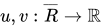

Now, analyzing the sums used to define the complex contour integral in question, it is easy to realize that
- Failed to parse (MathML with SVG or PNG fallback (recommended for modern browsers and accessibility tools): Invalid response ("Math extension cannot connect to Restbase.") from server "https://wikimedia.org/api/rest_v1/":): {\displaystyle \int_\Gamma f=\int_\Gamma u\,dx-v\,dy\quad+i\int_\Gamma v\,dx+u\,dy,}
the integrals on the RHS being usual line integrals. These remarks allow us to apply Green's Theorem to each one of these line integrals, finishing the proof.
Multiply-connected regions
Theorem. Let Failed to parse (MathML with SVG or PNG fallback (recommended for modern browsers and accessibility tools): Invalid response ("Math extension cannot connect to Restbase.") from server "https://wikimedia.org/api/rest_v1/":): {\displaystyle \Gamma_0,\Gamma_1,\ldots,\Gamma_n} be positively oriented rectifiable Jordan curves in Failed to parse (MathML with SVG or PNG fallback (recommended for modern browsers and accessibility tools): Invalid response ("Math extension cannot connect to Restbase.") from server "https://wikimedia.org/api/rest_v1/":): {\displaystyle \R^{2}} satisfying
- Failed to parse (MathML with SVG or PNG fallback (recommended for modern browsers and accessibility tools): Invalid response ("Math extension cannot connect to Restbase.") from server "https://wikimedia.org/api/rest_v1/":): {\displaystyle \begin{aligned} \Gamma_i \subset R_0,&&\text{if } 1\le i\le n\\ \Gamma_i \subset \R^2 \setminus \overline{R}_j,&&\text{if }1\le i,j \le n\text{ and }i\ne j, \end{aligned}}
where Failed to parse (MathML with SVG or PNG fallback (recommended for modern browsers and accessibility tools): Invalid response ("Math extension cannot connect to Restbase.") from server "https://wikimedia.org/api/rest_v1/":): {\displaystyle R_i} is the inner region of Failed to parse (MathML with SVG or PNG fallback (recommended for modern browsers and accessibility tools): Invalid response ("Math extension cannot connect to Restbase.") from server "https://wikimedia.org/api/rest_v1/":): {\displaystyle \Gamma_i} . Let
- Failed to parse (MathML with SVG or PNG fallback (recommended for modern browsers and accessibility tools): Invalid response ("Math extension cannot connect to Restbase.") from server "https://wikimedia.org/api/rest_v1/":): {\displaystyle D = R_0 \setminus (\overline{R}_1 \cup \overline{R}_2 \cup \cdots \cup \overline{R}_n).}
Suppose Failed to parse (MathML with SVG or PNG fallback (recommended for modern browsers and accessibility tools): Invalid response ("Math extension cannot connect to Restbase.") from server "https://wikimedia.org/api/rest_v1/":): {\displaystyle p: \overline{D} \to \R} and Failed to parse (MathML with SVG or PNG fallback (recommended for modern browsers and accessibility tools): Invalid response ("Math extension cannot connect to Restbase.") from server "https://wikimedia.org/api/rest_v1/":): {\displaystyle q: \overline{D} \to \R} are continuous functions whose restriction to Failed to parse (MathML with SVG or PNG fallback (recommended for modern browsers and accessibility tools): Invalid response ("Math extension cannot connect to Restbase.") from server "https://wikimedia.org/api/rest_v1/":): {\displaystyle D} is Fréchet-differentiable. If the function
- Failed to parse (MathML with SVG or PNG fallback (recommended for modern browsers and accessibility tools): Invalid response ("Math extension cannot connect to Restbase.") from server "https://wikimedia.org/api/rest_v1/":): {\displaystyle (x,y)\longmapsto\frac{\partial q}{\partial e_1}(x,y)-\frac{\partial p}{\partial e_2}(x,y)}
is Riemann-integrable over Failed to parse (MathML with SVG or PNG fallback (recommended for modern browsers and accessibility tools): Invalid response ("Math extension cannot connect to Restbase.") from server "https://wikimedia.org/api/rest_v1/":): {\displaystyle D} , then
- Failed to parse (MathML with SVG or PNG fallback (recommended for modern browsers and accessibility tools): Invalid response ("Math extension cannot connect to Restbase.") from server "https://wikimedia.org/api/rest_v1/":): {\displaystyle \begin{align} & \int_{\Gamma_0} p(x,y)\,dx+q(x,y)\,dy-\sum_{i=1}^n \int_{\Gamma_i} p(x,y)\,dx + q(x,y)\,dy \\[5pt] = {} & \int_D\left\{\frac{\partial q}{\partial e_1}(x,y)-\frac{\partial p}{\partial e_2}(x,y)\right\} \, d(x,y). \end{align} }
Relationship to Stokes' theorem
Green's theorem is a special case of the Kelvin–Stokes theorem, when applied to a region in the Failed to parse (MathML with SVG or PNG fallback (recommended for modern browsers and accessibility tools): Invalid response ("Math extension cannot connect to Restbase.") from server "https://wikimedia.org/api/rest_v1/":): {\displaystyle xy} -plane.
We can augment the two-dimensional field into a three-dimensional field with a z component that is always 0. Write F for the vector-valued function Failed to parse (MathML with SVG or PNG fallback (recommended for modern browsers and accessibility tools): Invalid response ("Math extension cannot connect to Restbase.") from server "https://wikimedia.org/api/rest_v1/":): {\displaystyle \mathbf{F}=(L,M,0)} . Start with the left side of Green's theorem:
- Failed to parse (MathML with SVG or PNG fallback (recommended for modern browsers and accessibility tools): Invalid response ("Math extension cannot connect to Restbase.") from server "https://wikimedia.org/api/rest_v1/":): {\displaystyle \oint_C (L\, dx + M\, dy) = \oint_C (L, M, 0) \cdot (dx, dy, dz) = \oint_C \mathbf{F} \cdot d\mathbf{r}. }
The Kelvin–Stokes theorem:
- Failed to parse (MathML with SVG or PNG fallback (recommended for modern browsers and accessibility tools): Invalid response ("Math extension cannot connect to Restbase.") from server "https://wikimedia.org/api/rest_v1/":): {\displaystyle \oint_C \mathbf{F} \cdot d\mathbf{r} = \iint_S \nabla \times \mathbf{F} \cdot \mathbf{\hat n} \, dS. }
The surface Failed to parse (MathML with SVG or PNG fallback (recommended for modern browsers and accessibility tools): Invalid response ("Math extension cannot connect to Restbase.") from server "https://wikimedia.org/api/rest_v1/":): {\displaystyle S} is just the region in the plane Failed to parse (MathML with SVG or PNG fallback (recommended for modern browsers and accessibility tools): Invalid response ("Math extension cannot connect to Restbase.") from server "https://wikimedia.org/api/rest_v1/":): {\displaystyle D} , with the unit normal Failed to parse (MathML with SVG or PNG fallback (recommended for modern browsers and accessibility tools): Invalid response ("Math extension cannot connect to Restbase.") from server "https://wikimedia.org/api/rest_v1/":): {\displaystyle \mathbf{\hat n}} defined (by convention) to have a positive z component in order to match the "positive orientation" definitions for both theorems.
The expression inside the integral becomes
- Failed to parse (MathML with SVG or PNG fallback (recommended for modern browsers and accessibility tools): Invalid response ("Math extension cannot connect to Restbase.") from server "https://wikimedia.org/api/rest_v1/":): {\displaystyle \nabla \times \mathbf{F} \cdot \mathbf{\hat n} = \left[ \left(\frac{\partial 0}{\partial y} - \frac{\partial M}{\partial z}\right) \mathbf{i} + \left(\frac{\partial L}{\partial z} - \frac{\partial 0}{\partial x}\right) \mathbf{j} + \left(\frac{\partial M}{\partial x} - \frac{\partial L}{\partial y}\right) \mathbf{k} \right] \cdot \mathbf{k} = \left(\frac{\partial M}{\partial x} - \frac{\partial L}{\partial y}\right). }
Thus we get the right side of Green's theorem
- Failed to parse (MathML with SVG or PNG fallback (recommended for modern browsers and accessibility tools): Invalid response ("Math extension cannot connect to Restbase.") from server "https://wikimedia.org/api/rest_v1/":): {\displaystyle \iint_S \nabla \times \mathbf{F} \cdot \mathbf{\hat n} \, dS = \iint_D \left(\frac{\partial M}{\partial x} - \frac{\partial L}{\partial y}\right) \, dA. }
Green's theorem is also a straightforward result of the general Stokes' theorem using differential forms and exterior derivatives:
- Failed to parse (MathML with SVG or PNG fallback (recommended for modern browsers and accessibility tools): Invalid response ("Math extension cannot connect to Restbase.") from server "https://wikimedia.org/api/rest_v1/":): {\displaystyle \begin{align} & \oint_C L \,dx + M \,dy = \oint_{\partial D} \omega = \int_D \,d\omega \\[5pt] = {} & \int_D \frac{\partial L}{\partial y} \,dy \wedge \,dx + \frac{\partial M}{\partial x} \,dx \wedge \,dy = \iint_D \left(\frac{\partial M}{\partial x} - \frac{\partial L}{\partial y} \right) \,dx \,dy. \end{align} }
Relationship to the divergence theorem
Considering only two-dimensional vector fields, Green's theorem is equivalent to the two-dimensional version of the divergence theorem:
where Failed to parse (MathML with SVG or PNG fallback (recommended for modern browsers and accessibility tools): Invalid response ("Math extension cannot connect to Restbase.") from server "https://wikimedia.org/api/rest_v1/":): {\displaystyle \nabla\cdot\mathbf{F}} is the divergence on the two-dimensional vector field Failed to parse (MathML with SVG or PNG fallback (recommended for modern browsers and accessibility tools): Invalid response ("Math extension cannot connect to Restbase.") from server "https://wikimedia.org/api/rest_v1/":): {\displaystyle \mathbf{F}} , and Failed to parse (MathML with SVG or PNG fallback (recommended for modern browsers and accessibility tools): Invalid response ("Math extension cannot connect to Restbase.") from server "https://wikimedia.org/api/rest_v1/":): {\displaystyle \mathbf{\hat n}} is the outward-pointing unit normal vector on the boundary.
To see this, consider the unit normal Failed to parse (MathML with SVG or PNG fallback (recommended for modern browsers and accessibility tools): Invalid response ("Math extension cannot connect to Restbase.") from server "https://wikimedia.org/api/rest_v1/":): {\displaystyle \mathbf{\hat n}} in the right side of the equation. Since in Green's theorem Failed to parse (MathML with SVG or PNG fallback (recommended for modern browsers and accessibility tools): Invalid response ("Math extension cannot connect to Restbase.") from server "https://wikimedia.org/api/rest_v1/":): {\displaystyle d\mathbf{r} = (dx, dy)} is a vector pointing tangential along the curve, and the curve C is the positively oriented (i.e. anticlockwise) curve along the boundary, an outward normal would be a vector which points 90° to the right of this; one choice would be Failed to parse (MathML with SVG or PNG fallback (recommended for modern browsers and accessibility tools): Invalid response ("Math extension cannot connect to Restbase.") from server "https://wikimedia.org/api/rest_v1/":): {\displaystyle (dy, -dx)} . The length of this vector is Failed to parse (MathML with SVG or PNG fallback (recommended for modern browsers and accessibility tools): Invalid response ("Math extension cannot connect to Restbase.") from server "https://wikimedia.org/api/rest_v1/":): {\textstyle \sqrt{dx^2 + dy^2} = ds.} So Failed to parse (MathML with SVG or PNG fallback (recommended for modern browsers and accessibility tools): Invalid response ("Math extension cannot connect to Restbase.") from server "https://wikimedia.org/api/rest_v1/":): {\displaystyle (dy, -dx) = \mathbf{\hat n}\,ds.}
Start with the left side of Green's theorem:
- Failed to parse (MathML with SVG or PNG fallback (recommended for modern browsers and accessibility tools): Invalid response ("Math extension cannot connect to Restbase.") from server "https://wikimedia.org/api/rest_v1/":): {\displaystyle \oint_C (L\, dx + M\, dy) = \oint_C (M, -L) \cdot (dy, -dx) = \oint_C (M, -L) \cdot \mathbf{\hat n}\,ds.}
Applying the two-dimensional divergence theorem with Failed to parse (MathML with SVG or PNG fallback (recommended for modern browsers and accessibility tools): Invalid response ("Math extension cannot connect to Restbase.") from server "https://wikimedia.org/api/rest_v1/":): {\displaystyle \mathbf{F} = (M, -L)} , we get the right side of Green's theorem:
- Failed to parse (MathML with SVG or PNG fallback (recommended for modern browsers and accessibility tools): Invalid response ("Math extension cannot connect to Restbase.") from server "https://wikimedia.org/api/rest_v1/":): {\displaystyle \oint_C (M, -L) \cdot \mathbf{\hat n}\,ds = \iint_D\left(\nabla \cdot (M, -L) \right) \, dA = \iint_D \left(\frac{\partial M}{\partial x} - \frac{\partial L}{\partial y}\right) \, dA.}
Area calculation
Green's theorem can be used to compute area by line integral.[1] The area of a planar region Failed to parse (MathML with SVG or PNG fallback (recommended for modern browsers and accessibility tools): Invalid response ("Math extension cannot connect to Restbase.") from server "https://wikimedia.org/api/rest_v1/":): {\displaystyle D} is given by
- Failed to parse (MathML with SVG or PNG fallback (recommended for modern browsers and accessibility tools): Invalid response ("Math extension cannot connect to Restbase.") from server "https://wikimedia.org/api/rest_v1/":): {\displaystyle A = \iint_D dA.}
Choose Failed to parse (MathML with SVG or PNG fallback (recommended for modern browsers and accessibility tools): Invalid response ("Math extension cannot connect to Restbase.") from server "https://wikimedia.org/api/rest_v1/":): {\displaystyle L} and Failed to parse (MathML with SVG or PNG fallback (recommended for modern browsers and accessibility tools): Invalid response ("Math extension cannot connect to Restbase.") from server "https://wikimedia.org/api/rest_v1/":): {\displaystyle M} such that Failed to parse (MathML with SVG or PNG fallback (recommended for modern browsers and accessibility tools): Invalid response ("Math extension cannot connect to Restbase.") from server "https://wikimedia.org/api/rest_v1/":): {\displaystyle \frac{\partial M}{\partial x} - \frac{\partial L}{\partial y} = 1} , the area is given by
- Failed to parse (MathML with SVG or PNG fallback (recommended for modern browsers and accessibility tools): Invalid response ("Math extension cannot connect to Restbase.") from server "https://wikimedia.org/api/rest_v1/":): {\displaystyle A = \oint_{C} (L\, dx + M\, dy).}
Possible formulas for the area of Failed to parse (MathML with SVG or PNG fallback (recommended for modern browsers and accessibility tools): Invalid response ("Math extension cannot connect to Restbase.") from server "https://wikimedia.org/api/rest_v1/":): {\displaystyle D} include[1]
- Failed to parse (MathML with SVG or PNG fallback (recommended for modern browsers and accessibility tools): Invalid response ("Math extension cannot connect to Restbase.") from server "https://wikimedia.org/api/rest_v1/":): {\displaystyle A=\oint_C x\, dy = -\oint_C y\, dx = \tfrac 12 \oint_C (-y\, dx + x\, dy).}
Resources
- Green's Theorem Part 1 by James Sousa, Math is Power 4U
- Green's Theorem Part 2 by James Sousa, Math is Power 4U
- Evaluate a Line Integral Using Green's Theorem by James Sousa, Math is Power 4U
- Use Green's Theorem to Evaluate a Line Integral on a Rectangle by James Sousa, Math is Power 4U
- Use Green's Theorem to Evaluate a Line Integral of a Vector Field on a Circle by James Sousa, Math is Power 4U
- Use Green's Theorem to Evaluate a Line Integral Using Polar Coordinates by James Sousa, Math is Power 4U
- Use Green's Theorem to Evaluate a Line Integral with Negative Orientation by James Sousa, Math is Power 4U
- Use Green's Theorem to Determine the Area of a Region Enclosed by a Curve by James Sousa, Math is Power 4U
- Determining Area Using Line Integrals by James Sousa, Math is Power 4U
- Flux Form of Green's Theorem by James Sousa, Math is Power 4U
- Determine the Flux of a 2D Vector Field Across a Rectangle Using Green's Theorem by James Sousa, Math is Power 4U
- Determine the Flux of a 2D Vector Field Across a Parabolic Region Using Green's Theorem by James Sousa, Math is Power 4U
- Determine the Flux of a 2D Vector Field Using Green's Theorem (Hole) by James Sousa, Math is Power 4U
- Green's Theorem by Patrick JMT
- Green's Theorem (One Region) by Krista King
- Green's Theorem (Two Regions) by Krista King
- Green's Theorem Example 1 by Khan Academy
- Green's Theorem Example 2 by Khan Academy
Licensing
Content obtained and/or adapted from:
- Green's Theorem, Wikipedia under a CC BY-SA license

