Reduction of the Order
Reduction of order is a technique in mathematics for solving second-order linear ordinary differential equations. It is employed when one solution is known and a second linearly independent solution is desired. The method also applies to n-th order equations. In this case the ansatz will yield an (n−1)-th order equation for .


Contents
Second-order linear ordinary differential equations
An example
Consider the general, homogeneous, second-order linear constant coefficient ordinary differential equation. (ODE)

where are real non-zero coefficients. Two linearly independent solutions for this ODE can be straightforwardly found using characteristic equations except for the case when the discriminant, , vanishes. In this case,



from which only one solution,
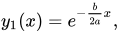
can be found using its characteristic equation.
The method of reduction of order is used to obtain a second linearly independent solution to this differential equation using our one known solution. To find a second solution we take as a guess

where is an unknown function to be determined. Since must satisfy the original ODE, we substitute it back in to get


Rearranging this equation in terms of the derivatives of we get

Since we know that is a solution to the original problem, the coefficient of the last term is equal to zero. Furthermore, substituting into the second term's coefficient yields (for that coefficient)

Therefore, we are left with

Since is assumed non-zero and is an exponential function (and thus always non-zero), we have


This can be integrated twice to yield

where are constants of integration. We now can write our second solution as


Since the second term in is a scalar multiple of the first solution (and thus linearly dependent) we can drop that term, yielding a final solution of

Finally, we can prove that the second solution found via this method is linearly independent of the first solution by calculating the Wronskian

Thus is the second linearly independent solution we were looking for.
General method
Given the general non-homogeneous linear differential equation

and a single solution of the homogeneous equation [], let us try a solution of the full non-homogeneous equation in the form:


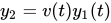
where is an arbitrary function. Thus


and

If these are substituted for , , and in the differential equation, then



Since is a solution of the original homogeneous differential equation, , so we can reduce to


which is a first-order differential equation for (reduction of order). Divide by , obtaining


The integrating factor is .

Multiplying the differential equation by the integrating factor Failed to parse (MathML with SVG or PNG fallback (recommended for modern browsers and accessibility tools): Invalid response ("Math extension cannot connect to Restbase.") from server "https://wikimedia.org/api/rest_v1/":): {\displaystyle \mu(t)} , the equation for Failed to parse (MathML with SVG or PNG fallback (recommended for modern browsers and accessibility tools): Invalid response ("Math extension cannot connect to Restbase.") from server "https://wikimedia.org/api/rest_v1/":): {\displaystyle v(t)} can be reduced to
- Failed to parse (MathML with SVG or PNG fallback (recommended for modern browsers and accessibility tools): Invalid response ("Math extension cannot connect to Restbase.") from server "https://wikimedia.org/api/rest_v1/":): {\displaystyle \frac{d}{dt}\left(v'(t) y_1^2(t) e^{\int p(t) dt}\right) = y_1(t)r(t)e^{\int p(t) dt}.}
After integrating the last equation, Failed to parse (MathML with SVG or PNG fallback (recommended for modern browsers and accessibility tools): Invalid response ("Math extension cannot connect to Restbase.") from server "https://wikimedia.org/api/rest_v1/":): {\displaystyle v'(t)} is found, containing one constant of integration. Then, integrate Failed to parse (MathML with SVG or PNG fallback (recommended for modern browsers and accessibility tools): Invalid response ("Math extension cannot connect to Restbase.") from server "https://wikimedia.org/api/rest_v1/":): {\displaystyle v'(t)} to find the full solution of the original non-homogeneous second-order equation, exhibiting two constants of integration as it should:
- Failed to parse (MathML with SVG or PNG fallback (recommended for modern browsers and accessibility tools): Invalid response ("Math extension cannot connect to Restbase.") from server "https://wikimedia.org/api/rest_v1/":): {\displaystyle y_2(t) = v(t)y_1(t).}
Resources
- Reduction of the Order Notes. Produced by Paul Dawkins, Lamar University
Licensing
Content obtained and/or adapted from:
- Reduction of order, Wikipedia under a CC BY-SA license

