The Substitution and Composition Theorems
Contents
Substitution Theorem
Definite integrals
Let φ : [a, b] → I be a differentiable function with a continuous derivative, where I ⊆ R is an interval. Suppose that f : I → R is a continuous function. Then

In Leibniz notation, the substitution u = φ(x) yields
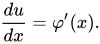
Working heuristically with infinitesimals yields the equation
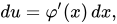
which suggests the substitution formula above. (This equation may be put on a rigorous foundation by interpreting it as a statement about differential forms.) One may view the method of integration by substitution as a partial justification of Leibniz's notation for integrals and derivatives.
The formula is used to transform one integral into another integral that is easier to compute. Thus, the formula can be read from left to right or from right to left in order to simplify a given integral. When used in the former manner, it is sometimes known as u-substitution or w-substitution in which a new variable is defined to be a function of the original variable found inside the composite function multiplied by the derivative of the inner function. The latter manner is commonly used in trigonometric substitution, replacing the original variable with a trigonometric function of a new variable and the original differential with the differential of the trigonometric function.
Proof
Integration by substitution can be derived from the fundamental theorem of calculus as follows. Let f and φ be two functions satisfying the above hypothesis that f is continuous on I and φ′ is integrable on the closed interval [a,b]. Then the function f(φ(x))φ′(x) is also integrable on [a,b]. Hence the integrals
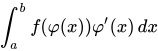
and
- Failed to parse (MathML with SVG or PNG fallback (recommended for modern browsers and accessibility tools): Invalid response ("Math extension cannot connect to Restbase.") from server "https://wikimedia.org/api/rest_v1/":): {\displaystyle \int_{\varphi(a)}^{\varphi(b)} f(u)\,du}
in fact exist, and it remains to show that they are equal.
Since f is continuous, it has an antiderivative F. The composite function F ∘ φ is then defined. Since φ is differentiable, combining the chain rule and the definition of an antiderivative gives
- Failed to parse (MathML with SVG or PNG fallback (recommended for modern browsers and accessibility tools): Invalid response ("Math extension cannot connect to Restbase.") from server "https://wikimedia.org/api/rest_v1/":): {\displaystyle (F \circ \varphi)'(x) = F'(\varphi(x))\varphi'(x) = f(\varphi(x))\varphi'(x).}
Applying the fundamental theorem of calculus twice gives
- Failed to parse (MathML with SVG or PNG fallback (recommended for modern browsers and accessibility tools): Invalid response ("Math extension cannot connect to Restbase.") from server "https://wikimedia.org/api/rest_v1/":): {\displaystyle \begin{align} \int_a^b f(\varphi(x))\varphi'(x)\,dx &= \int_a^b (F \circ \varphi)'(x)\,dx \\ &= (F \circ \varphi)(b) - (F \circ \varphi)(a) \\ &= F(\varphi(b)) - F(\varphi(a)) \\ &= \int_{\varphi(a)}^{\varphi(b)} f(u)\,du, \end{align} }
which is the substitution rule.
Examples
Example 1
Consider the integral
- Failed to parse (MathML with SVG or PNG fallback (recommended for modern browsers and accessibility tools): Invalid response ("Math extension cannot connect to Restbase.") from server "https://wikimedia.org/api/rest_v1/":): {\displaystyle \int_0^2 x \cos(x^2+1) dx.}
Make the substitution Failed to parse (MathML with SVG or PNG fallback (recommended for modern browsers and accessibility tools): Invalid response ("Math extension cannot connect to Restbase.") from server "https://wikimedia.org/api/rest_v1/":): {\displaystyle u = x^{2} + 1} to obtain Failed to parse (MathML with SVG or PNG fallback (recommended for modern browsers and accessibility tools): Invalid response ("Math extension cannot connect to Restbase.") from server "https://wikimedia.org/api/rest_v1/":): {\displaystyle du = 2xdx} , meaning Failed to parse (MathML with SVG or PNG fallback (recommended for modern browsers and accessibility tools): Invalid response ("Math extension cannot connect to Restbase.") from server "https://wikimedia.org/api/rest_v1/":): {\displaystyle \textstyle xdx = \frac{1}{2}du} . Therefore,
- Failed to parse (MathML with SVG or PNG fallback (recommended for modern browsers and accessibility tools): Invalid response ("Math extension cannot connect to Restbase.") from server "https://wikimedia.org/api/rest_v1/":): {\displaystyle \begin{align} \int_{x=0}^{x=2} x \cos(x^2+1) dx &= \frac{1}{2} \int_{u=1}^{u=5}\cos(u)\,du \\[6pt] &= \frac{1}{2}(\sin(5)-\sin(1)). \end{align}}
Since the lower limit Failed to parse (MathML with SVG or PNG fallback (recommended for modern browsers and accessibility tools): Invalid response ("Math extension cannot connect to Restbase.") from server "https://wikimedia.org/api/rest_v1/":): {\displaystyle x = 0} was replaced with Failed to parse (MathML with SVG or PNG fallback (recommended for modern browsers and accessibility tools): Invalid response ("Math extension cannot connect to Restbase.") from server "https://wikimedia.org/api/rest_v1/":): {\displaystyle u = 1} , and the upper limit Failed to parse (MathML with SVG or PNG fallback (recommended for modern browsers and accessibility tools): Invalid response ("Math extension cannot connect to Restbase.") from server "https://wikimedia.org/api/rest_v1/":): {\displaystyle x = 2} with Failed to parse (MathML with SVG or PNG fallback (recommended for modern browsers and accessibility tools): Invalid response ("Math extension cannot connect to Restbase.") from server "https://wikimedia.org/api/rest_v1/":): {\displaystyle 2^{2} + 1 = 5} , a transformation back into terms of Failed to parse (MathML with SVG or PNG fallback (recommended for modern browsers and accessibility tools): Invalid response ("Math extension cannot connect to Restbase.") from server "https://wikimedia.org/api/rest_v1/":): {\displaystyle x} was unnecessary.
Alternatively, one may fully evaluate the indefinite integral first then apply the boundary conditions. This becomes especially handy when multiple substitutions are used.
Example 2
For the integral
- Failed to parse (MathML with SVG or PNG fallback (recommended for modern browsers and accessibility tools): Invalid response ("Math extension cannot connect to Restbase.") from server "https://wikimedia.org/api/rest_v1/":): {\displaystyle \int_0^1 \sqrt{1-x^2}\,dx,}
a variation of the above procedure is needed. The substitution Failed to parse (MathML with SVG or PNG fallback (recommended for modern browsers and accessibility tools): Invalid response ("Math extension cannot connect to Restbase.") from server "https://wikimedia.org/api/rest_v1/":): {\displaystyle x = \sin u } implying Failed to parse (MathML with SVG or PNG fallback (recommended for modern browsers and accessibility tools): Invalid response ("Math extension cannot connect to Restbase.") from server "https://wikimedia.org/api/rest_v1/":): {\displaystyle dx = \cos u \,du} is useful because Failed to parse (MathML with SVG or PNG fallback (recommended for modern browsers and accessibility tools): Invalid response ("Math extension cannot connect to Restbase.") from server "https://wikimedia.org/api/rest_v1/":): {\displaystyle \sqrt{1-\sin^2u} = \cos(u)} . We thus have
- Failed to parse (MathML with SVG or PNG fallback (recommended for modern browsers and accessibility tools): Invalid response ("Math extension cannot connect to Restbase.") from server "https://wikimedia.org/api/rest_v1/":): {\displaystyle \begin{align} \int_0^1 \sqrt{1-x^2}\,dx &= \int_0^{\pi/2} \sqrt{1-\sin^2u} \cos(u)\,du \\[6pt] &= \int_0^{\pi/2} \cos^2u\,du \\[6pt] &= \left[\frac{u}{2} + \frac{\sin(2u)}{4}\right]\Biggl|_0^{\pi/2} \\[6pt] &= \frac{\pi}{4} + 0 = \frac{\pi}{4}. \end{align}}
The resulting integral can be computed using integration by parts or a double angle formula, Failed to parse (MathML with SVG or PNG fallback (recommended for modern browsers and accessibility tools): Invalid response ("Math extension cannot connect to Restbase.") from server "https://wikimedia.org/api/rest_v1/":): {\displaystyle 2\cos^{2} u = 1 + \cos (2u)} , followed by one more substitution. One can also note that the function being integrated is the upper right quarter of a circle with a radius of one, and hence integrating the upper right quarter from zero to one is the geometric equivalent to the area of one quarter of the unit circle, or Failed to parse (MathML with SVG or PNG fallback (recommended for modern browsers and accessibility tools): Invalid response ("Math extension cannot connect to Restbase.") from server "https://wikimedia.org/api/rest_v1/":): {\displaystyle \pi / 4 } .
Indefinite Integrals
Substitution can be used to determine antiderivatives. One chooses a relation between Failed to parse (MathML with SVG or PNG fallback (recommended for modern browsers and accessibility tools): Invalid response ("Math extension cannot connect to Restbase.") from server "https://wikimedia.org/api/rest_v1/":): {\displaystyle x} and Failed to parse (MathML with SVG or PNG fallback (recommended for modern browsers and accessibility tools): Invalid response ("Math extension cannot connect to Restbase.") from server "https://wikimedia.org/api/rest_v1/":): {\displaystyle u} , determines the corresponding relation between Failed to parse (MathML with SVG or PNG fallback (recommended for modern browsers and accessibility tools): Invalid response ("Math extension cannot connect to Restbase.") from server "https://wikimedia.org/api/rest_v1/":): {\displaystyle dx} and Failed to parse (MathML with SVG or PNG fallback (recommended for modern browsers and accessibility tools): Invalid response ("Math extension cannot connect to Restbase.") from server "https://wikimedia.org/api/rest_v1/":): {\displaystyle du} by differentiating, and performs the substitutions. An antiderivative for the substituted function can hopefully be determined; the original substitution between Failed to parse (MathML with SVG or PNG fallback (recommended for modern browsers and accessibility tools): Invalid response ("Math extension cannot connect to Restbase.") from server "https://wikimedia.org/api/rest_v1/":): {\displaystyle x} and Failed to parse (MathML with SVG or PNG fallback (recommended for modern browsers and accessibility tools): Invalid response ("Math extension cannot connect to Restbase.") from server "https://wikimedia.org/api/rest_v1/":): {\displaystyle u} is then undone.
Similar to example 1 above, the following antiderivative can be obtained with this method:
- Failed to parse (MathML with SVG or PNG fallback (recommended for modern browsers and accessibility tools): Invalid response ("Math extension cannot connect to Restbase.") from server "https://wikimedia.org/api/rest_v1/":): {\displaystyle \begin{align} \int x \cos(x^2+1) \,dx &= \frac{1}{2} \int 2x \cos(x^2+1) \,dx \\[6pt] &= \frac{1}{2} \int\cos u\,du \\[6pt] &= \frac{1}{2}\sin u + C = \frac{1}{2}\sin(x^2+1) + C, \end{align}}
where Failed to parse (MathML with SVG or PNG fallback (recommended for modern browsers and accessibility tools): Invalid response ("Math extension cannot connect to Restbase.") from server "https://wikimedia.org/api/rest_v1/":): {\displaystyle C} is an arbitrary constant of integration.
There were no integral boundaries to transform, but in the last step reverting the original substitution Failed to parse (MathML with SVG or PNG fallback (recommended for modern browsers and accessibility tools): Invalid response ("Math extension cannot connect to Restbase.") from server "https://wikimedia.org/api/rest_v1/":): {\displaystyle u = x^{2} + 1} was necessary. When evaluating definite integrals by substitution, one may calculate the antiderivative fully first, then apply the boundary conditions. In that case, there is no need to transform the boundary terms.
The tangent function can be integrated using substitution by expressing it in terms of the sine and cosine:
- Failed to parse (MathML with SVG or PNG fallback (recommended for modern browsers and accessibility tools): Invalid response ("Math extension cannot connect to Restbase.") from server "https://wikimedia.org/api/rest_v1/":): {\displaystyle \int \tan x \,dx = \int \frac{\sin x}{\cos x} \,dx}
Using the substitution Failed to parse (MathML with SVG or PNG fallback (recommended for modern browsers and accessibility tools): Invalid response ("Math extension cannot connect to Restbase.") from server "https://wikimedia.org/api/rest_v1/":): {\displaystyle u = \cos x} gives Failed to parse (MathML with SVG or PNG fallback (recommended for modern browsers and accessibility tools): Invalid response ("Math extension cannot connect to Restbase.") from server "https://wikimedia.org/api/rest_v1/":): {\displaystyle du = -\sin x\,dx} and
- Failed to parse (MathML with SVG or PNG fallback (recommended for modern browsers and accessibility tools): Invalid response ("Math extension cannot connect to Restbase.") from server "https://wikimedia.org/api/rest_v1/":): {\displaystyle \begin{align} \int \tan x \,dx &= \int \frac{\sin x}{\cos x} \,dx \\ &= \int -\frac{du}{u} \\ &= -\ln |u| + C \\ &= -\ln |\cos x| + C = \ln |\sec x| + C. \end{align}}
Composition Theorem
Let Failed to parse (MathML with SVG or PNG fallback (recommended for modern browsers and accessibility tools): Invalid response ("Math extension cannot connect to Restbase.") from server "https://wikimedia.org/api/rest_v1/":): {\displaystyle f } be Riemann integrable on Failed to parse (MathML with SVG or PNG fallback (recommended for modern browsers and accessibility tools): Invalid response ("Math extension cannot connect to Restbase.") from server "https://wikimedia.org/api/rest_v1/":): {\displaystyle [a,b] } , with Failed to parse (MathML with SVG or PNG fallback (recommended for modern browsers and accessibility tools): Invalid response ("Math extension cannot connect to Restbase.") from server "https://wikimedia.org/api/rest_v1/":): {\displaystyle f([a,b]) \subseteq [c,d] } , and let Failed to parse (MathML with SVG or PNG fallback (recommended for modern browsers and accessibility tools): Invalid response ("Math extension cannot connect to Restbase.") from server "https://wikimedia.org/api/rest_v1/":): {\displaystyle \phi : [c,d]\to\R } be continuous. Then the composition Failed to parse (MathML with SVG or PNG fallback (recommended for modern browsers and accessibility tools): Invalid response ("Math extension cannot connect to Restbase.") from server "https://wikimedia.org/api/rest_v1/":): {\displaystyle \varphi \circ f } is Riemann integrable on Failed to parse (MathML with SVG or PNG fallback (recommended for modern browsers and accessibility tools): Invalid response ("Math extension cannot connect to Restbase.") from server "https://wikimedia.org/api/rest_v1/":): {\displaystyle [a,b] } as well.
Product Theorem
Licensing
Content obtained and/or adapted from:
- Integration by substitution, Wikipedia under a CC BY-SA license

