Differentiation Rule

From Department of Mathematics at UTSA
Revision as of 23:21, 13 November 2021 by Khanh (talk | contribs)
(diff) ← Older revision | Latest revision (diff) | Newer revision → (diff)
Jump to navigation Jump to search

This is a summary of differentiation rules, that is, rules for computing the derivative of a function in calculus.

Elementary rules of differentiation

Unless otherwise stated, all functions are functions of real numbers (R) that return real values; although more generally, the formulae below apply wherever they are well defined— including the case of complex numbers (C).

Differentiation is linear

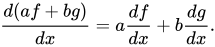
For any functions and and any real numbers and , the derivative of the function with respect to is

In Leibniz's notation this is written as:
Special cases include:

  • The constant factor rule
  • The sum rule
  • The subtraction rule

The product rule

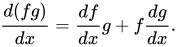
For the functions f and g, the derivative of the function h(x) = f(x) g(x) with respect to x is

In Leibniz's notation this is written
The chain rule

The derivative of the function is

In Leibniz's notation, this is written as:

often abridged to
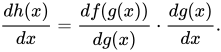
Focusing on the notion of maps, and the differential being a map , this is written in a more concise way as:

The inverse function rule

If the function f has an inverse function g, meaning that and then

In Leibniz notation, this is written as

Power laws, polynomials, quotients, and reciprocals

The polynomial or elementary power rule

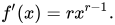
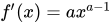
If , for any real number then

When this becomes the special case that if then

Combining the power rule with the sum and constant multiple rules permits the computation of the derivative of any polynomial.

The reciprocal rule

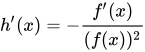
The derivative of for any (nonvanishing) function f is:
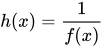
wherever f is non-zero.

In Leibniz's notation, this is written
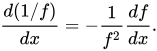
The reciprocal rule can be derived either from the quotient rule, or from the combination of power rule and chain rule.

The quotient rule

If f and g are functions, then:
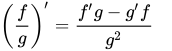
wherever g is nonzero.

This can be derived from the product rule and the reciprocal rule.

Generalized power rule

The elementary power rule generalizes considerably. The most general power rule is the functional power rule: for any functions f and g,

wherever both sides are well defined.

Special cases

  • If , then when a is any non-zero real number and x is positive.
  • The reciprocal rule may be derived as the special case where .

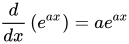
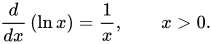
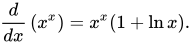
Derivatives of exponential and logarithmic functions

the equation above is true for all c, but the derivative for yields a complex number.

the equation above is also true for all c, but yields a complex number if .

where is the Lambert W function

Logarithmic derivatives

The logarithmic derivative is another way of stating the rule for differentiating the logarithm of a function (using the chain rule):
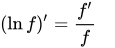
Failed to parse (MathML with SVG or PNG fallback (recommended for modern browsers and accessibility tools): Invalid response ("Math extension cannot connect to Restbase.") from server "https://wikimedia.org/api/rest_v1/":): {\displaystyle (\ln f)'= \frac{f'}{f} \quad} wherever f is positive.

Logarithmic differentiation is a technique which uses logarithms and its differentiation rules to simplify certain expressions before actually applying the derivative. Logarithms can be used to remove exponents, convert products into sums, and convert division into subtraction — each of which may lead to a simplified expression for taking derivatives.


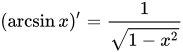
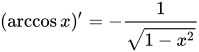
Derivatives of trigonometric functions

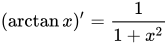
Failed to parse (MathML with SVG or PNG fallback (recommended for modern browsers and accessibility tools): Invalid response ("Math extension cannot connect to Restbase.") from server "https://wikimedia.org/api/rest_v1/":): {\displaystyle (\tan x)' = \sec^2 x = { 1 \over \cos^2 x} = 1 + \tan^2 x } Failed to parse (MathML with SVG or PNG fallback (recommended for modern browsers and accessibility tools): Invalid response ("Math extension cannot connect to Restbase.") from server "https://wikimedia.org/api/rest_v1/":): {\displaystyle (\arctan x)' = { 1 \over 1 + x^2} }
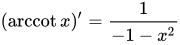
Failed to parse (MathML with SVG or PNG fallback (recommended for modern browsers and accessibility tools): Invalid response ("Math extension cannot connect to Restbase.") from server "https://wikimedia.org/api/rest_v1/":): {\displaystyle (\cot x)' = -\csc^2 x = -{ 1 \over \sin^2 x} = -1 - \cot^2 x} Failed to parse (MathML with SVG or PNG fallback (recommended for modern browsers and accessibility tools): Invalid response ("Math extension cannot connect to Restbase.") from server "https://wikimedia.org/api/rest_v1/":): {\displaystyle (\operatorname{arccot} x)' = {1 \over -1 - x^2} }
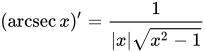
Failed to parse (MathML with SVG or PNG fallback (recommended for modern browsers and accessibility tools): Invalid response ("Math extension cannot connect to Restbase.") from server "https://wikimedia.org/api/rest_v1/":): {\displaystyle (\sec x)' = \sec{x}\tan{x} } Failed to parse (MathML with SVG or PNG fallback (recommended for modern browsers and accessibility tools): Invalid response ("Math extension cannot connect to Restbase.") from server "https://wikimedia.org/api/rest_v1/":): {\displaystyle (\operatorname{arcsec} x)' = { 1 \over |x|\sqrt{x^2 - 1}} }
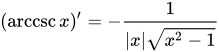
Failed to parse (MathML with SVG or PNG fallback (recommended for modern browsers and accessibility tools): Invalid response ("Math extension cannot connect to Restbase.") from server "https://wikimedia.org/api/rest_v1/":): {\displaystyle (\csc x)' = -\csc{x}\cot{x} } Failed to parse (MathML with SVG or PNG fallback (recommended for modern browsers and accessibility tools): Invalid response ("Math extension cannot connect to Restbase.") from server "https://wikimedia.org/api/rest_v1/":): {\displaystyle (\operatorname{arccsc} x)' = -{1 \over |x|\sqrt{x^2 - 1}} }

The derivatives in the table above is for when the range of the inverse secant is Failed to parse (MathML with SVG or PNG fallback (recommended for modern browsers and accessibility tools): Invalid response ("Math extension cannot connect to Restbase.") from server "https://wikimedia.org/api/rest_v1/":): {\displaystyle [0,\pi]\!} and when the range of the inverse cosecant is Failed to parse (MathML with SVG or PNG fallback (recommended for modern browsers and accessibility tools): Invalid response ("Math extension cannot connect to Restbase.") from server "https://wikimedia.org/api/rest_v1/":): {\displaystyle \left[-\frac{\pi}{2},\frac{\pi}{2}\right]\!} .

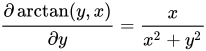
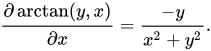
It is common to additionally define an inverse tangent function with two arguments, Failed to parse (MathML with SVG or PNG fallback (recommended for modern browsers and accessibility tools): Invalid response ("Math extension cannot connect to Restbase.") from server "https://wikimedia.org/api/rest_v1/":): {\displaystyle \arctan(y,x)\!} . Its value lies in the range Failed to parse (MathML with SVG or PNG fallback (recommended for modern browsers and accessibility tools): Invalid response ("Math extension cannot connect to Restbase.") from server "https://wikimedia.org/api/rest_v1/":): {\displaystyle [-\pi,\pi]\!} and reflects the quadrant of the point Failed to parse (MathML with SVG or PNG fallback (recommended for modern browsers and accessibility tools): Invalid response ("Math extension cannot connect to Restbase.") from server "https://wikimedia.org/api/rest_v1/":): {\displaystyle (x,y)\!} . For the first and fourth quadrant (i.e. Failed to parse (MathML with SVG or PNG fallback (recommended for modern browsers and accessibility tools): Invalid response ("Math extension cannot connect to Restbase.") from server "https://wikimedia.org/api/rest_v1/":): {\displaystyle x > 0\!} ) one has Failed to parse (MathML with SVG or PNG fallback (recommended for modern browsers and accessibility tools): Invalid response ("Math extension cannot connect to Restbase.") from server "https://wikimedia.org/api/rest_v1/":): {\displaystyle \arctan(y, x>0) = \arctan(y/x)\!} . Its partial derivatives are

Failed to parse (MathML with SVG or PNG fallback (recommended for modern browsers and accessibility tools): Invalid response ("Math extension cannot connect to Restbase.") from server "https://wikimedia.org/api/rest_v1/":): {\displaystyle \frac{\partial \arctan(y,x)}{\partial y} = \frac{x}{x^2 + y^2}} , and Failed to parse (MathML with SVG or PNG fallback (recommended for modern browsers and accessibility tools): Invalid response ("Math extension cannot connect to Restbase.") from server "https://wikimedia.org/api/rest_v1/":): {\displaystyle \frac{\partial \arctan(y,x)}{\partial x} = \frac{-y}{x^2 + y^2}.}

Derivatives of hyperbolic functions

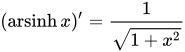
Failed to parse (MathML with SVG or PNG fallback (recommended for modern browsers and accessibility tools): Invalid response ("Math extension cannot connect to Restbase.") from server "https://wikimedia.org/api/rest_v1/":): {\displaystyle ( \sinh x )'= \cosh x = \frac{e^x + e^{-x}}{2}} Failed to parse (MathML with SVG or PNG fallback (recommended for modern browsers and accessibility tools): Invalid response ("Math extension cannot connect to Restbase.") from server "https://wikimedia.org/api/rest_v1/":): {\displaystyle (\operatorname{arsinh}x)' = { 1 \over \sqrt{1 + x^2}}}
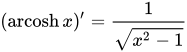
Failed to parse (MathML with SVG or PNG fallback (recommended for modern browsers and accessibility tools): Invalid response ("Math extension cannot connect to Restbase.") from server "https://wikimedia.org/api/rest_v1/":): {\displaystyle (\cosh x )'= \sinh x = \frac{e^x - e^{-x}}{2}} Failed to parse (MathML with SVG or PNG fallback (recommended for modern browsers and accessibility tools): Invalid response ("Math extension cannot connect to Restbase.") from server "https://wikimedia.org/api/rest_v1/":): {\displaystyle (\operatorname{arcosh}x)' = {\frac {1}{\sqrt{x^2-1}}}}
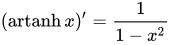
Failed to parse (MathML with SVG or PNG fallback (recommended for modern browsers and accessibility tools): Invalid response ("Math extension cannot connect to Restbase.") from server "https://wikimedia.org/api/rest_v1/":): {\displaystyle (\tanh x )'= {\operatorname{sech}^2x} = { 1 \over \cosh^2 x} = 1 - \tanh^2 x} Failed to parse (MathML with SVG or PNG fallback (recommended for modern browsers and accessibility tools): Invalid response ("Math extension cannot connect to Restbase.") from server "https://wikimedia.org/api/rest_v1/":): {\displaystyle (\operatorname{artanh}x)' = { 1 \over 1 - x^2}}
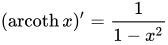
Failed to parse (MathML with SVG or PNG fallback (recommended for modern browsers and accessibility tools): Invalid response ("Math extension cannot connect to Restbase.") from server "https://wikimedia.org/api/rest_v1/":): {\displaystyle (\coth x )' = -\operatorname{csch}^2x = -{ 1 \over \sinh^2 x} = 1 - \coth^2 x} Failed to parse (MathML with SVG or PNG fallback (recommended for modern browsers and accessibility tools): Invalid response ("Math extension cannot connect to Restbase.") from server "https://wikimedia.org/api/rest_v1/":): {\displaystyle (\operatorname{arcoth}x)' = { 1 \over 1 - x^2}}
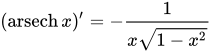
Failed to parse (MathML with SVG or PNG fallback (recommended for modern browsers and accessibility tools): Invalid response ("Math extension cannot connect to Restbase.") from server "https://wikimedia.org/api/rest_v1/":): {\displaystyle (\operatorname{sech} x)' = -\operatorname{sech}{x}\tanh{x}} Failed to parse (MathML with SVG or PNG fallback (recommended for modern browsers and accessibility tools): Invalid response ("Math extension cannot connect to Restbase.") from server "https://wikimedia.org/api/rest_v1/":): {\displaystyle (\operatorname{arsech}x)' = -{1 \over x\sqrt{1 - x^2}}}
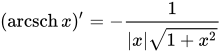
Failed to parse (MathML with SVG or PNG fallback (recommended for modern browsers and accessibility tools): Invalid response ("Math extension cannot connect to Restbase.") from server "https://wikimedia.org/api/rest_v1/":): {\displaystyle (\operatorname{csch}x)' = -\operatorname{csch}{x}\coth{x}} Failed to parse (MathML with SVG or PNG fallback (recommended for modern browsers and accessibility tools): Invalid response ("Math extension cannot connect to Restbase.") from server "https://wikimedia.org/api/rest_v1/":): {\displaystyle (\operatorname{arcsch}x)' = -{1 \over |x|\sqrt{1 + x^2}}}

Derivatives of special functions

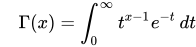
Gamma function Failed to parse (MathML with SVG or PNG fallback (recommended for modern browsers and accessibility tools): Invalid response ("Math extension cannot connect to Restbase.") from server "https://wikimedia.org/api/rest_v1/":): {\displaystyle \quad \Gamma(x) = \int_0^\infty t^{x-1} e^{-t}\, dt}
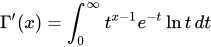
Failed to parse (MathML with SVG or PNG fallback (recommended for modern browsers and accessibility tools): Invalid response ("Math extension cannot connect to Restbase.") from server "https://wikimedia.org/api/rest_v1/":): {\displaystyle \Gamma'(x) = \int_0^\infty t^{x-1} e^{-t} \ln t\,dt}
Failed to parse (MathML with SVG or PNG fallback (recommended for modern browsers and accessibility tools): Invalid response ("Math extension cannot connect to Restbase.") from server "https://wikimedia.org/api/rest_v1/":): {\displaystyle \, = \Gamma(x) \left(\sum_{n=1}^\infty \left(\ln\left(1 + \dfrac{1}{n}\right) - \dfrac{1}{x + n}\right) - \dfrac{1}{x}\right)}
Failed to parse (MathML with SVG or PNG fallback (recommended for modern browsers and accessibility tools): Invalid response ("Math extension cannot connect to Restbase.") from server "https://wikimedia.org/api/rest_v1/":): {\displaystyle \, = \Gamma(x) \psi(x)}

with Failed to parse (MathML with SVG or PNG fallback (recommended for modern browsers and accessibility tools): Invalid response ("Math extension cannot connect to Restbase.") from server "https://wikimedia.org/api/rest_v1/":): {\displaystyle \psi(x)} being the digamma function, expressed by the parenthesized expression to the right of Failed to parse (MathML with SVG or PNG fallback (recommended for modern browsers and accessibility tools): Invalid response ("Math extension cannot connect to Restbase.") from server "https://wikimedia.org/api/rest_v1/":): {\displaystyle \Gamma(x)} in the line above.

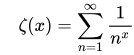
Riemann Zeta functionFailed to parse (MathML with SVG or PNG fallback (recommended for modern browsers and accessibility tools): Invalid response ("Math extension cannot connect to Restbase.") from server "https://wikimedia.org/api/rest_v1/":): {\displaystyle \quad\zeta(x) =\sum_{n=1}^\infty\frac{1}{n^x}}
Failed to parse (MathML with SVG or PNG fallback (recommended for modern browsers and accessibility tools): Invalid response ("Math extension cannot connect to Restbase.") from server "https://wikimedia.org/api/rest_v1/":): {\displaystyle \zeta'(x) = -\sum_{n=1}^\infty \frac{\ln n}{n^x} =-\frac{\ln 2}{2^x} - \frac{\ln 3}{3^x} - \frac{\ln 4}{4^x} - \cdots }
Failed to parse (MathML with SVG or PNG fallback (recommended for modern browsers and accessibility tools): Invalid response ("Math extension cannot connect to Restbase.") from server "https://wikimedia.org/api/rest_v1/":): {\displaystyle \, = -\sum_{p \text{ prime}} \frac{p^{-x} \ln p}{(1-p^{-x})^2}\prod_{q \text{ prime}, q \neq p} \frac{1}{1-q^{-x}} }

Derivatives of integrals

Suppose that it is required to differentiate with respect to x the function
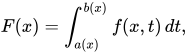
Failed to parse (MathML with SVG or PNG fallback (recommended for modern browsers and accessibility tools): Invalid response ("Math extension cannot connect to Restbase.") from server "https://wikimedia.org/api/rest_v1/":): {\displaystyle F(x)=\int_{a(x)}^{b(x)}f(x,t)\,dt,}

where the functions Failed to parse (MathML with SVG or PNG fallback (recommended for modern browsers and accessibility tools): Invalid response ("Math extension cannot connect to Restbase.") from server "https://wikimedia.org/api/rest_v1/":): {\displaystyle f(x,t)} and Failed to parse (MathML with SVG or PNG fallback (recommended for modern browsers and accessibility tools): Invalid response ("Math extension cannot connect to Restbase.") from server "https://wikimedia.org/api/rest_v1/":): {\displaystyle \frac{\partial}{\partial x}\,f(x,t)} are both continuous in both Failed to parse (MathML with SVG or PNG fallback (recommended for modern browsers and accessibility tools): Invalid response ("Math extension cannot connect to Restbase.") from server "https://wikimedia.org/api/rest_v1/":): {\displaystyle t} and Failed to parse (MathML with SVG or PNG fallback (recommended for modern browsers and accessibility tools): Invalid response ("Math extension cannot connect to Restbase.") from server "https://wikimedia.org/api/rest_v1/":): {\displaystyle x} in some region of the Failed to parse (MathML with SVG or PNG fallback (recommended for modern browsers and accessibility tools): Invalid response ("Math extension cannot connect to Restbase.") from server "https://wikimedia.org/api/rest_v1/":): {\displaystyle (t,x)} plane, including Failed to parse (MathML with SVG or PNG fallback (recommended for modern browsers and accessibility tools): Invalid response ("Math extension cannot connect to Restbase.") from server "https://wikimedia.org/api/rest_v1/":): {\displaystyle a(x)\leq t\leq b(x),} , and the functions Failed to parse (MathML with SVG or PNG fallback (recommended for modern browsers and accessibility tools): Invalid response ("Math extension cannot connect to Restbase.") from server "https://wikimedia.org/api/rest_v1/":): {\displaystyle a(x)} and Failed to parse (MathML with SVG or PNG fallback (recommended for modern browsers and accessibility tools): Invalid response ("Math extension cannot connect to Restbase.") from server "https://wikimedia.org/api/rest_v1/":): {\displaystyle b(x)} are both continuous and both have continuous derivatives for Failed to parse (MathML with SVG or PNG fallback (recommended for modern browsers and accessibility tools): Invalid response ("Math extension cannot connect to Restbase.") from server "https://wikimedia.org/api/rest_v1/":): {\displaystyle x_0\leq x\leq x_1} . Then for Failed to parse (MathML with SVG or PNG fallback (recommended for modern browsers and accessibility tools): Invalid response ("Math extension cannot connect to Restbase.") from server "https://wikimedia.org/api/rest_v1/":): {\displaystyle \,x_0\leq x\leq x_1} :

Failed to parse (MathML with SVG or PNG fallback (recommended for modern browsers and accessibility tools): Invalid response ("Math extension cannot connect to Restbase.") from server "https://wikimedia.org/api/rest_v1/":): {\displaystyle F'(x) = f(x,b(x))\,b'(x) - f(x,a(x))\,a'(x) + \int_{a(x)}^{b(x)} \frac{\partial}{\partial x}\, f(x,t)\; dt\,. }

This formula is the general form of the Leibniz integral rule and can be derived using the fundamental theorem of calculus.

Derivatives to nth order

Some rules exist for computing the n-th derivative of functions, where n is a positive integer. These include:

Faà di Bruno's formula

If f and g are n-times differentiable, then

Failed to parse (MathML with SVG or PNG fallback (recommended for modern browsers and accessibility tools): Invalid response ("Math extension cannot connect to Restbase.") from server "https://wikimedia.org/api/rest_v1/":): {\displaystyle \frac{d^n}{d x^n} [f(g(x))]= n! \sum_{\{k_m\}}^{} f^{(r)}(g(x)) \prod_{m=1}^n \frac{1}{k_m!} \left(g^{(m)}(x) \right)^{k_m}}

where Failed to parse (MathML with SVG or PNG fallback (recommended for modern browsers and accessibility tools): Invalid response ("Math extension cannot connect to Restbase.") from server "https://wikimedia.org/api/rest_v1/":): {\displaystyle r = \sum_{m=1}^{n-1} k_m} and the set Failed to parse (MathML with SVG or PNG fallback (recommended for modern browsers and accessibility tools): Invalid response ("Math extension cannot connect to Restbase.") from server "https://wikimedia.org/api/rest_v1/":): {\displaystyle \{k_m\}} consists of all non-negative integer solutions of the Diophantine equation Failed to parse (MathML with SVG or PNG fallback (recommended for modern browsers and accessibility tools): Invalid response ("Math extension cannot connect to Restbase.") from server "https://wikimedia.org/api/rest_v1/":): {\displaystyle \sum_{m=1}^{n} m k_m = n} .

General Leibniz rule

If f and g are n-times differentiable, then

Failed to parse (MathML with SVG or PNG fallback (recommended for modern browsers and accessibility tools): Invalid response ("Math extension cannot connect to Restbase.") from server "https://wikimedia.org/api/rest_v1/":): {\displaystyle \frac{d^n}{dx^n}[f(x)g(x)] = \sum_{k=0}^{n} \binom{n}{k} \frac{d^{n-k}}{d x^{n-k}} f(x) \frac{d^k}{d x^k} g(x)}

Licensing

Content obtained and/or adapted from: