Bounded Functions

A function f defined on some set X with real or complex values is called bounded if the set of its values is bounded. In other words, there exists a real number M such that

for all x in X.[1] A function that is not bounded is said to be unbounded.Template:Citation needed
If f is real-valued and f(x) ≤ A for all x in X, then the function is said to be bounded (from) above by A. If f(x) ≥ B for all x in X, then the function is said to be bounded (from) below by B. A real-valued function is bounded if and only if it is bounded from above and below.[1]Template:Additional citation needed
An important special case is a bounded sequence, where X is taken to be the set N of natural numbers. Thus a sequence f = (a0, a1, a2, ...) is bounded if there exists a real number M such that

for every natural number n. The set of all bounded sequences forms the sequence space .Template:Citation needed

The definition of boundedness can be generalized to functions f : X → Y taking values in a more general space Y by requiring that the image f(X) is a bounded set in Y.Template:Citation needed
Related notions
Weaker than boundedness is local boundedness. A family of bounded functions may be uniformly bounded.
A bounded operator T : X → Y is not a bounded function in the sense of this page's definition (unless T = 0), but has the weaker property of preserving boundedness: Bounded sets M ⊆ X are mapped to bounded sets T(M) ⊆ Y. This definition can be extended to any function f : X → Y if X and Y allow for the concept of a bounded set. Boundedness can also be determined by looking at a graph.
Examples
- The sine function sin : R → R is bounded since for all .


- The function , defined for all real x except for −1 and 1, is unbounded. As x approaches −1 or 1, the values of this function get larger and larger in magnitude. This function can be made bounded if one considers its domain to be, for example, [2, ∞) or (−∞, −2].

- The function , defined for all real x, is bounded.

- The inverse trigonometric function arctangent defined as: y = arctan(x) or x = tan(y) is increasing for all real numbers x and bounded with −Template:Sfrac < y < Template:Sfrac radians.
- By the boundedness theorem, every continuous function on a closed interval, such as f : [0, 1] → R, is bounded. More generally, any continuous function from a compact space into a metric space is bounded.
- All complex-valued functions f : C → C which are entire are either unbounded or constant as a consequence of Liouville's theorem. In particular, the complex sin : C → C must be unbounded since it is entire.
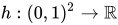
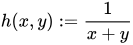
- The function f which takes the value 0 for x rational number and 1 for x irrational number (cf. Dirichlet function) is bounded. Thus, a function does not need to be "nice" in order to be bounded. The set of all bounded functions defined on [0, 1] is much larger than the set of continuous functions on that interval. Moreover, continuous functions need not be bounded; for example, the functions and defined by and are both continuous, but neither is bounded. (However, a continuous function must be bounded if its domain is both closed and bounded.)


Licensing
Content obtained and/or adapted from:
- Bounded function, Wikipedia under a CC BY-SA license

