Graphs of Rational Functions
In mathematics, a rational function is any function that can be defined by a rational fraction, which is an algebraic fraction such that both the numerator and the denominator are polynomials. The coefficients of the polynomials need not be rational numbers; they may be taken in any field K. In this case, one speaks of a rational function and a rational fraction over K. The values of the variables may be taken in any field L containing K. Then the domain of the function is the set of the values of the variables for which the denominator is not zero, and the codomain is L.
The set of rational functions over a field K is a field, the field of fractions of the ring of the polynomial functions over K.
Contents
Definitions
A function Failed to parse (MathML with SVG or PNG fallback (recommended for modern browsers and accessibility tools): Invalid response ("Math extension cannot connect to Restbase.") from server "https://wikimedia.org/api/rest_v1/":): {\displaystyle f(x)} is called a rational function if and only if it can be written in the form
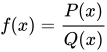
where and are polynomial functions of and Failed to parse (MathML with SVG or PNG fallback (recommended for modern browsers and accessibility tools): Invalid response ("Math extension cannot connect to Restbase.") from server "https://wikimedia.org/api/rest_v1/":): {\displaystyle Q\,} is not the zero function. The domain of f is the set of all values of for which the denominator is not zero.


However, if and have a non-constant polynomial greatest common divisor , then setting and produces a rational function


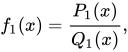
which may have a larger domain than , and is equal to on the domain of It is a common usage to identify and , that is to extend "by continuity" the domain of Failed to parse (MathML with SVG or PNG fallback (recommended for modern browsers and accessibility tools): Invalid response ("Math extension cannot connect to Restbase.") from server "https://wikimedia.org/api/rest_v1/":): {\displaystyle f(x)} to that of Failed to parse (MathML with SVG or PNG fallback (recommended for modern browsers and accessibility tools): Invalid response ("Math extension cannot connect to Restbase.") from server "https://wikimedia.org/api/rest_v1/":): {\displaystyle f_1(x).} Indeed, one can define a rational fraction as an equivalence class of fractions of polynomials, where two fractions Failed to parse (MathML with SVG or PNG fallback (recommended for modern browsers and accessibility tools): Invalid response ("Math extension cannot connect to Restbase.") from server "https://wikimedia.org/api/rest_v1/":): {\displaystyle \frac{A(x)}{B(x)}} and Failed to parse (MathML with SVG or PNG fallback (recommended for modern browsers and accessibility tools): Invalid response ("Math extension cannot connect to Restbase.") from server "https://wikimedia.org/api/rest_v1/":): {\displaystyle \frac{C(x)}{D(x)}} are considered equivalent if Failed to parse (MathML with SVG or PNG fallback (recommended for modern browsers and accessibility tools): Invalid response ("Math extension cannot connect to Restbase.") from server "https://wikimedia.org/api/rest_v1/":): {\displaystyle A(x)D(x)=B(x)C(x)} . In this case Failed to parse (MathML with SVG or PNG fallback (recommended for modern browsers and accessibility tools): Invalid response ("Math extension cannot connect to Restbase.") from server "https://wikimedia.org/api/rest_v1/":): {\displaystyle \frac{P(x)}{Q(x)}} is equivalent to Failed to parse (MathML with SVG or PNG fallback (recommended for modern browsers and accessibility tools): Invalid response ("Math extension cannot connect to Restbase.") from server "https://wikimedia.org/api/rest_v1/":): {\displaystyle \frac{P_1(x)}{Q_1(x)}} .


A proper rational function is a rational function in which the Degree of a polynomial|degree of Failed to parse (MathML with SVG or PNG fallback (recommended for modern browsers and accessibility tools): Invalid response ("Math extension cannot connect to Restbase.") from server "https://wikimedia.org/api/rest_v1/":): {\displaystyle P(x)} is no greater than the degree of Failed to parse (MathML with SVG or PNG fallback (recommended for modern browsers and accessibility tools): Invalid response ("Math extension cannot connect to Restbase.") from server "https://wikimedia.org/api/rest_v1/":): {\displaystyle Q(x)} and both are real polynomials.
Degree
There are several non equivalent definitions of the degree of a rational function.
Most commonly, the degree of a rational function is the maximum of the degrees of its constituent polynomials P and Q, when the fraction is reduced to lowest terms. If the degree of f is d, then the equation
- Failed to parse (MathML with SVG or PNG fallback (recommended for modern browsers and accessibility tools): Invalid response ("Math extension cannot connect to Restbase.") from server "https://wikimedia.org/api/rest_v1/":): {\displaystyle f(z) = w \,}
has d distinct solutions in z except for certain values of w, called critical values, where two or more solutions coincide or where some solution is rejected at infinity (that is, when the degree of the equation decrease after having cleared the denominator).
In the case of complex coefficients, a rational function with degree one is a Möbius transformation.
The degree of the graph of a rational function is not the degree as defined above: it is the maximum of the degree of the numerator and one plus the degree of the denominator.
In some contexts, such as in asymptotic analysis, the degree of a rational function is the difference between the degrees of the numerator and the denominator.
In network synthesis and network analysis, a rational function of degree two (that is, the ratio of two polynomials of degree at most two) is often called a biquadratic function.
Examples
The rational function
- Failed to parse (MathML with SVG or PNG fallback (recommended for modern browsers and accessibility tools): Invalid response ("Math extension cannot connect to Restbase.") from server "https://wikimedia.org/api/rest_v1/":): {\displaystyle f(x) = \frac{x^3-2x}{2(x^2-5)}}
is not defined at
- Failed to parse (MathML with SVG or PNG fallback (recommended for modern browsers and accessibility tools): Invalid response ("Math extension cannot connect to Restbase.") from server "https://wikimedia.org/api/rest_v1/":): {\displaystyle x^2=5 \Leftrightarrow x=\pm \sqrt{5}.}
It is asymptotic to Failed to parse (MathML with SVG or PNG fallback (recommended for modern browsers and accessibility tools): Invalid response ("Math extension cannot connect to Restbase.") from server "https://wikimedia.org/api/rest_v1/":): {\displaystyle \tfrac{x}{2}} as Failed to parse (MathML with SVG or PNG fallback (recommended for modern browsers and accessibility tools): Invalid response ("Math extension cannot connect to Restbase.") from server "https://wikimedia.org/api/rest_v1/":): {\displaystyle x\to \infty.}
The rational function
- Failed to parse (MathML with SVG or PNG fallback (recommended for modern browsers and accessibility tools): Invalid response ("Math extension cannot connect to Restbase.") from server "https://wikimedia.org/api/rest_v1/":): {\displaystyle f(x) = \frac{x^2 + 2}{x^2 + 1}}
is defined for all real numbers, but not for all complex numbers, since if x were a square root of -1 (i.e. the imaginary unit or its negative), then formal evaluation would lead to division by zero:
- Failed to parse (MathML with SVG or PNG fallback (recommended for modern browsers and accessibility tools): Invalid response ("Math extension cannot connect to Restbase.") from server "https://wikimedia.org/api/rest_v1/":): {\displaystyle f(i) = \frac{i^2 + 2}{i^2 + 1} = \frac{-1 + 2}{-1 + 1} = \frac{1}{0},}
which is undefined.
A constant function such as f(x) = π is a rational function since constants are polynomials. The function itself is rational, even though the value of f(x) is irrational for all x.
Every polynomial function Failed to parse (MathML with SVG or PNG fallback (recommended for modern browsers and accessibility tools): Invalid response ("Math extension cannot connect to Restbase.") from server "https://wikimedia.org/api/rest_v1/":): {\displaystyle f(x) = P(x)} is a rational function with Failed to parse (MathML with SVG or PNG fallback (recommended for modern browsers and accessibility tools): Invalid response ("Math extension cannot connect to Restbase.") from server "https://wikimedia.org/api/rest_v1/":): {\displaystyle Q(x) = 1.} A function that cannot be written in this form, such as Failed to parse (MathML with SVG or PNG fallback (recommended for modern browsers and accessibility tools): Invalid response ("Math extension cannot connect to Restbase.") from server "https://wikimedia.org/api/rest_v1/":): {\displaystyle f(x) = \sin(x),} is not a rational function. However, the adjective "irrational" is not generally used for functions.
The rational function Failed to parse (MathML with SVG or PNG fallback (recommended for modern browsers and accessibility tools): Invalid response ("Math extension cannot connect to Restbase.") from server "https://wikimedia.org/api/rest_v1/":): {\displaystyle f(x) = \tfrac{x}{x}} is equal to 1 for all x except 0, where there is a removable singularity. The sum, product, or quotient (excepting division by the zero polynomial) of two rational functions is itself a rational function. However, the process of reduction to standard form may inadvertently result in the removal of such singularities unless care is taken. Using the definition of rational functions as equivalence classes gets around this, since x/x is equivalent to 1/1.
Sketch a graph of rational functions
- Evaluate the function at 0 to find the y-intercept.
- Factor the numerator and denominator.
- For factors in the numerator not common to the denominator, determine where each factor of the numerator is zero to find the x-intercepts.
- Find the multiplicities of the x-intercepts to determine the behavior of the graph at those points.
- For factors in the denominator, note the multiplicities of the zeros to determine the local behavior. For those factors not common to the numerator, find the vertical asymptotes by setting those factors equal to zero and then solve.
- For factors in the denominator common to factors in the numerator, find the removable discontinuities by setting those factors equal to 0 and then solve.
- Compare the degrees of the numerator and the denominator to determine the horizontal or slant asymptotes.
- Sketch the graph.
References
- Martin J. Corless, Art Frazho, Linear Systems and Control, p. 163, CRC Press, 2003 ISBN 0203911377.
- Malcolm W. Pownall, Functions and Graphs: Calculus Preparatory Mathematics, p. 203, Prentice-Hall, 1983 ISBN 0133323048.
- Glisson, Tildon H., Introduction to Circuit Analysis and Design, Springer, 2011 ISBN ISBN 9048194431.
- "Rational function", Encyclopedia of Mathematics, EMS Press, 2001 [1994]
- Press, W.H.; Teukolsky, S.A.; Vetterling, W.T.; Flannery, B.P. (2007), "Section 3.4. Rational Function Interpolation and Extrapolation", Numerical Recipes: The Art of Scientific Computing (3rd ed.), New York: Cambridge University Press, ISBN 978-0-521-88068-8
- Graph Rational Functions, Lumen Learning
Licensing
Content obtained and/or adapted from:
- Rational function, Wikipedia under a CC BY-SA license
- Graph Rational Functions, Lumen Learning College Algebra under a CC BY license


