The Calculus of Parametric Equations
Derivatives of Parametric Systems
Just as we are able to differentiate functions of , we are able to differentiate and , which are functions of . Consider:


We would find the derivative of with respect to , and the derivative of with respect to :

In general, we say that if

then:

It's that simple.
This process works for any amount of variables.
Slope of Parametric Equations
In the above process, has told us only the rate at which is changing, not the rate for , and vice versa. Neither is the slope.

In order to find the slope, we need something of the form .

We can discover a way to do this by simple algebraic manipulation:
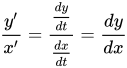
So, for the example in section 1, the slope at any time :
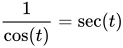
In order to find a vertical tangent line, set the horizontal change, or , equal to 0 and solve.
In order to find a horizontal tangent line, set the vertical change, or , equal to 0 and solve.

If there is a time when both are 0, that point is called a singular point.

Concavity of Parametric Equations
Solving for the second derivative of a parametric equation can be more complex than it may seem at first glance.
When you have take the derivative of in terms of , you are left with Failed to parse (MathML with SVG or PNG fallback (recommended for modern browsers and accessibility tools): Invalid response ("Math extension cannot connect to Restbase.") from server "https://wikimedia.org/api/rest_v1/":): {\displaystyle \frac{\frac{d^2y}{dx}}{dt}} :
Failed to parse (MathML with SVG or PNG fallback (recommended for modern browsers and accessibility tools): Invalid response ("Math extension cannot connect to Restbase.") from server "https://wikimedia.org/api/rest_v1/":): {\displaystyle \frac{d}{dt}\left[\frac{dy}{dx}\right]=\frac{\frac{d^2y}{dx}}{dt}} .
By multiplying this expression by Failed to parse (MathML with SVG or PNG fallback (recommended for modern browsers and accessibility tools): Invalid response ("Math extension cannot connect to Restbase.") from server "https://wikimedia.org/api/rest_v1/":): {\displaystyle \frac{dt}{dx}} , we are able to solve for the second derivative of the parametric equation:
Failed to parse (MathML with SVG or PNG fallback (recommended for modern browsers and accessibility tools): Invalid response ("Math extension cannot connect to Restbase.") from server "https://wikimedia.org/api/rest_v1/":): {\displaystyle \frac{\frac{d^2y}{dx}}{dt}\times\frac{dt}{dx}=\frac{d^2y}{dx^2}} .
Thus, the concavity of a parametric equation can be described as:
Failed to parse (MathML with SVG or PNG fallback (recommended for modern browsers and accessibility tools): Invalid response ("Math extension cannot connect to Restbase.") from server "https://wikimedia.org/api/rest_v1/":): {\displaystyle \frac{d}{dt}\left[\frac{dy}{dx}\right]\times\frac{dt}{dx}}
So for the example in sections 1 and 2, the concavity at any time Failed to parse (MathML with SVG or PNG fallback (recommended for modern browsers and accessibility tools): Invalid response ("Math extension cannot connect to Restbase.") from server "https://wikimedia.org/api/rest_v1/":): {\displaystyle t} :
Failed to parse (MathML with SVG or PNG fallback (recommended for modern browsers and accessibility tools): Invalid response ("Math extension cannot connect to Restbase.") from server "https://wikimedia.org/api/rest_v1/":): {\displaystyle \frac{d}{dt}[\csc(t)]\times\cos(t)=-\csc^2(t)\times\cos(t)}
Parametric Integration
Because most parametric equations are given in explicit form, they can be integrated like many other equations. Integration has a variety of applications with respect to parametric equations, especially in kinematics and vector calculus.
- Failed to parse (MathML with SVG or PNG fallback (recommended for modern browsers and accessibility tools): Invalid response ("Math extension cannot connect to Restbase.") from server "https://wikimedia.org/api/rest_v1/":): {\displaystyle \begin{align}x&=\int x'(t)\mathrm{d}t\\y&=\int y'(t)\mathrm{d}t\end{align}}
So, taking a simple example, with respect to t:
- Failed to parse (MathML with SVG or PNG fallback (recommended for modern browsers and accessibility tools): Invalid response ("Math extension cannot connect to Restbase.") from server "https://wikimedia.org/api/rest_v1/":): {\displaystyle y=\int\cos(t)\mathrm{d}t=\sin(t) + C}
Arc length
Consider a function defined by,
- Failed to parse (MathML with SVG or PNG fallback (recommended for modern browsers and accessibility tools): Invalid response ("Math extension cannot connect to Restbase.") from server "https://wikimedia.org/api/rest_v1/":): {\displaystyle x = f(t)}
- Failed to parse (MathML with SVG or PNG fallback (recommended for modern browsers and accessibility tools): Invalid response ("Math extension cannot connect to Restbase.") from server "https://wikimedia.org/api/rest_v1/":): {\displaystyle y = g(t)}
Say that Failed to parse (MathML with SVG or PNG fallback (recommended for modern browsers and accessibility tools): Invalid response ("Math extension cannot connect to Restbase.") from server "https://wikimedia.org/api/rest_v1/":): {\displaystyle f} is increasing on some interval, Failed to parse (MathML with SVG or PNG fallback (recommended for modern browsers and accessibility tools): Invalid response ("Math extension cannot connect to Restbase.") from server "https://wikimedia.org/api/rest_v1/":): {\displaystyle [\alpha, \beta]} . Recall, as we have derived in a previous chapter, that the length of the arc created by a function over an interval, Failed to parse (MathML with SVG or PNG fallback (recommended for modern browsers and accessibility tools): Invalid response ("Math extension cannot connect to Restbase.") from server "https://wikimedia.org/api/rest_v1/":): {\displaystyle [\alpha, \beta]} , is given by,
- Failed to parse (MathML with SVG or PNG fallback (recommended for modern browsers and accessibility tools): Invalid response ("Math extension cannot connect to Restbase.") from server "https://wikimedia.org/api/rest_v1/":): {\displaystyle L = \int_\alpha^\beta \sqrt{1 + (f'(x))^2} \mathrm{d}x}
It may assist your understanding, here, to write the above using Leibniz's notation,
- Failed to parse (MathML with SVG or PNG fallback (recommended for modern browsers and accessibility tools): Invalid response ("Math extension cannot connect to Restbase.") from server "https://wikimedia.org/api/rest_v1/":): {\displaystyle L = \int_\alpha^\beta \sqrt{1 + \left(\frac{\mathrm{d}y}{\mathrm{d}x}\right)^2} \mathrm{d}x}
Using the chain rule,
- Failed to parse (MathML with SVG or PNG fallback (recommended for modern browsers and accessibility tools): Invalid response ("Math extension cannot connect to Restbase.") from server "https://wikimedia.org/api/rest_v1/":): {\displaystyle \frac{\mathrm{d}y}{\mathrm{d}x} = \frac{\mathrm{d}y}{\mathrm{d}t} \cdot \frac{\mathrm{d}t}{\mathrm{d}x}}
We may then rewrite Failed to parse (MathML with SVG or PNG fallback (recommended for modern browsers and accessibility tools): Invalid response ("Math extension cannot connect to Restbase.") from server "https://wikimedia.org/api/rest_v1/":): {\displaystyle \mathrm{d}x} ,
- Failed to parse (MathML with SVG or PNG fallback (recommended for modern browsers and accessibility tools): Invalid response ("Math extension cannot connect to Restbase.") from server "https://wikimedia.org/api/rest_v1/":): {\displaystyle \frac{\mathrm{d}x}{\mathrm{d}t} \mathrm{d}t}
Hence, Failed to parse (MathML with SVG or PNG fallback (recommended for modern browsers and accessibility tools): Invalid response ("Math extension cannot connect to Restbase.") from server "https://wikimedia.org/api/rest_v1/":): {\displaystyle L} becomes,
- Failed to parse (MathML with SVG or PNG fallback (recommended for modern browsers and accessibility tools): Invalid response ("Math extension cannot connect to Restbase.") from server "https://wikimedia.org/api/rest_v1/":): {\displaystyle L = \int_\alpha^\beta \sqrt{1 + \left(\frac{\mathrm{d}y}{\mathrm{d}t} \cdot \frac{\mathrm{d}t}{\mathrm{d}x}\right)^2} \frac{\mathrm{d}x}{\mathrm{d}t} \mathrm{d}t}
Extracting a factor of Failed to parse (MathML with SVG or PNG fallback (recommended for modern browsers and accessibility tools): Invalid response ("Math extension cannot connect to Restbase.") from server "https://wikimedia.org/api/rest_v1/":): {\displaystyle \left(\frac{\mathrm{d}t}{\mathrm{d}x}\right)^2} ,
- Failed to parse (MathML with SVG or PNG fallback (recommended for modern browsers and accessibility tools): Invalid response ("Math extension cannot connect to Restbase.") from server "https://wikimedia.org/api/rest_v1/":): {\displaystyle L = \int_\alpha^\beta \sqrt{\left(\frac{\mathrm{d}t}{\mathrm{d}x}\right)^2}\sqrt{\left(\frac{\mathrm{d}x}{\mathrm{d}t}\right)^2 + \left(\frac{\mathrm{d}y}{\mathrm{d}t}\right)^2} \frac{\mathrm{d}x}{\mathrm{d}t} \mathrm{d}t}
As Failed to parse (MathML with SVG or PNG fallback (recommended for modern browsers and accessibility tools): Invalid response ("Math extension cannot connect to Restbase.") from server "https://wikimedia.org/api/rest_v1/":): {\displaystyle f} is increasing on Failed to parse (MathML with SVG or PNG fallback (recommended for modern browsers and accessibility tools): Invalid response ("Math extension cannot connect to Restbase.") from server "https://wikimedia.org/api/rest_v1/":): {\displaystyle [\alpha,\beta]} , Failed to parse (MathML with SVG or PNG fallback (recommended for modern browsers and accessibility tools): Invalid response ("Math extension cannot connect to Restbase.") from server "https://wikimedia.org/api/rest_v1/":): {\displaystyle \sqrt{\left(\frac{\mathrm{d}t}{\mathrm{d}x}\right)^2} = \frac{\mathrm{d}t}{\mathrm{d}x}} , and hence we may write our final expression for as,

- Failed to parse (MathML with SVG or PNG fallback (recommended for modern browsers and accessibility tools): Invalid response ("Math extension cannot connect to Restbase.") from server "https://wikimedia.org/api/rest_v1/":): {\displaystyle \int_\alpha^\beta \sqrt{\left(\frac{\mathrm{d}x}{\mathrm{d}t}\right)^2 + \left(\frac{\mathrm{d}y}{\mathrm{d}t}\right)^2} \mathrm{d}t}
Example
Take a circle of radius Failed to parse (MathML with SVG or PNG fallback (recommended for modern browsers and accessibility tools): Invalid response ("Math extension cannot connect to Restbase.") from server "https://wikimedia.org/api/rest_v1/":): {\displaystyle R} , which may be defined with the parametric equations,
- Failed to parse (MathML with SVG or PNG fallback (recommended for modern browsers and accessibility tools): Invalid response ("Math extension cannot connect to Restbase.") from server "https://wikimedia.org/api/rest_v1/":): {\displaystyle x = R\sin\theta}
- Failed to parse (MathML with SVG or PNG fallback (recommended for modern browsers and accessibility tools): Invalid response ("Math extension cannot connect to Restbase.") from server "https://wikimedia.org/api/rest_v1/":): {\displaystyle y = R\cos\theta}
As an example, we can take the length of the arc created by the curve over the interval Failed to parse (MathML with SVG or PNG fallback (recommended for modern browsers and accessibility tools): Invalid response ("Math extension cannot connect to Restbase.") from server "https://wikimedia.org/api/rest_v1/":): {\displaystyle [0,R]} . Writing in terms of Failed to parse (MathML with SVG or PNG fallback (recommended for modern browsers and accessibility tools): Invalid response ("Math extension cannot connect to Restbase.") from server "https://wikimedia.org/api/rest_v1/":): {\displaystyle \theta} ,
- Failed to parse (MathML with SVG or PNG fallback (recommended for modern browsers and accessibility tools): Invalid response ("Math extension cannot connect to Restbase.") from server "https://wikimedia.org/api/rest_v1/":): {\displaystyle x = 0 \implies \theta = \arcsin\left(\frac{0}{R}\right) = 0}
- Failed to parse (MathML with SVG or PNG fallback (recommended for modern browsers and accessibility tools): Invalid response ("Math extension cannot connect to Restbase.") from server "https://wikimedia.org/api/rest_v1/":): {\displaystyle x = R \implies \theta = \arcsin\left(\frac{R}{R}\right) = \arcsin(1) = \frac{\pi}{2}}
Computing the derivatives of both equations,
- Failed to parse (MathML with SVG or PNG fallback (recommended for modern browsers and accessibility tools): Invalid response ("Math extension cannot connect to Restbase.") from server "https://wikimedia.org/api/rest_v1/":): {\displaystyle \frac{\mathrm{d}x}{\mathrm{d}\theta} = R\cos\theta}
- Failed to parse (MathML with SVG or PNG fallback (recommended for modern browsers and accessibility tools): Invalid response ("Math extension cannot connect to Restbase.") from server "https://wikimedia.org/api/rest_v1/":): {\displaystyle \frac{\mathrm{d}y}{\mathrm{d}\theta} = -R\sin\theta}
Which means that the arc length is given by,
- Failed to parse (MathML with SVG or PNG fallback (recommended for modern browsers and accessibility tools): Invalid response ("Math extension cannot connect to Restbase.") from server "https://wikimedia.org/api/rest_v1/":): {\displaystyle L = \int_0^{\frac{\pi}{2}} \sqrt{(-R\sin\theta)^2 + R^2\cos^2\theta}\mathrm{d}\theta}
By the Pythagorean identity,
- Failed to parse (MathML with SVG or PNG fallback (recommended for modern browsers and accessibility tools): Invalid response ("Math extension cannot connect to Restbase.") from server "https://wikimedia.org/api/rest_v1/":): {\displaystyle L = R\int_0^{\frac{\pi}{2}} \mathrm{d}\theta = R\frac{\pi}{2}}
One can use this result to determine the perimeter of a circle of a given radius. As this is the arc length over one "quadrant", one may multiply Failed to parse (MathML with SVG or PNG fallback (recommended for modern browsers and accessibility tools): Invalid response ("Math extension cannot connect to Restbase.") from server "https://wikimedia.org/api/rest_v1/":): {\displaystyle L} by 4 to deduce the perimeter of a circle of radius Failed to parse (MathML with SVG or PNG fallback (recommended for modern browsers and accessibility tools): Invalid response ("Math extension cannot connect to Restbase.") from server "https://wikimedia.org/api/rest_v1/":): {\displaystyle R} to be Failed to parse (MathML with SVG or PNG fallback (recommended for modern browsers and accessibility tools): Invalid response ("Math extension cannot connect to Restbase.") from server "https://wikimedia.org/api/rest_v1/":): {\displaystyle 2\pi R} .
Resources
Derivatives of Parametric Equations
- The Derivatvie of Parametric Equations by James Sousa, Math is Power 4U
- Derivatives of Parametric Equations, Example 1 by James Sousa, Math is Power 4U
- Derivatives of Parametric Equations, Example 2 by James Sousa, Math is Power 4U
- Equation of a Tangent Line to a Parametric Curve, Example 1 by James Sousa, Math is Power 4U
- Equation of a Tangent Line to a Parametric Curve, Example 2 by James Sousa, Math is Power 4U
- Equation of a Tangent Line to a Parametric Curve, Example 3 by James Sousa, Math is Power 4U
- Determine the Points Where the Tangent Lines are Horizontal or Vertical by James Sousa, Math is Power 4U
- The Second Derivative of Parametric Equations, Part 1 by James Sousa, Math is Power 4U
- The Second Derivative of Parametric Equations, Part 2 by James Sousa, Math is Power 4U
- The First and Second Derivative of Parametric Equations, Example 1 by James Sousa, Math is Power 4U
- The First and Second Derivative of Parametric Equations, Example 2 by James Sousa, Math is Power 4U
- Derivatives of Parametric Equations by Patrick JMT
- Derivatives of Parametric Equations, Example 1 by Patrick JMT
- Derivatives of Parametric Equations, Example 2 by Patrick JMT
- The Second Derivative of Parametric Curves by Patrick JMT
- The Derivative of a Parametric Curve by Krista King
- Tangent Line to a Parametric Curve by Krista King
- The Second Derivative of a Parametric Curve by Krista King
- Derivatives of Parametric Equations by The Organic Chemistry Tutor
- Tangent Lines of Parametric Curves by The Organic Chemistry Tutor
- Horizontal and Vertical Tangent Lines of Parametric Curves by The Organic Chemistry Tutor
- The Second Derivative of Parametric Equations by The Organic Chemistry Tutor
Area Under Parametric Curves
- Area Under Parametric Curves by James Sousa, Math is Power 4U
- Area Under a Parametric Curve by Patrick JMT
- Area Under Parametric Curves by The Organic Chemistry Tutor
Arc Length of Parametric Curves
- Arc Length in Parametric Form by James Sousa, Math is Power 4U
- Find the Arc Length of a Parametric Curve, Example 1 by James Sousa, Math is Power 4U
- Find the Arc Length of a Parametric Curve, Example 2 by James Sousa, Math is Power 4U
- Find the Arc Length of a Loop of a Parametric Curve by James Sousa, Math is Power 4U
- Arc Length of a Parametric Curve by Patrick JMT
- Arc Length of a Parametric Curve by Krista King
- Arc Length of a Parametric Curve by Krista King
- Arc Length of Parametric Curves by The Organic Chemistry Tutor
Surface Area of Revolution in Parametric Form
- Surface Area of Revolution in Parametric Form by James Sousa, Math is Power 4U
- Surface Area of Revolution in Parametric Form, Example 1 (y-axis) by James Sousa, Math is Power 4U
- Surface Area of Revolution in Parametric Form, Example 2 (x-axis) by James Sousa, Math is Power 4U
- Surface Area of Revolution in Parametric Form by Krista King
- Surface Area of Revolution of a Parametric Curve Rotated About the y-Axis by Krista King
- Surface Area of Revolution in Parametric Form by The Organic Chemistry Tutor

