Properties of Polygons (Sides, Angles and Diagonals)
Angles
Any polygon has as many corners as it has sides. Each corner has several angles. The two most important ones are:
- Interior angle – The sum of the interior angles of a simple n-gon is (n − 2)π radians or (n − 2) × 180 degrees. This is because any simple n-gon ( having n sides ) can be considered to be made up of (n − 2) triangles, each of which has an angle sum of π radians or 180 degrees. The measure of any interior angle of a convex regular n-gon is Failed to parse (MathML with SVG or PNG fallback (recommended for modern browsers and accessibility tools): Invalid response ("Math extension cannot connect to Restbase.") from server "https://wikimedia.org/api/rest_v1/":): {\displaystyle \left(1-\tfrac {2}{n}\right)\pi} radians or Failed to parse (MathML with SVG or PNG fallback (recommended for modern browsers and accessibility tools): Invalid response ("Math extension cannot connect to Restbase.") from server "https://wikimedia.org/api/rest_v1/":): {\displaystyle 180-\tfrac {360}{n}} degrees. The interior angles of regular star polygons were first studied by Poinsot, in the same paper in which he describes the four regular star polyhedra: for a regular Failed to parse (MathML with SVG or PNG fallback (recommended for modern browsers and accessibility tools): Invalid response ("Math extension cannot connect to Restbase.") from server "https://wikimedia.org/api/rest_v1/":): {\displaystyle \tfrac {p}{q}} -gon (a p-gon with central density q), each interior angle is Failed to parse (MathML with SVG or PNG fallback (recommended for modern browsers and accessibility tools): Invalid response ("Math extension cannot connect to Restbase.") from server "https://wikimedia.org/api/rest_v1/":): {\displaystyle \tfrac {\pi (p-2q)}{p}} radians or Failed to parse (MathML with SVG or PNG fallback (recommended for modern browsers and accessibility tools): Invalid response ("Math extension cannot connect to Restbase.") from server "https://wikimedia.org/api/rest_v1/":): {\displaystyle \tfrac {180(p-2q)}{p}} degrees.
- Exterior angle – The exterior angle is the supplementary angle to the interior angle. Tracing around a convex n-gon, the angle "turned" at a corner is the exterior or external angle. Tracing all the way around the polygon makes one full turn, so the sum of the exterior angles must be 360°. This argument can be generalized to concave simple polygons, if external angles that turn in the opposite direction are subtracted from the total turned. Tracing around an n-gon in general, the sum of the exterior angles (the total amount one rotates at the vertices) can be any integer multiple d of 360°, e.g. 720° for a pentagram and 0° for an angular "eight" or antiparallelogram, where d is the density or turning number of the polygon. See also orbit (dynamics).
Area
In this section, the vertices of the polygon under consideration are taken to be Failed to parse (MathML with SVG or PNG fallback (recommended for modern browsers and accessibility tools): Invalid response ("Math extension cannot connect to Restbase.") from server "https://wikimedia.org/api/rest_v1/":): {\displaystyle (x_{0},y_{0}),(x_{1},y_{1}),\ldots ,(x_{n-1},y_{n-1})} in order. For convenience in some formulas, the notation Failed to parse (MathML with SVG or PNG fallback (recommended for modern browsers and accessibility tools): Invalid response ("Math extension cannot connect to Restbase.") from server "https://wikimedia.org/api/rest_v1/":): {\displaystyle (x_n, y_n) = (x_0, y_0)} will also be used.
If the polygon is non-self-intersecting (that is, simple), the signed area is
Failed to parse (MathML with SVG or PNG fallback (recommended for modern browsers and accessibility tools): Invalid response ("Math extension cannot connect to Restbase.") from server "https://wikimedia.org/api/rest_v1/":): {\displaystyle A=\frac {1}{2}\sum_{i=0}^{n-1} (x_{i}y_{i+1}-x_{i+1}y_{i}) \quad \text{where } x_{n}=x_{0} \quad \text{and} \quad y_{n}=y_{0}} ,
or, using determinants
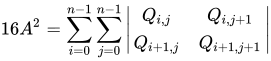
Failed to parse (MathML with SVG or PNG fallback (recommended for modern browsers and accessibility tools): Invalid response ("Math extension cannot connect to Restbase.") from server "https://wikimedia.org/api/rest_v1/":): {\displaystyle 16A^{2}=\sum_{i=0}^{n-1} \sum _{j=0}^{n-1} \begin{vmatrix}Q_{i,j}&Q_{i,j+1}\\Q_{i+1,j}&Q_{i+1,j+1}\end{vmatrix}} ,
where Failed to parse (MathML with SVG or PNG fallback (recommended for modern browsers and accessibility tools): Invalid response ("Math extension cannot connect to Restbase.") from server "https://wikimedia.org/api/rest_v1/":): {\displaystyle Q_{i,j}} is the squared distance between Failed to parse (MathML with SVG or PNG fallback (recommended for modern browsers and accessibility tools): Invalid response ("Math extension cannot connect to Restbase.") from server "https://wikimedia.org/api/rest_v1/":): {\displaystyle (x_{i},y_{i}) } and Failed to parse (MathML with SVG or PNG fallback (recommended for modern browsers and accessibility tools): Invalid response ("Math extension cannot connect to Restbase.") from server "https://wikimedia.org/api/rest_v1/":): {\displaystyle (x_{j},y_{j})} .
The signed area depends on the ordering of the vertices and of the orientation of the plane. Commonly, the positive orientation is defined by the (counterclockwise) rotation that maps the positive x-axis to the positive y-axis. If the vertices are ordered counterclockwise (that is, according to positive orientation), the signed area is positive; otherwise, it is negative. In either case, the area formula is correct in absolute value. This is commonly called the shoelace formula or Surveyor's formula.
The area A of a simple polygon can also be computed if the lengths of the sides, a1, a2, ..., an and the exterior angles, θ1, θ2, ..., θn are known, from:
Failed to parse (MathML with SVG or PNG fallback (recommended for modern browsers and accessibility tools): Invalid response ("Math extension cannot connect to Restbase.") from server "https://wikimedia.org/api/rest_v1/":): {\displaystyle \begin{aligned}A={\frac {1}{2}}(a_{1}[a_{2}\sin(\theta _{1})+a_{3}\sin(\theta _{1}+\theta _{2})+\cdots +a_{n-1}\sin(\theta _{1}+\theta _{2}+\cdots +\theta _{n-2})]\\{}+a_{2}[a_{3}\sin(\theta _{2})+a_{4}\sin(\theta _{2}+\theta _{3})+\cdots +a_{n-1}\sin(\theta _{2}+\cdots +\theta _{n-2})]\\{}+\cdots +a_{n-2}[a_{n-1}\sin(\theta _{n-2})])\end{aligned} } .
The formula was described by Lopshits in 1963.
If the polygon can be drawn on an equally spaced grid such that all its vertices are grid points, Pick's theorem gives a simple formula for the polygon's area based on the numbers of interior and boundary grid points: the former number plus one-half the latter number, minus 1.
In every polygon with perimeter p and area A , the isoperimetric inequality Failed to parse (MathML with SVG or PNG fallback (recommended for modern browsers and accessibility tools): Invalid response ("Math extension cannot connect to Restbase.") from server "https://wikimedia.org/api/rest_v1/":): {\displaystyle p^{2}> 4 \pi A } holds.
For any two simple polygons of equal area, the Bolyai–Gerwien theorem asserts that the first can be cut into polygonal pieces which can be reassembled to form the second polygon.
The lengths of the sides of a polygon do not in general determine its area. However, if the polygon is simple and cyclic then the sides do determine the area. Of all n-gons with given side lengths, the one with the largest area is cyclic. Of all n-gons with a given perimeter, the one with the largest area is regular (and therefore cyclic).
Regular polygons
Many specialized formulas apply to the areas of regular polygons.
The area of a regular polygon is given in terms of the radius r of its inscribed circle and its perimeter p by
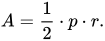
Failed to parse (MathML with SVG or PNG fallback (recommended for modern browsers and accessibility tools): Invalid response ("Math extension cannot connect to Restbase.") from server "https://wikimedia.org/api/rest_v1/":): {\displaystyle A=\frac {1}{2}\cdot p\cdot r.}
This radius is also termed its apothem and is often represented as a.
The area of a regular n-gon in terms of the radius R of its circumscribed circle can be expressed trigonometrically as:

Failed to parse (MathML with SVG or PNG fallback (recommended for modern browsers and accessibility tools): Invalid response ("Math extension cannot connect to Restbase.") from server "https://wikimedia.org/api/rest_v1/":): {\displaystyle A=R^{2}\cdot {\frac {n}{2}}\cdot \sin {\frac {2\pi }{n}}=R^{2}\cdot n\cdot \sin {\frac {\pi }{n}}\cdot \cos {\frac {\pi }{n}}}
The area of a regular n-gon inscribed in a unit-radius circle, with side s and interior angle Failed to parse (MathML with SVG or PNG fallback (recommended for modern browsers and accessibility tools): Invalid response ("Math extension cannot connect to Restbase.") from server "https://wikimedia.org/api/rest_v1/":): {\displaystyle \alpha } , can also be expressed trigonometrically as:
Failed to parse (MathML with SVG or PNG fallback (recommended for modern browsers and accessibility tools): Invalid response ("Math extension cannot connect to Restbase.") from server "https://wikimedia.org/api/rest_v1/":): {\displaystyle A={\frac {ns^{2}}{4}}\cot {\frac {\pi }{n}}={\frac {ns^{2}}{4}}\cot {\frac {\alpha }{n-2}}=n\cdot \sin {\frac {\alpha }{n-2}}\cdot \cos {\frac {\alpha }{n-2}}.}
Self-intersecting
The area of a self-intersecting polygon can be defined in two different ways, giving different answers:
- Using the formulas for simple polygons, we allow that particular regions within the polygon may have their area multiplied by a factor which we call the density of the region. For example, the central convex pentagon in the center of a pentagram has density 2. The two triangular regions of a cross-quadrilateral (like a figure 8) have opposite-signed densities, and adding their areas together can give a total area of zero for the whole figure.
- Considering the enclosed regions as point sets, we can find the area of the enclosed point set. This corresponds to the area of the plane covered by the polygon or to the area of one or more simple polygons having the same outline as the self-intersecting one. In the case of the cross-quadrilateral, it is treated as two simple triangles.
Centroid
Using the same convention for vertex coordinates as in the previous section, the coordinates of the centroid of a solid simple polygon are
Failed to parse (MathML with SVG or PNG fallback (recommended for modern browsers and accessibility tools): Invalid response ("Math extension cannot connect to Restbase.") from server "https://wikimedia.org/api/rest_v1/":): {\displaystyle C_{x}= \frac {1}{6A} \sum _{i=0}^{n-1}(x_{i}+x_{i+1})(x_{i}y_{i+1}-x_{i+1}y_{i})} ,
Failed to parse (MathML with SVG or PNG fallback (recommended for modern browsers and accessibility tools): Invalid response ("Math extension cannot connect to Restbase.") from server "https://wikimedia.org/api/rest_v1/":): {\displaystyle C_{y}= \frac {1}{6A} \sum _{i=0}^{n-1}(y_{i}+y_{i+1})(x_{i}y_{i+1}-x_{i+1}y_{i})} .
In these formulas, the signed value of area A must be used.
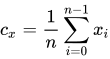
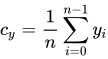
For triangles (n = 3), the centroids of the vertices and of the solid shape are the same, but, in general, this is not true for n > 3. The centroid of the vertex set of a polygon with n vertices has the coordinates
Failed to parse (MathML with SVG or PNG fallback (recommended for modern browsers and accessibility tools): Invalid response ("Math extension cannot connect to Restbase.") from server "https://wikimedia.org/api/rest_v1/":): {\displaystyle c_{x}=\frac {1}{n} \sum _{i=0}^{n-1}x_{i}} ,
Failed to parse (MathML with SVG or PNG fallback (recommended for modern browsers and accessibility tools): Invalid response ("Math extension cannot connect to Restbase.") from server "https://wikimedia.org/api/rest_v1/":): {\displaystyle c_{y}=\frac {1}{n} \sum _{i=0}^{n-1}y_{i}} .
Licensing
Content obtained and/or adapted from:
- Polygon, Wikipedia under a CC BY-SA license