Difference between revisions of "Partial Derivatives and Integrals"
| Line 1: | Line 1: | ||
| − | + | ==Partial Derivatives of Functions from Rn to Rm== | |
<p>One of the core concepts of multivariable calculus involves the various differentiations of functions from <span class="math-inline"><math>\mathbb{R}^n</math></span> to <span class="math-inline"><math>\mathbb{R}^m</math></span>. We begin by defining the concept of a partial derivative of such functions.</p> | <p>One of the core concepts of multivariable calculus involves the various differentiations of functions from <span class="math-inline"><math>\mathbb{R}^n</math></span> to <span class="math-inline"><math>\mathbb{R}^m</math></span>. We begin by defining the concept of a partial derivative of such functions.</p> | ||
<blockquote style="background: white; border: 1px solid black; padding: 1em;"> | <blockquote style="background: white; border: 1px solid black; padding: 1em;"> | ||
| Line 25: | Line 25: | ||
<div style="text-align: center;"><math>\begin{align} \quad D_1 \mathbf{f}(\mathbf{c}) &= \lim_{h \to 0} \frac{\mathbf{f}(\mathbf{c} + h(1, 0)) - \mathbf{f}(\mathbf{c})}{h} \\ &= \lim_{h \to 0} \frac{(f_1((c_1, c_2)+ h(1, 0)), f_2((c_1, c_2)+ h(1, 0))) - (f_1(\mathbf{c}), f_2(c_1, c_2)))}{h} \\ &= \lim_{h \to 0} \frac{f_1(c_1 + h, c_2), f_2(c_1 + h, c_2)) - (f_1(c_1, c_2), f_2(c_1, c_2))}{h} \\ &= \lim_{h \to 0} \frac{(f_1(c_1 + h, c_2) - f_1(c_1, c_2), f_2(c_1 + h, c_2) - f_2(c_1, c_2))}{h} \\ &= \lim_{h \to 0} \frac{((c_1 + h)^2 + c_2^2 - [c_1^2 + c_2^2], 2(c_1 + h)(c_2) - 2c_1c_2)}{h} \\ &= \lim_{h \to 0} \frac{(c_1^2 + 2c_1h + h^2) + c_2^2 - c_1^2 - c_2^2, 2c_1c_2 + 2c_2h - 2c_1c_2)}{h} \\ &= \lim_{h \to 0} \frac{(2c_1h + h^2, 2c_2h)}{h} \\ &= \left ( \lim_{h \to 0} \frac{2c_1h + h^2}{h}, \lim_{h \to 0} \frac{2c_2h}{h} \right ) \\ &= \left ( \lim_{h \to 0} [2c_1 + h], \lim_{h \to 0} 2c_2 \right ) \\ &= (2c_1, 2c_2) \end{align}</math></div> | <div style="text-align: center;"><math>\begin{align} \quad D_1 \mathbf{f}(\mathbf{c}) &= \lim_{h \to 0} \frac{\mathbf{f}(\mathbf{c} + h(1, 0)) - \mathbf{f}(\mathbf{c})}{h} \\ &= \lim_{h \to 0} \frac{(f_1((c_1, c_2)+ h(1, 0)), f_2((c_1, c_2)+ h(1, 0))) - (f_1(\mathbf{c}), f_2(c_1, c_2)))}{h} \\ &= \lim_{h \to 0} \frac{f_1(c_1 + h, c_2), f_2(c_1 + h, c_2)) - (f_1(c_1, c_2), f_2(c_1, c_2))}{h} \\ &= \lim_{h \to 0} \frac{(f_1(c_1 + h, c_2) - f_1(c_1, c_2), f_2(c_1 + h, c_2) - f_2(c_1, c_2))}{h} \\ &= \lim_{h \to 0} \frac{((c_1 + h)^2 + c_2^2 - [c_1^2 + c_2^2], 2(c_1 + h)(c_2) - 2c_1c_2)}{h} \\ &= \lim_{h \to 0} \frac{(c_1^2 + 2c_1h + h^2) + c_2^2 - c_1^2 - c_2^2, 2c_1c_2 + 2c_2h - 2c_1c_2)}{h} \\ &= \lim_{h \to 0} \frac{(2c_1h + h^2, 2c_2h)}{h} \\ &= \left ( \lim_{h \to 0} \frac{2c_1h + h^2}{h}, \lim_{h \to 0} \frac{2c_2h}{h} \right ) \\ &= \left ( \lim_{h \to 0} [2c_1 + h], \lim_{h \to 0} 2c_2 \right ) \\ &= (2c_1, 2c_2) \end{align}</math></div> | ||
<p>So the partial derivative of <span class="math-inline"><math>\mathbf{f}</math></span> with respect to the first variable at say <span class="math-inline"><math>(1, 2)</math></span> is <span class="math-inline"><math>D_1 \mathbf{f}(1, 2) = (2, 4)</math></span>.</p> | <p>So the partial derivative of <span class="math-inline"><math>\mathbf{f}</math></span> with respect to the first variable at say <span class="math-inline"><math>(1, 2)</math></span> is <span class="math-inline"><math>D_1 \mathbf{f}(1, 2) = (2, 4)</math></span>.</p> | ||
| + | |||
| + | == The Riemann Integral== | ||
| + | Let <math>f</math> be a bounded function defined on the closed and bounded interval <math>[a, b]</math>. Let <math>P = \{ a = x_0, x_1, ..., x_n = b \}</math> be a partition of <math>[a, b]</math> with: | ||
| + | |||
| + | <div style="text-align: center;"><math>\begin{align} \quad a = x_0 < x_1 < ... < x_n = b \end{align}</math></div> | ||
| + | |||
| + | Let <math>\mathcal P[a, b]</math> denote the set of all partitions on <math>[a, b]</math>. For each <math>i \in \{ 1, 2, ..., n \}</math> we define: | ||
| + | |||
| + | <div style="text-align: center;"><math>\begin{align} \quad M_i & = \sup \{ f(x) : x \in [x_{i-1}, x_i] \} \\ \quad m_i & = \inf \{ f(x) : x \in [x_{i-1}, x_i] \} \end{align}</math></div> | ||
| + | |||
| + | With the notation above we can define the upper and lower Riemann sums associated with the partition <math>P</math> for the function <math>f</math>. | ||
| + | |||
| + | <blockquote style="background: white; border: 1px solid black; padding: 1em;"> | ||
| + | :'''Definition:''' Let <math>f</math> be a bounded function on the closed and bounded interval <math>[a, b]</math> and let <math>P \in \mathcal \wp [a, b]</math>. The '''Upper Riemann Sum Associated with the Partition <math>P</math> for <math>f</math>''' is <math>\displaystyle{U(P, f) = \sum_{i=1}^{n} M_i \Delta x_i}</math>. The '''Lower Riemann Sum Associated with the Partition <math>P</math> for <math>f</math>''' is <math>\displaystyle{L(P, f) = \sum_{i=1}^{n} m_i \Delta x_i}</math>.</td> | ||
| + | </blockquote> | ||
| + | |||
| + | It can be shown that for any partitions <math>P_1, P_2 \in \mathcal \wp [a, b]</math> with <math>P_1 \subseteq P_2</math> we have that: | ||
| + | |||
| + | <div style="text-align: center;"><math>\begin{align} \quad U(P_2, f) \leq U(P_1, f) \quad \mathrm{and} \quad L(P_1, f) \leq L(P_2, f) \end{align}</math></div> | ||
| + | |||
| + | So as we consider partitions that are finer and finer, <math>U(P, f)</math> decreases and <math>L(P, f)</math> increases. It can also be shown that for any partitions <math>P, P' \in \wp [a, b]</math>: | ||
| + | |||
| + | <div style="text-align: center;"><math>\begin{align} \quad L(P, f) \leq U(P', f) \end{align}</math></div> | ||
| + | |||
| + | That is, the set of all upper Riemann sums is bounded below by any lower Riemann sum, and the set of all lower Riemann sums is bounded above by any upper Riemann sum. We now define the upper and lower Riemann integrals of a bounded function <math>f</math> on <math>[a, b]</math>. | ||
| + | |||
| + | <blockquote style="background: white; border: 1px solid black; padding: 1em;"> | ||
| + | :'''Definition:''' Let <math>f</math> be a bounded function on the closed and bounded interval <math>[a, b]</math>. The '''Upper Riemann Integral of <math>f</math>''' is defined to be | ||
| + | :<math> (R) \overline \int_{a}^{b} f(x) \, dx = \inf \{ U(P, f) : P \in \wp [a, b] \} </math> and the '''Lower Riemann Integral of <math>f</math>''' is defined to be | ||
| + | :<math>(R) \underline \int_{a}^{b} f(x) \, dx = \sup \{ L(P, f) : P \in \wp [a, b] \}</math>. | ||
| + | </blockquote> | ||
| + | |||
| + | Another way t o define the upper and lower Riemann integrals of <math>f</math> is through step functions. If <math>\varphi</math> is a step function defined on <math>[a, b]</math> then it is easy to show that the upper and lower Riemann integrals of <math>\varphi</math> exist and define the upper and lower Riemann integrals of <math>f</math> to also be: | ||
| + | |||
| + | <div style="text-align: center;"><math> \begin{align} \quad (R) \overline \int_{a}^{b} f(x) \, dx = \inf \left \{ (R) \int_{a}^{b} \psi(x) \, dx : \psi \text{is a step function}, f(x) \leq \psi (x) \text{on} [a, b] \right \} \end{align}</math></div> | ||
| + | |||
| + | <div style="text-align: center;"><math>\begin{align} \quad (R) \underline \int_{a}^{b} f(x) \, dx = \sup \left \{ (R) \int_{a}^{b} \varphi(x) \, dx : \varphi \text{is a step function}, \varphi(x) \leq f(x) \text{on} [a, b] \right \} \end{align}</math></div> | ||
| + | |||
| + | We are finally able to define what it means for a bounded function <math>f</math> defined on a closed and bounded interval <math>[a,b]</math> to be Riemann integrable. | ||
| + | |||
| + | <blockquote style="background: white; border: 1px solid black; padding: 1em;"> | ||
| + | :'''Definition:''' Let <math>f</math> be a bounded function on the closed and bounded interval <math>[a, b]</math>. Then <math>f</math> is said to be '''Riemann Integrable''' on <math>[a, b]</math> denoted <math>f \in R[a, b]</math> if <math>(R) \overline \int_{a}^{b} f(x) \, dx = \underline \int_{a}^{b} f(x) \, dx </math>. | ||
| + | </blockquote> | ||
==Licensing== | ==Licensing== | ||
Content obtained and/or adapted from: | Content obtained and/or adapted from: | ||
* [http://mathonline.wikidot.com/partial-derivatives-of-functions-from-rn-to-rm Partial Derivatives of Functions from Rn to Rm, mathonline.wikidot.com] under a CC BY-SA license | * [http://mathonline.wikidot.com/partial-derivatives-of-functions-from-rn-to-rm Partial Derivatives of Functions from Rn to Rm, mathonline.wikidot.com] under a CC BY-SA license | ||
| + | * [http://mathonline.wikidot.com/the-riemann-integral The Riemann Integral, mathonline.wikidot.com] under a CC BY-SA license | ||
Latest revision as of 18:09, 11 November 2021
Partial Derivatives of Functions from Rn to Rm
One of the core concepts of multivariable calculus involves the various differentiations of functions from Failed to parse (MathML with SVG or PNG fallback (recommended for modern browsers and accessibility tools): Invalid response ("Math extension cannot connect to Restbase.") from server "https://wikimedia.org/api/rest_v1/":): {\displaystyle \mathbb{R}^n} to . We begin by defining the concept of a partial derivative of such functions.

Definition: Let be open, , and . Denote for each Failed to parse (MathML with SVG or PNG fallback (recommended for modern browsers and accessibility tools): Invalid response ("Math extension cannot connect to Restbase.") from server "https://wikimedia.org/api/rest_v1/":): {\displaystyle k \in \{ 1, 2, ..., n \}} , i.e., Failed to parse (MathML with SVG or PNG fallback (recommended for modern browsers and accessibility tools): Invalid response ("Math extension cannot connect to Restbase.") from server "https://wikimedia.org/api/rest_v1/":): {\displaystyle \mathbf{e}_k} is the unit vector in the direction of the Failed to parse (MathML with SVG or PNG fallback (recommended for modern browsers and accessibility tools): Invalid response ("Math extension cannot connect to Restbase.") from server "https://wikimedia.org/api/rest_v1/":): {\displaystyle k^{\mathrm{th}}} coordinate axis. Then the Partial Derivative of Failed to parse (MathML with SVG or PNG fallback (recommended for modern browsers and accessibility tools): Invalid response ("Math extension cannot connect to Restbase.") from server "https://wikimedia.org/api/rest_v1/":): {\displaystyle \mathbf{f}} at Failed to parse (MathML with SVG or PNG fallback (recommended for modern browsers and accessibility tools): Invalid response ("Math extension cannot connect to Restbase.") from server "https://wikimedia.org/api/rest_v1/":): {\displaystyle \mathbf{c}} with Respect to the Failed to parse (MathML with SVG or PNG fallback (recommended for modern browsers and accessibility tools): Invalid response ("Math extension cannot connect to Restbase.") from server "https://wikimedia.org/api/rest_v1/":): {\displaystyle k^{\mathrm{th}}} Variable is defined as Failed to parse (MathML with SVG or PNG fallback (recommended for modern browsers and accessibility tools): Invalid response ("Math extension cannot connect to Restbase.") from server "https://wikimedia.org/api/rest_v1/":): {\displaystyle \displaystyle{D_k \mathbf{f} (\mathbf{c}) = \lim_{h \to 0} \frac{\mathbf{f} (\mathbf{c} + h\mathbf{e}_k) - \mathbf{f}(\mathbf{c})}{h}}} provided that this limit exists.



Suppose that Failed to parse (MathML with SVG or PNG fallback (recommended for modern browsers and accessibility tools): Invalid response ("Math extension cannot connect to Restbase.") from server "https://wikimedia.org/api/rest_v1/":): {\displaystyle S \subseteq \mathbb{R}^n} is open, Failed to parse (MathML with SVG or PNG fallback (recommended for modern browsers and accessibility tools): Invalid response ("Math extension cannot connect to Restbase.") from server "https://wikimedia.org/api/rest_v1/":): {\displaystyle \mathbf{c} \in S} , and Failed to parse (MathML with SVG or PNG fallback (recommended for modern browsers and accessibility tools): Invalid response ("Math extension cannot connect to Restbase.") from server "https://wikimedia.org/api/rest_v1/":): {\displaystyle f : S \to \mathbb{R}} . Then the partial derivative of Failed to parse (MathML with SVG or PNG fallback (recommended for modern browsers and accessibility tools): Invalid response ("Math extension cannot connect to Restbase.") from server "https://wikimedia.org/api/rest_v1/":): {\displaystyle f} at Failed to parse (MathML with SVG or PNG fallback (recommended for modern browsers and accessibility tools): Invalid response ("Math extension cannot connect to Restbase.") from server "https://wikimedia.org/api/rest_v1/":): {\displaystyle \mathbf{c}} with respect to the Failed to parse (MathML with SVG or PNG fallback (recommended for modern browsers and accessibility tools): Invalid response ("Math extension cannot connect to Restbase.") from server "https://wikimedia.org/api/rest_v1/":): {\displaystyle k^{\mathrm{th}}} variable is:
For example, consider the function Failed to parse (MathML with SVG or PNG fallback (recommended for modern browsers and accessibility tools): Invalid response ("Math extension cannot connect to Restbase.") from server "https://wikimedia.org/api/rest_v1/":): {\displaystyle f : \mathbb{R}^3 \to \mathbb{R}} defined by:
Then the partial derivative of Failed to parse (MathML with SVG or PNG fallback (recommended for modern browsers and accessibility tools): Invalid response ("Math extension cannot connect to Restbase.") from server "https://wikimedia.org/api/rest_v1/":): {\displaystyle f} with respect to the variable Failed to parse (MathML with SVG or PNG fallback (recommended for modern browsers and accessibility tools): Invalid response ("Math extension cannot connect to Restbase.") from server "https://wikimedia.org/api/rest_v1/":): {\displaystyle x} at the point Failed to parse (MathML with SVG or PNG fallback (recommended for modern browsers and accessibility tools): Invalid response ("Math extension cannot connect to Restbase.") from server "https://wikimedia.org/api/rest_v1/":): {\displaystyle (1, 2, -1)} is:
We can also easily calculate the partial derivatives Failed to parse (MathML with SVG or PNG fallback (recommended for modern browsers and accessibility tools): Invalid response ("Math extension cannot connect to Restbase.") from server "https://wikimedia.org/api/rest_v1/":): {\displaystyle D_2 f(1, 2, -1)} and Failed to parse (MathML with SVG or PNG fallback (recommended for modern browsers and accessibility tools): Invalid response ("Math extension cannot connect to Restbase.") from server "https://wikimedia.org/api/rest_v1/":): {\displaystyle D_3(1, 2, -1)} . So the definition of a partial derivative for Failed to parse (MathML with SVG or PNG fallback (recommended for modern browsers and accessibility tools): Invalid response ("Math extension cannot connect to Restbase.") from server "https://wikimedia.org/api/rest_v1/":): {\displaystyle \mathbf{f} : S \to \mathbb{R}^m} is somewhat justified since the case when Failed to parse (MathML with SVG or PNG fallback (recommended for modern browsers and accessibility tools): Invalid response ("Math extension cannot connect to Restbase.") from server "https://wikimedia.org/api/rest_v1/":): {\displaystyle m = 1} yields the definition of the partial derivative for a multivariable real-valued function.
Furthermore, suppose that Failed to parse (MathML with SVG or PNG fallback (recommended for modern browsers and accessibility tools): Invalid response ("Math extension cannot connect to Restbase.") from server "https://wikimedia.org/api/rest_v1/":): {\displaystyle S \subseteq \mathbb{R}} and that Failed to parse (MathML with SVG or PNG fallback (recommended for modern browsers and accessibility tools): Invalid response ("Math extension cannot connect to Restbase.") from server "https://wikimedia.org/api/rest_v1/":): {\displaystyle \mathbf{f} : S \to \mathbb{R}^m} . Then Failed to parse (MathML with SVG or PNG fallback (recommended for modern browsers and accessibility tools): Invalid response ("Math extension cannot connect to Restbase.") from server "https://wikimedia.org/api/rest_v1/":): {\displaystyle \mathbf{f} = (f_1, f_2, ..., f_m)} where Failed to parse (MathML with SVG or PNG fallback (recommended for modern browsers and accessibility tools): Invalid response ("Math extension cannot connect to Restbase.") from server "https://wikimedia.org/api/rest_v1/":): {\displaystyle f_i : S \to \mathbb{R}} for each Failed to parse (MathML with SVG or PNG fallback (recommended for modern browsers and accessibility tools): Invalid response ("Math extension cannot connect to Restbase.") from server "https://wikimedia.org/api/rest_v1/":): {\displaystyle i \in \{ 1, 2, ..., m \}} are single-variable real-valued functions. The partial derivative of Failed to parse (MathML with SVG or PNG fallback (recommended for modern browsers and accessibility tools): Invalid response ("Math extension cannot connect to Restbase.") from server "https://wikimedia.org/api/rest_v1/":): {\displaystyle \mathbf{f}} with respect to the first variable (the only variable, or simply just the derivative) at Failed to parse (MathML with SVG or PNG fallback (recommended for modern browsers and accessibility tools): Invalid response ("Math extension cannot connect to Restbase.") from server "https://wikimedia.org/api/rest_v1/":): {\displaystyle \mathbf{c}} is:
For example, consider the function Failed to parse (MathML with SVG or PNG fallback (recommended for modern browsers and accessibility tools): Invalid response ("Math extension cannot connect to Restbase.") from server "https://wikimedia.org/api/rest_v1/":): {\displaystyle f : \mathbb{R} \to \mathbb{R}^4} defined by:
Then the derivative of Failed to parse (MathML with SVG or PNG fallback (recommended for modern browsers and accessibility tools): Invalid response ("Math extension cannot connect to Restbase.") from server "https://wikimedia.org/api/rest_v1/":): {\displaystyle \mathbf{f}} is:
And the derivative of Failed to parse (MathML with SVG or PNG fallback (recommended for modern browsers and accessibility tools): Invalid response ("Math extension cannot connect to Restbase.") from server "https://wikimedia.org/api/rest_v1/":): {\displaystyle \mathbf{f}} at Failed to parse (MathML with SVG or PNG fallback (recommended for modern browsers and accessibility tools): Invalid response ("Math extension cannot connect to Restbase.") from server "https://wikimedia.org/api/rest_v1/":): {\displaystyle c = 2} is:
Once again, the definition is justified since when Failed to parse (MathML with SVG or PNG fallback (recommended for modern browsers and accessibility tools): Invalid response ("Math extension cannot connect to Restbase.") from server "https://wikimedia.org/api/rest_v1/":): {\displaystyle n = 1} we have that the definition reduces down to the special case of differentiating a single variable vector-valued function.
Now let's look at a more complicated example of computing a partial derivative. Let Failed to parse (MathML with SVG or PNG fallback (recommended for modern browsers and accessibility tools): Invalid response ("Math extension cannot connect to Restbase.") from server "https://wikimedia.org/api/rest_v1/":): {\displaystyle \mathbf{f} : \mathbb{R}^2 \to \mathbb{R}^2} be defined by:
Then the partial derivative of Failed to parse (MathML with SVG or PNG fallback (recommended for modern browsers and accessibility tools): Invalid response ("Math extension cannot connect to Restbase.") from server "https://wikimedia.org/api/rest_v1/":): {\displaystyle \mathbf{f}} at Failed to parse (MathML with SVG or PNG fallback (recommended for modern browsers and accessibility tools): Invalid response ("Math extension cannot connect to Restbase.") from server "https://wikimedia.org/api/rest_v1/":): {\displaystyle \mathbf{c}} with respect to the first variable is:
So the partial derivative of with respect to the first variable at say is .



The Riemann Integral
Let Failed to parse (MathML with SVG or PNG fallback (recommended for modern browsers and accessibility tools): Invalid response ("Math extension cannot connect to Restbase.") from server "https://wikimedia.org/api/rest_v1/":): {\displaystyle f} be a bounded function defined on the closed and bounded interval Failed to parse (MathML with SVG or PNG fallback (recommended for modern browsers and accessibility tools): Invalid response ("Math extension cannot connect to Restbase.") from server "https://wikimedia.org/api/rest_v1/":): {\displaystyle [a, b]} . Let Failed to parse (MathML with SVG or PNG fallback (recommended for modern browsers and accessibility tools): Invalid response ("Math extension cannot connect to Restbase.") from server "https://wikimedia.org/api/rest_v1/":): {\displaystyle P = \{ a = x_0, x_1, ..., x_n = b \}} be a partition of Failed to parse (MathML with SVG or PNG fallback (recommended for modern browsers and accessibility tools): Invalid response ("Math extension cannot connect to Restbase.") from server "https://wikimedia.org/api/rest_v1/":): {\displaystyle [a, b]} with:
Let Failed to parse (MathML with SVG or PNG fallback (recommended for modern browsers and accessibility tools): Invalid response ("Math extension cannot connect to Restbase.") from server "https://wikimedia.org/api/rest_v1/":): {\displaystyle \mathcal P[a, b]} denote the set of all partitions on Failed to parse (MathML with SVG or PNG fallback (recommended for modern browsers and accessibility tools): Invalid response ("Math extension cannot connect to Restbase.") from server "https://wikimedia.org/api/rest_v1/":): {\displaystyle [a, b]} . For each Failed to parse (MathML with SVG or PNG fallback (recommended for modern browsers and accessibility tools): Invalid response ("Math extension cannot connect to Restbase.") from server "https://wikimedia.org/api/rest_v1/":): {\displaystyle i \in \{ 1, 2, ..., n \}} we define:
With the notation above we can define the upper and lower Riemann sums associated with the partition Failed to parse (MathML with SVG or PNG fallback (recommended for modern browsers and accessibility tools): Invalid response ("Math extension cannot connect to Restbase.") from server "https://wikimedia.org/api/rest_v1/":): {\displaystyle P} for the function Failed to parse (MathML with SVG or PNG fallback (recommended for modern browsers and accessibility tools): Invalid response ("Math extension cannot connect to Restbase.") from server "https://wikimedia.org/api/rest_v1/":): {\displaystyle f} .
- Definition: Let Failed to parse (MathML with SVG or PNG fallback (recommended for modern browsers and accessibility tools): Invalid response ("Math extension cannot connect to Restbase.") from server "https://wikimedia.org/api/rest_v1/":): {\displaystyle f} be a bounded function on the closed and bounded interval Failed to parse (MathML with SVG or PNG fallback (recommended for modern browsers and accessibility tools): Invalid response ("Math extension cannot connect to Restbase.") from server "https://wikimedia.org/api/rest_v1/":): {\displaystyle [a, b]} and let Failed to parse (MathML with SVG or PNG fallback (recommended for modern browsers and accessibility tools): Invalid response ("Math extension cannot connect to Restbase.") from server "https://wikimedia.org/api/rest_v1/":): {\displaystyle P \in \mathcal \wp [a, b]} . The Upper Riemann Sum Associated with the Partition Failed to parse (MathML with SVG or PNG fallback (recommended for modern browsers and accessibility tools): Invalid response ("Math extension cannot connect to Restbase.") from server "https://wikimedia.org/api/rest_v1/":): {\displaystyle P} for Failed to parse (MathML with SVG or PNG fallback (recommended for modern browsers and accessibility tools): Invalid response ("Math extension cannot connect to Restbase.") from server "https://wikimedia.org/api/rest_v1/":): {\displaystyle f} is Failed to parse (MathML with SVG or PNG fallback (recommended for modern browsers and accessibility tools): Invalid response ("Math extension cannot connect to Restbase.") from server "https://wikimedia.org/api/rest_v1/":): {\displaystyle \displaystyle{U(P, f) = \sum_{i=1}^{n} M_i \Delta x_i}} . The Lower Riemann Sum Associated with the Partition Failed to parse (MathML with SVG or PNG fallback (recommended for modern browsers and accessibility tools): Invalid response ("Math extension cannot connect to Restbase.") from server "https://wikimedia.org/api/rest_v1/":): {\displaystyle P} for Failed to parse (MathML with SVG or PNG fallback (recommended for modern browsers and accessibility tools): Invalid response ("Math extension cannot connect to Restbase.") from server "https://wikimedia.org/api/rest_v1/":): {\displaystyle f} is Failed to parse (MathML with SVG or PNG fallback (recommended for modern browsers and accessibility tools): Invalid response ("Math extension cannot connect to Restbase.") from server "https://wikimedia.org/api/rest_v1/":): {\displaystyle \displaystyle{L(P, f) = \sum_{i=1}^{n} m_i \Delta x_i}} .
It can be shown that for any partitions Failed to parse (MathML with SVG or PNG fallback (recommended for modern browsers and accessibility tools): Invalid response ("Math extension cannot connect to Restbase.") from server "https://wikimedia.org/api/rest_v1/":): {\displaystyle P_1, P_2 \in \mathcal \wp [a, b]} with Failed to parse (MathML with SVG or PNG fallback (recommended for modern browsers and accessibility tools): Invalid response ("Math extension cannot connect to Restbase.") from server "https://wikimedia.org/api/rest_v1/":): {\displaystyle P_1 \subseteq P_2} we have that:
So as we consider partitions that are finer and finer, Failed to parse (MathML with SVG or PNG fallback (recommended for modern browsers and accessibility tools): Invalid response ("Math extension cannot connect to Restbase.") from server "https://wikimedia.org/api/rest_v1/":): {\displaystyle U(P, f)} decreases and Failed to parse (MathML with SVG or PNG fallback (recommended for modern browsers and accessibility tools): Invalid response ("Math extension cannot connect to Restbase.") from server "https://wikimedia.org/api/rest_v1/":): {\displaystyle L(P, f)} increases. It can also be shown that for any partitions Failed to parse (MathML with SVG or PNG fallback (recommended for modern browsers and accessibility tools): Invalid response ("Math extension cannot connect to Restbase.") from server "https://wikimedia.org/api/rest_v1/":): {\displaystyle P, P' \in \wp [a, b]} :
That is, the set of all upper Riemann sums is bounded below by any lower Riemann sum, and the set of all lower Riemann sums is bounded above by any upper Riemann sum. We now define the upper and lower Riemann integrals of a bounded function Failed to parse (MathML with SVG or PNG fallback (recommended for modern browsers and accessibility tools): Invalid response ("Math extension cannot connect to Restbase.") from server "https://wikimedia.org/api/rest_v1/":): {\displaystyle f} on Failed to parse (MathML with SVG or PNG fallback (recommended for modern browsers and accessibility tools): Invalid response ("Math extension cannot connect to Restbase.") from server "https://wikimedia.org/api/rest_v1/":): {\displaystyle [a, b]} .
- Definition: Let Failed to parse (MathML with SVG or PNG fallback (recommended for modern browsers and accessibility tools): Invalid response ("Math extension cannot connect to Restbase.") from server "https://wikimedia.org/api/rest_v1/":): {\displaystyle f} be a bounded function on the closed and bounded interval Failed to parse (MathML with SVG or PNG fallback (recommended for modern browsers and accessibility tools): Invalid response ("Math extension cannot connect to Restbase.") from server "https://wikimedia.org/api/rest_v1/":): {\displaystyle [a, b]} . The Upper Riemann Integral of Failed to parse (MathML with SVG or PNG fallback (recommended for modern browsers and accessibility tools): Invalid response ("Math extension cannot connect to Restbase.") from server "https://wikimedia.org/api/rest_v1/":): {\displaystyle f} is defined to be
- Failed to parse (MathML with SVG or PNG fallback (recommended for modern browsers and accessibility tools): Invalid response ("Math extension cannot connect to Restbase.") from server "https://wikimedia.org/api/rest_v1/":): {\displaystyle (R) \overline \int_{a}^{b} f(x) \, dx = \inf \{ U(P, f) : P \in \wp [a, b] \} } and the Lower Riemann Integral of Failed to parse (MathML with SVG or PNG fallback (recommended for modern browsers and accessibility tools): Invalid response ("Math extension cannot connect to Restbase.") from server "https://wikimedia.org/api/rest_v1/":): {\displaystyle f} is defined to be
- Failed to parse (MathML with SVG or PNG fallback (recommended for modern browsers and accessibility tools): Invalid response ("Math extension cannot connect to Restbase.") from server "https://wikimedia.org/api/rest_v1/":): {\displaystyle (R) \underline \int_{a}^{b} f(x) \, dx = \sup \{ L(P, f) : P \in \wp [a, b] \}} .
Another way t o define the upper and lower Riemann integrals of Failed to parse (MathML with SVG or PNG fallback (recommended for modern browsers and accessibility tools): Invalid response ("Math extension cannot connect to Restbase.") from server "https://wikimedia.org/api/rest_v1/":): {\displaystyle f} is through step functions. If Failed to parse (MathML with SVG or PNG fallback (recommended for modern browsers and accessibility tools): Invalid response ("Math extension cannot connect to Restbase.") from server "https://wikimedia.org/api/rest_v1/":): {\displaystyle \varphi} is a step function defined on Failed to parse (MathML with SVG or PNG fallback (recommended for modern browsers and accessibility tools): Invalid response ("Math extension cannot connect to Restbase.") from server "https://wikimedia.org/api/rest_v1/":): {\displaystyle [a, b]} then it is easy to show that the upper and lower Riemann integrals of Failed to parse (MathML with SVG or PNG fallback (recommended for modern browsers and accessibility tools): Invalid response ("Math extension cannot connect to Restbase.") from server "https://wikimedia.org/api/rest_v1/":): {\displaystyle \varphi} exist and define the upper and lower Riemann integrals of Failed to parse (MathML with SVG or PNG fallback (recommended for modern browsers and accessibility tools): Invalid response ("Math extension cannot connect to Restbase.") from server "https://wikimedia.org/api/rest_v1/":): {\displaystyle f} to also be:
We are finally able to define what it means for a bounded function Failed to parse (MathML with SVG or PNG fallback (recommended for modern browsers and accessibility tools): Invalid response ("Math extension cannot connect to Restbase.") from server "https://wikimedia.org/api/rest_v1/":): {\displaystyle f} defined on a closed and bounded interval Failed to parse (MathML with SVG or PNG fallback (recommended for modern browsers and accessibility tools): Invalid response ("Math extension cannot connect to Restbase.") from server "https://wikimedia.org/api/rest_v1/":): {\displaystyle [a,b]} to be Riemann integrable.
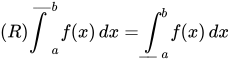
- Definition: Let Failed to parse (MathML with SVG or PNG fallback (recommended for modern browsers and accessibility tools): Invalid response ("Math extension cannot connect to Restbase.") from server "https://wikimedia.org/api/rest_v1/":): {\displaystyle f} be a bounded function on the closed and bounded interval Failed to parse (MathML with SVG or PNG fallback (recommended for modern browsers and accessibility tools): Invalid response ("Math extension cannot connect to Restbase.") from server "https://wikimedia.org/api/rest_v1/":): {\displaystyle [a, b]} . Then Failed to parse (MathML with SVG or PNG fallback (recommended for modern browsers and accessibility tools): Invalid response ("Math extension cannot connect to Restbase.") from server "https://wikimedia.org/api/rest_v1/":): {\displaystyle f} is said to be Riemann Integrable on Failed to parse (MathML with SVG or PNG fallback (recommended for modern browsers and accessibility tools): Invalid response ("Math extension cannot connect to Restbase.") from server "https://wikimedia.org/api/rest_v1/":): {\displaystyle [a, b]} denoted Failed to parse (MathML with SVG or PNG fallback (recommended for modern browsers and accessibility tools): Invalid response ("Math extension cannot connect to Restbase.") from server "https://wikimedia.org/api/rest_v1/":): {\displaystyle f \in R[a, b]} if .
Licensing
Content obtained and/or adapted from:
- Partial Derivatives of Functions from Rn to Rm, mathonline.wikidot.com under a CC BY-SA license
- The Riemann Integral, mathonline.wikidot.com under a CC BY-SA license

