Difference between revisions of "Antiderivatives"
(Added links for PowerPoint and worksheet) |
|||
| (2 intermediate revisions by 2 users not shown) | |||
| Line 1: | Line 1: | ||
| + | ==Definition== | ||
| + | Now recall that <math>F</math> is said to be an antiderivative of ''f'' if <math>F'(x)=f(x)</math> . However, <math>F</math> is not the only antiderivative. We can add any constant to <math>F</math> without changing the derivative. With this, we define the '''indefinite integral''' as follows: | ||
| + | |||
| + | <math>\int f(x)dx=F(x)+C</math> where <math>F</math> satisfies <math>F'(x)=f(x)</math> and <math>C</math> is any constant. | ||
| + | |||
| + | |||
| + | The function <math>f(x)</math> , the function being integrated, is known as the '''integrand'''. Note that the indefinite integral yields a ''family'' of functions. | ||
| + | |||
| + | '''Example''' | ||
| + | |||
| + | Since the derivative of <math>x^4</math> is <math>4x^3</math>, the general antiderivative of <math>4x^3</math> is <math>x^4</math> plus a constant. Thus, | ||
| + | :<math>\int 4x^3dx=x^4+C</math> | ||
| + | |||
| + | '''Example: Finding antiderivatives''' | ||
| + | |||
| + | Let's take a look at <math>6x^2</math> . How would we go about finding the integral of this function? Recall the rule from differentiation that | ||
| + | :<math>\frac{d}{dx}x^n=nx^{n-1}</math> | ||
| + | In our circumstance, we have: | ||
| + | :<math>\frac{d}{dx}x^3=3x^2</math> | ||
| + | This is a start! We now know that the function we seek will have a power of 3 in it. How would we get the constant of 6? Well, | ||
| + | :<math>2\frac{d}{dx}x^3=2\times 3x^2=6x^2</math> | ||
| + | |||
| + | Thus, we say that <math>2x^3</math> is an antiderivative of <math>6x^2</math> . | ||
| + | |||
| + | ==Indefinite integral identities== | ||
| + | ===Basic Properties of Indefinite Integrals=== | ||
| + | '''Constant Rule for indefinite integrals'''<br/> | ||
| + | If <math>c</math> is a constant then <math>\int c\cdot f(x)dx=c\int f(x)dx</math> | ||
| + | |||
| + | '''Sum/Difference Rule for indefinite integrals'''<br/> | ||
| + | :<math>\int\Big(f(x)+g(x)\Big)dx=\int f(x)dx+\int g(x)dx</math> | ||
| + | :<math>\int\Big(f(x)-g(x)\Big)dx=\int f(x)dx-\int g(x)dx</math> | ||
| + | |||
| + | ===Indefinite integrals of Polynomials=== | ||
| + | Say we are given a function of the form, <math>f(x)=x^n</math> , and would like to determine the antiderivative of <math>f</math> . Considering that | ||
| + | :<math>\frac{d}{dx}\frac{1}{n+1}x^{n+1}=x^n</math> | ||
| + | we have the following rule for indefinite integrals: | ||
| + | |||
| + | '''Power rule for indefinite integrals''' | ||
| + | <math>\int x^ndx=\frac{x^{n+1}}{n+1}+C</math> for all <math>n\ne -1</math> | ||
| + | |||
| + | ===Integral of the Inverse function=== | ||
| + | To integrate <math>f(x)=\frac{1}{x}</math> , we should first remember | ||
| + | :<math>\frac{d}{dx}\ln(x)=\frac{1}{x}</math> | ||
| + | |||
| + | Therefore, since <math>\frac{1}{x}</math> is the derivative of <math>\ln(x)</math> we can conclude that | ||
| + | |||
| + | <math>\int\frac{dx}{x}=\ln|x|+C</math> | ||
| + | |||
| + | Note that the polynomial integration rule does not apply when the exponent is <math>-1</math> . This technique of integration must be used instead. Since the argument of the natural logarithm function must be positive (on the real line), the absolute value signs are added around its argument to ensure that the argument is positive. | ||
| + | |||
| + | ===Integral of the Exponential function=== | ||
| + | Since | ||
| + | :<math>\frac{d}{dx}e^x=e^x</math> | ||
| + | we see that <math>e^x</math> is its own antiderivative. This allows us to find the integral of an exponential function: | ||
| + | <math>\int e^xdx=e^x+C</math> | ||
| + | |||
| + | ===Integral of Sine and Cosine=== | ||
| + | Recall that | ||
| + | :<math>\frac{d}{dx}\sin(x)=\cos(x)</math> | ||
| + | :<math>\frac{d}{dx}\cos(x)=-\sin(x)</math> | ||
| + | |||
| + | So <math>\sin(x)</math> is an antiderivative of <math>\cos(x)</math> and <math>-\cos(x)</math> is an antiderivative of <math>\sin(x)</math> . Hence we get the following rules for integrating <math>\sin(x)</math> and <math>\cos(x)</math> | ||
| + | |||
| + | <math>\int\cos(x)dx=\sin(x)+C</math></br><math>\int\sin(x)dx=-\cos(x)+C</math> | ||
| + | |||
| + | We will find how to integrate more complicated trigonometric functions in the chapter on integration techniques. | ||
| + | |||
| + | '''Example''' | ||
| + | |||
| + | Suppose we want to integrate the function <math>f(x)=x^4+1+2\sin(x)</math> . An application of the sum rule from above allows us to use the power rule and our rule for integrating <math>\sin(x)</math> as follows, | ||
| + | :{| | ||
| + | |<math>\int f(x)dx</math> | ||
| + | |<math>=\int\Big(x^4+1+2\sin(x)\Big)dx</math> | ||
| + | |- | ||
| + | | | ||
| + | |<math>=\int x^4dx+\int 1\,dx+\int 2\sin(x)dx</math> | ||
| + | |- | ||
| + | | | ||
| + | |<math>=\frac{x^5}{5}+x-2\cos(x)+C</math> . | ||
| + | |} | ||
| + | |||
| + | ==The Substitution Rule== | ||
| + | The substitution rule is a valuable asset in the toolbox of any integration greasemonkey. It is essentially the chain rule (a differentiation technique you should be familiar with) in reverse. First, let's take a look at an example: | ||
| + | |||
| + | ===Preliminary Example=== | ||
| + | Suppose we want to find <math>\int x\cos(x^2)dx</math> . That is, we want to find a function such that its derivative equals <math>x\cos(x^2)</math> . Stated yet another way, we want to find an antiderivative of <math>f(x)=x\cos(x^2)</math> . Since <math>\sin(x)</math> differentiates to <math>\cos(x)</math> , as a first guess we might try the function <math>\sin(x^2)</math> . But by the Chain Rule, | ||
| + | :<math>\frac{d}{dx}\sin(x^2)=\cos(x^2)\cdot\frac{d}{dx}x^2=\cos(x^2)\cdot 2x=2x\cos(x^2)</math> | ||
| + | Which is almost what we want apart from the fact that there is an extra factor of 2 in front. But this is easily dealt with because we can divide by a constant (in this case 2). So, | ||
| + | :<math>\frac{d}{dx}\frac{\sin(x^2)}{2}=\frac{1}{2}\cdot\frac{d}{dx}\sin(x^2)=\frac{1}{2}\cdot 2\cos(x^2)x=x\cos(x^2)=f(x)</math> | ||
| + | Thus, we have discovered a function, <math>F(x)=\frac{\sin(x^2)}{2}</math>, whose derivative is <math>x\cos(x^2)</math> . That is, <math>F</math> is an antiderivative of <math>f(x)=x\cos(x^2)</math> . This gives us | ||
| + | :<math>\int x\cos(x^2)dx=\frac{\sin(x^2)}{2}+C</math> | ||
| + | |||
| + | ===Generalization=== | ||
| + | In fact, this technique will work for more general integrands. Suppose <math>u</math> is a differentiable function. Then to evaluate <math>\int u'(x)\cos\bigl(u(x)\bigr)dx</math> we just have to notice that by the Chain Rule | ||
| + | :<math>\frac{d}{dx}\sin\bigl(u(x)\bigr)=\cos\bigl(u(x)\bigr)\frac{du}{dx}=u'(x)\cos\bigl(u(x)\bigr)</math> | ||
| + | As long as <math>u'</math> is continuous we have that | ||
| + | :<math>\int\cos\bigl(u(x)\bigr)u'(x)dx=\sin\bigl(u(x)\bigr)+C</math> | ||
| + | Now the right hand side of this equation is just the integral of <math>\cos(u)</math> but with respect to <math>u</math> . If we write <math>u</math> instead of <math>u(x)</math> this becomes | ||
| + | <math>\int\cos(u(x))u'(x)dx=\sin(u)+C=\int\cos(u)du</math> | ||
| + | |||
| + | So, for instance, if <math>u(x)=x^3</math> we have worked out that | ||
| + | :<math>\int\bigl(\cos(x^3)\cdot 3x^2\bigr)dx=\sin(x^3)+C</math> | ||
| + | |||
| + | ===General Substitution Rule=== | ||
| + | Now there was nothing special about using the cosine function in the discussion above, and it could be replaced by any other function. Doing this gives us the substitution rule for indefinite integrals: | ||
| + | |||
| + | '''Substitution rule for indefinite integrals''' </br> | ||
| + | Assume <math>u</math> is differentiable with continuous derivative and that <math>f</math> is continuous on the range of <math>u</math> . Then | ||
| + | <math>\int f\bigl(u(x)\bigr)\frac{du}{dx}dx=\int f(u)du</math> | ||
| + | |||
| + | Notice that it looks like you can "cancel" in the expression <math>\frac{du}{dx}dx</math> to leave just a <math>du</math> . This does not really make any sense because <math>\frac{du}{dx}</math> is '''not a fraction'''. But it's a good way to remember the substitution rule. | ||
| + | |||
| + | ===Examples=== | ||
| + | The following example shows how powerful a technique substitution can be. At first glance the following integral seems intractable, but after a little simplification, it's possible to tackle using substitution. | ||
| + | |||
| + | '''Example''' | ||
| + | |||
| + | We will show that | ||
| + | :<math>\int\frac{dx}{(x^2+a^2)\sqrt{x^2+a^2}}=\frac{x}{a^2\sqrt{x^2+a^2}}+C</math> | ||
| + | |||
| + | First, we re-write the integral: | ||
| + | |||
| + | :{| | ||
| + | |<math>\int\frac{dx}{(x^2+a^2)\sqrt{x^2+a^2}}</math> | ||
| + | |<math>=\int (x^2+a^2)^{-\frac32}dx</math> | ||
| + | |- | ||
| + | | | ||
| + | |<math>=\int\left(x^2\left(1+\tfrac{a^2}{x^2}\right)\right)^{-\frac32} dx</math> | ||
| + | |- | ||
| + | | | ||
| + | |<math>=\int x^{-3}\left(1+\tfrac{a^2}{x^2}\right)^{-\frac32} dx</math> | ||
| + | |- | ||
| + | | | ||
| + | |<math>=\int \left(1+\tfrac{a^2}{x^2}\right)^{-\frac32} \left(x^{-3} dx\right)</math> | ||
| + | |} | ||
| + | |||
| + | Now we perform the following substitution: | ||
| + | :<math>u=1+\frac{a^2}{x^2}</math> | ||
| + | :<math>\frac{du}{dx}=-2a^2x^{-3}\ \implies\ x^{-3}dx=-\frac{du}{2a^2}</math> | ||
| + | Which yields: | ||
| + | ::<math>\int\left(1+\tfrac{a^2}{x^2}\right)^{-\frac32} \left(x^{-3}dx\right)=</math> | ||
| + | ::<math>=\int u^{-\frac32}\left(-\frac{du}{2a^2}\right)</math> | ||
| + | ::<math>=-\frac{1}{2a^2}\int u^{-\frac32}du</math> | ||
| + | ::<math>=-\frac{1}{2a^2}\left(-\frac{2}{\sqrt u}\right)+C</math> | ||
| + | ::<math>=\frac{1}{a^2 \sqrt{1+\frac{a^2}{x^2}}}+C</math> | ||
| + | ::<math>=\left(\frac{x}{x}\right) \frac{1}{a^2 \sqrt{1+\frac{a^2}{x^2}}} + C</math> | ||
| + | ::<math>=\frac{x}{a^2 \sqrt{x^2+a^2}}+C</math> | ||
| + | |||
| + | ==Integration by Parts== | ||
| + | Integration by parts is another powerful tool for integration. It was mentioned above that one could consider integration by substitution as an application of the chain rule in reverse. In a similar manner, one may consider integration by parts as the product rule in reverse. | ||
| + | |||
| + | ===Preliminary Example=== | ||
| + | |||
| + | ===General Integration by Parts=== | ||
| + | |||
| + | '''Integration by parts for indefinite integrals''' </br> | ||
| + | Suppose <math>f</math> and <math>g</math> are differentiable and their derivatives are continuous. Then | ||
| + | :<math>\int f(x)g(x)dx=f(x)\int g(x)dx-\int\left(f'(x)\int g(x)dx\right)dx</math> | ||
| + | it is also very important to notice that<br><math>\int f(x)g(x)dx=f(x)\int g(x)dx-\int\left(f'(x)\int g(x)dx\right)dx</math><br> | ||
| + | is not equal to<br><math>\int f(x)g(x)dx=g(x)\int f(x)dx-\int\left(g'(x)\int f(x)dx\right)dx</math> | ||
| + | |||
| + | to set the <math>f(x)</math> and <math>g(x)</math> we need to follow the rule called I.L.A.T.E.<br> | ||
| + | <hr>ILATE defines the order in which we must set the <math>f(x)</math><br> | ||
| + | <ul> | ||
| + | <li>I for inverse trigonometric function</li> | ||
| + | <li>L for log functions</li> | ||
| + | <li>A for algebraic functions </li> | ||
| + | <li>T for trigonometric functions </li> | ||
| + | <li>E for exponential function</li> | ||
| + | </ul><hr><hr> | ||
| + | f(x) and g(x) must be in the order of ILATE | ||
| + | or else your final answers will not match with the main key | ||
| + | |||
| + | ===Examples=== | ||
| + | '''Example''' | ||
| + | |||
| + | Find <math>\int x\cos(x)dx</math> | ||
| + | |||
| + | Here we let: | ||
| + | :<math>u=x</math> , so that <math>du=dx</math> , | ||
| + | :<math>dv=\cos(x)dx</math> , so that <math>v=\sin(x)</math> . | ||
| + | |||
| + | Then: | ||
| + | :{| | ||
| + | |- | ||
| + | |<math>\int x\cos(x)dx</math> | ||
| + | |<math>=\int u\,dv</math> | ||
| + | |- | ||
| + | | | ||
| + | |<math>=uv-\int v\,du</math> | ||
| + | |- | ||
| + | | | ||
| + | |<math>=x\sin(x)-\int\sin(x)dx</math> | ||
| + | |- | ||
| + | | | ||
| + | |<math>=x\sin(x)+\cos(x)+C</math> | ||
| + | |} | ||
| + | |||
| + | '''Example''' | ||
| + | |||
| + | Find <math>\int x^2e^xdx</math> | ||
| + | |||
| + | In this example we will have to use integration by parts twice. | ||
| + | |||
| + | Here we let | ||
| + | :<math>u=x^2</math> , so that <math>du=2xdx</math> , | ||
| + | :<math>dv=e^xdx</math> , so that <math>v=e^x</math> . | ||
| + | |||
| + | Then: | ||
| + | |||
| + | :{| | ||
| + | |- | ||
| + | |<math>\int x^2e^xdx</math> | ||
| + | |<math>=\int u\,dv</math> | ||
| + | |- | ||
| + | | | ||
| + | |<math>= uv - \int v \,du</math> | ||
| + | |- | ||
| + | | | ||
| + | |<math>=x^2e^x-\int 2xe^xdx</math> | ||
| + | |- | ||
| + | | | ||
| + | |<math>=x^2e^x-2\int xe^xdx</math> | ||
| + | |} | ||
| + | |||
| + | Now to calculate the last integral we use integration by parts again. Let | ||
| + | :<math>u=x</math> , so that <math>du=dx</math> , | ||
| + | :<math>dv=e^xdx</math> , so that <math>v=e^x</math> | ||
| + | and integrating by parts gives | ||
| + | :<math>\int xe^xdx=xe^x-\int e^xdx=e^x(x-1)</math> | ||
| + | So, finally we obtain | ||
| + | :<math>\int x^2e^xdx=x^2e^x-2e^x(x-1)+C=e^x(x^2-2x+2)+C</math> | ||
| + | |||
| + | '''Example''' | ||
| + | |||
| + | Find <math>\int\ln(x)dx</math> | ||
| + | |||
| + | The trick here is to write this integral as | ||
| + | :<math>\int\ln(x)\cdot 1\,dx</math> | ||
| + | |||
| + | Now let | ||
| + | :<math>u=\ln(x)</math> so <math>du=\frac{dx}{x}</math> , | ||
| + | :<math>v=x</math> so <math>dv=1\,dx</math> . | ||
| + | |||
| + | Then using integration by parts, | ||
| + | :{| | ||
| + | |- | ||
| + | |<math>\int\ln(x)dx</math> | ||
| + | |<math>=x\ln(x)-\int\frac{x}{x}dx</math> | ||
| + | |- | ||
| + | | | ||
| + | |<math>=x\ln(x)-\int 1\,dx</math> | ||
| + | |- | ||
| + | | | ||
| + | |<math>=x\ln(x)-x+C</math> | ||
| + | |- | ||
| + | | | ||
| + | |<math>=x\bigl(\ln(x)-1\bigr)+C</math> | ||
| + | |} | ||
| + | |||
| + | '''Example''' | ||
| + | |||
| + | Find <math>\int\arctan(x)dx</math> | ||
| + | |||
| + | Again the trick here is to write the integrand as <math>\arctan(x)=\arctan(x)\cdot 1</math> . Then let | ||
| + | :<math>u=\arctan(x)</math> so <math>du=\frac{dx}{1+x^2}</math> | ||
| + | :<math>v=x</math> so <math>dv=1\,dx</math> | ||
| + | so using integration by parts, | ||
| + | :{| | ||
| + | |- | ||
| + | |<math>\int\arctan(x)dx</math> | ||
| + | |<math>=x\arctan(x)-\int\frac{x}{1+x^2}dx</math> | ||
| + | |- | ||
| + | | | ||
| + | |<math>=x\arctan(x)-\tfrac12\ln(1+x^2)+C</math> | ||
| + | |} | ||
| + | |||
| + | '''Example''' | ||
| + | |||
| + | Find <math>\int e^x\cos(x)dx</math> | ||
| + | |||
| + | This example uses integration by parts twice. First let, | ||
| + | |||
| + | :<math>u=e^x</math> so <math>du=e^xdx</math> | ||
| + | :<math>dv=\cos(x)dx</math> so <math>v=\sin(x)</math> | ||
| + | so | ||
| + | :<math>\int e^x\cos(x)dx=e^x\sin(x)-\int e^x\sin(x)dx</math> | ||
| + | |||
| + | Now, to evaluate the remaining integral, we use integration by parts again, with | ||
| + | |||
| + | :<math>u=e^x</math> so <math>du=e^xdx</math> | ||
| + | :<math>v=-\cos(x)</math> so <math>dv=\sin(x)dx</math> | ||
| + | |||
| + | Then | ||
| + | :{| | ||
| + | |- | ||
| + | |<math>\int e^x\sin(x)dx</math> | ||
| + | |<math>=-e^x\cos(x)-\int -e^x\cos(x)dx</math> | ||
| + | |- | ||
| + | | | ||
| + | |<math>=-e^x\cos(x)+\int e^x\cos(x)dx</math> | ||
| + | |} | ||
| + | |||
| + | Putting these together, we have | ||
| + | :<math>\int e^x\cos(x)dx=e^x\sin(x)+e^x\cos(x)-\int e^x\cos(x)dx</math> | ||
| + | |||
| + | Notice that the same integral shows up on both sides of this equation, but with opposite signs. The integral does not cancel; it doubles when we add the integral to both sides to get | ||
| + | |||
| + | :<math>2\int e^x\cos(x)dx=e^x\bigl(\sin(x)+\cos(x)\bigr)</math> | ||
| + | :<math>\int e^x\cos(x)dx=\frac{e^x\bigl(\sin(x)+\cos(x)\bigr)}{2}</math> | ||
| + | |||
| + | |||
| + | ==Resources== | ||
| + | * [https://mathresearch.utsa.edu/wikiFiles/MAT1193/The%20Definite%20Integral/Presentation11_Distance_Definite_Integral.pptx Distance Definite Integral] (Slides 23-38). PowerPoint file created by Professor Cynthia Roberts, UTSA. | ||
| + | * [https://mathresearch.utsa.edu/wikiFiles/MAT1193/The%20Definite%20Integral/Presentation12_DefiniteIntegral%20&%20Antiderivatives.pptx Definite Integral & Antiderivatives]. PowerPoint file created by Professor Cynthia Roberts, UTSA. | ||
* [https://mathresearch.utsa.edu/wikiFiles/MAT1214/Antiderivatives/MAT1214-4.10AntiderivativesPwPt.pptx Antiderivatives] PowerPoint file created by Dr. Sara Shirinkam, UTSA. | * [https://mathresearch.utsa.edu/wikiFiles/MAT1214/Antiderivatives/MAT1214-4.10AntiderivativesPwPt.pptx Antiderivatives] PowerPoint file created by Dr. Sara Shirinkam, UTSA. | ||
* [https://mathresearch.utsa.edu/wikiFiles/MAT1214/Antiderivatives/MAT1214-4.10AntiderivativesWS1.pdf Antiderivatives Worksheet] | * [https://mathresearch.utsa.edu/wikiFiles/MAT1214/Antiderivatives/MAT1214-4.10AntiderivativesWS1.pdf Antiderivatives Worksheet] | ||
| + | |||
| + | ==Licensing== | ||
| + | Content obtained and/or adapted from: | ||
| + | * [https://en.wikibooks.org/wiki/Calculus/Indefinite_integral Indefinite integral, Wikibooks: Calculus] under a CC BY-SA license | ||
Latest revision as of 10:19, 28 October 2021
Contents
Definition
Now recall that is said to be an antiderivative of f if . However, Failed to parse (MathML with SVG or PNG fallback (recommended for modern browsers and accessibility tools): Invalid response ("Math extension cannot connect to Restbase.") from server "https://wikimedia.org/api/rest_v1/":): {\displaystyle F} is not the only antiderivative. We can add any constant to Failed to parse (MathML with SVG or PNG fallback (recommended for modern browsers and accessibility tools): Invalid response ("Math extension cannot connect to Restbase.") from server "https://wikimedia.org/api/rest_v1/":): {\displaystyle F} without changing the derivative. With this, we define the indefinite integral as follows:


Failed to parse (MathML with SVG or PNG fallback (recommended for modern browsers and accessibility tools): Invalid response ("Math extension cannot connect to Restbase.") from server "https://wikimedia.org/api/rest_v1/":): {\displaystyle \int f(x)dx=F(x)+C} where Failed to parse (MathML with SVG or PNG fallback (recommended for modern browsers and accessibility tools): Invalid response ("Math extension cannot connect to Restbase.") from server "https://wikimedia.org/api/rest_v1/":): {\displaystyle F} satisfies Failed to parse (MathML with SVG or PNG fallback (recommended for modern browsers and accessibility tools): Invalid response ("Math extension cannot connect to Restbase.") from server "https://wikimedia.org/api/rest_v1/":): {\displaystyle F'(x)=f(x)} and Failed to parse (MathML with SVG or PNG fallback (recommended for modern browsers and accessibility tools): Invalid response ("Math extension cannot connect to Restbase.") from server "https://wikimedia.org/api/rest_v1/":): {\displaystyle C} is any constant.
The function Failed to parse (MathML with SVG or PNG fallback (recommended for modern browsers and accessibility tools): Invalid response ("Math extension cannot connect to Restbase.") from server "https://wikimedia.org/api/rest_v1/":): {\displaystyle f(x)}
, the function being integrated, is known as the integrand. Note that the indefinite integral yields a family of functions.
Example
Since the derivative of Failed to parse (MathML with SVG or PNG fallback (recommended for modern browsers and accessibility tools): Invalid response ("Math extension cannot connect to Restbase.") from server "https://wikimedia.org/api/rest_v1/":): {\displaystyle x^4} is Failed to parse (MathML with SVG or PNG fallback (recommended for modern browsers and accessibility tools): Invalid response ("Math extension cannot connect to Restbase.") from server "https://wikimedia.org/api/rest_v1/":): {\displaystyle 4x^3} , the general antiderivative of Failed to parse (MathML with SVG or PNG fallback (recommended for modern browsers and accessibility tools): Invalid response ("Math extension cannot connect to Restbase.") from server "https://wikimedia.org/api/rest_v1/":): {\displaystyle 4x^3} is Failed to parse (MathML with SVG or PNG fallback (recommended for modern browsers and accessibility tools): Invalid response ("Math extension cannot connect to Restbase.") from server "https://wikimedia.org/api/rest_v1/":): {\displaystyle x^4} plus a constant. Thus,
- Failed to parse (MathML with SVG or PNG fallback (recommended for modern browsers and accessibility tools): Invalid response ("Math extension cannot connect to Restbase.") from server "https://wikimedia.org/api/rest_v1/":): {\displaystyle \int 4x^3dx=x^4+C}
Example: Finding antiderivatives
Let's take a look at Failed to parse (MathML with SVG or PNG fallback (recommended for modern browsers and accessibility tools): Invalid response ("Math extension cannot connect to Restbase.") from server "https://wikimedia.org/api/rest_v1/":): {\displaystyle 6x^2} . How would we go about finding the integral of this function? Recall the rule from differentiation that
- Failed to parse (MathML with SVG or PNG fallback (recommended for modern browsers and accessibility tools): Invalid response ("Math extension cannot connect to Restbase.") from server "https://wikimedia.org/api/rest_v1/":): {\displaystyle \frac{d}{dx}x^n=nx^{n-1}}
In our circumstance, we have:
- Failed to parse (MathML with SVG or PNG fallback (recommended for modern browsers and accessibility tools): Invalid response ("Math extension cannot connect to Restbase.") from server "https://wikimedia.org/api/rest_v1/":): {\displaystyle \frac{d}{dx}x^3=3x^2}
This is a start! We now know that the function we seek will have a power of 3 in it. How would we get the constant of 6? Well,
- Failed to parse (MathML with SVG or PNG fallback (recommended for modern browsers and accessibility tools): Invalid response ("Math extension cannot connect to Restbase.") from server "https://wikimedia.org/api/rest_v1/":): {\displaystyle 2\frac{d}{dx}x^3=2\times 3x^2=6x^2}
Thus, we say that Failed to parse (MathML with SVG or PNG fallback (recommended for modern browsers and accessibility tools): Invalid response ("Math extension cannot connect to Restbase.") from server "https://wikimedia.org/api/rest_v1/":): {\displaystyle 2x^3} is an antiderivative of Failed to parse (MathML with SVG or PNG fallback (recommended for modern browsers and accessibility tools): Invalid response ("Math extension cannot connect to Restbase.") from server "https://wikimedia.org/api/rest_v1/":): {\displaystyle 6x^2} .
Indefinite integral identities
Basic Properties of Indefinite Integrals
Constant Rule for indefinite integrals
If Failed to parse (MathML with SVG or PNG fallback (recommended for modern browsers and accessibility tools): Invalid response ("Math extension cannot connect to Restbase.") from server "https://wikimedia.org/api/rest_v1/":): {\displaystyle c}
is a constant then Failed to parse (MathML with SVG or PNG fallback (recommended for modern browsers and accessibility tools): Invalid response ("Math extension cannot connect to Restbase.") from server "https://wikimedia.org/api/rest_v1/":): {\displaystyle \int c\cdot f(x)dx=c\int f(x)dx}
Sum/Difference Rule for indefinite integrals
- Failed to parse (MathML with SVG or PNG fallback (recommended for modern browsers and accessibility tools): Invalid response ("Math extension cannot connect to Restbase.") from server "https://wikimedia.org/api/rest_v1/":): {\displaystyle \int\Big(f(x)+g(x)\Big)dx=\int f(x)dx+\int g(x)dx}
- Failed to parse (MathML with SVG or PNG fallback (recommended for modern browsers and accessibility tools): Invalid response ("Math extension cannot connect to Restbase.") from server "https://wikimedia.org/api/rest_v1/":): {\displaystyle \int\Big(f(x)-g(x)\Big)dx=\int f(x)dx-\int g(x)dx}
Indefinite integrals of Polynomials
Say we are given a function of the form, Failed to parse (MathML with SVG or PNG fallback (recommended for modern browsers and accessibility tools): Invalid response ("Math extension cannot connect to Restbase.") from server "https://wikimedia.org/api/rest_v1/":): {\displaystyle f(x)=x^n} , and would like to determine the antiderivative of Failed to parse (MathML with SVG or PNG fallback (recommended for modern browsers and accessibility tools): Invalid response ("Math extension cannot connect to Restbase.") from server "https://wikimedia.org/api/rest_v1/":): {\displaystyle f} . Considering that
- Failed to parse (MathML with SVG or PNG fallback (recommended for modern browsers and accessibility tools): Invalid response ("Math extension cannot connect to Restbase.") from server "https://wikimedia.org/api/rest_v1/":): {\displaystyle \frac{d}{dx}\frac{1}{n+1}x^{n+1}=x^n}
we have the following rule for indefinite integrals:
Power rule for indefinite integrals Failed to parse (MathML with SVG or PNG fallback (recommended for modern browsers and accessibility tools): Invalid response ("Math extension cannot connect to Restbase.") from server "https://wikimedia.org/api/rest_v1/":): {\displaystyle \int x^ndx=\frac{x^{n+1}}{n+1}+C} for all Failed to parse (MathML with SVG or PNG fallback (recommended for modern browsers and accessibility tools): Invalid response ("Math extension cannot connect to Restbase.") from server "https://wikimedia.org/api/rest_v1/":): {\displaystyle n\ne -1}
Integral of the Inverse function
To integrate Failed to parse (MathML with SVG or PNG fallback (recommended for modern browsers and accessibility tools): Invalid response ("Math extension cannot connect to Restbase.") from server "https://wikimedia.org/api/rest_v1/":): {\displaystyle f(x)=\frac{1}{x}} , we should first remember
- Failed to parse (MathML with SVG or PNG fallback (recommended for modern browsers and accessibility tools): Invalid response ("Math extension cannot connect to Restbase.") from server "https://wikimedia.org/api/rest_v1/":): {\displaystyle \frac{d}{dx}\ln(x)=\frac{1}{x}}
Therefore, since Failed to parse (MathML with SVG or PNG fallback (recommended for modern browsers and accessibility tools): Invalid response ("Math extension cannot connect to Restbase.") from server "https://wikimedia.org/api/rest_v1/":): {\displaystyle \frac{1}{x}} is the derivative of Failed to parse (MathML with SVG or PNG fallback (recommended for modern browsers and accessibility tools): Invalid response ("Math extension cannot connect to Restbase.") from server "https://wikimedia.org/api/rest_v1/":): {\displaystyle \ln(x)} we can conclude that
Failed to parse (MathML with SVG or PNG fallback (recommended for modern browsers and accessibility tools): Invalid response ("Math extension cannot connect to Restbase.") from server "https://wikimedia.org/api/rest_v1/":): {\displaystyle \int\frac{dx}{x}=\ln|x|+C}
Note that the polynomial integration rule does not apply when the exponent is Failed to parse (MathML with SVG or PNG fallback (recommended for modern browsers and accessibility tools): Invalid response ("Math extension cannot connect to Restbase.") from server "https://wikimedia.org/api/rest_v1/":): {\displaystyle -1} . This technique of integration must be used instead. Since the argument of the natural logarithm function must be positive (on the real line), the absolute value signs are added around its argument to ensure that the argument is positive.
Integral of the Exponential function
Since
- Failed to parse (MathML with SVG or PNG fallback (recommended for modern browsers and accessibility tools): Invalid response ("Math extension cannot connect to Restbase.") from server "https://wikimedia.org/api/rest_v1/":): {\displaystyle \frac{d}{dx}e^x=e^x}
we see that Failed to parse (MathML with SVG or PNG fallback (recommended for modern browsers and accessibility tools): Invalid response ("Math extension cannot connect to Restbase.") from server "https://wikimedia.org/api/rest_v1/":): {\displaystyle e^x} is its own antiderivative. This allows us to find the integral of an exponential function: Failed to parse (MathML with SVG or PNG fallback (recommended for modern browsers and accessibility tools): Invalid response ("Math extension cannot connect to Restbase.") from server "https://wikimedia.org/api/rest_v1/":): {\displaystyle \int e^xdx=e^x+C}
Integral of Sine and Cosine
Recall that
- Failed to parse (MathML with SVG or PNG fallback (recommended for modern browsers and accessibility tools): Invalid response ("Math extension cannot connect to Restbase.") from server "https://wikimedia.org/api/rest_v1/":): {\displaystyle \frac{d}{dx}\sin(x)=\cos(x)}
- Failed to parse (MathML with SVG or PNG fallback (recommended for modern browsers and accessibility tools): Invalid response ("Math extension cannot connect to Restbase.") from server "https://wikimedia.org/api/rest_v1/":): {\displaystyle \frac{d}{dx}\cos(x)=-\sin(x)}
So Failed to parse (MathML with SVG or PNG fallback (recommended for modern browsers and accessibility tools): Invalid response ("Math extension cannot connect to Restbase.") from server "https://wikimedia.org/api/rest_v1/":): {\displaystyle \sin(x)} is an antiderivative of Failed to parse (MathML with SVG or PNG fallback (recommended for modern browsers and accessibility tools): Invalid response ("Math extension cannot connect to Restbase.") from server "https://wikimedia.org/api/rest_v1/":): {\displaystyle \cos(x)} and Failed to parse (MathML with SVG or PNG fallback (recommended for modern browsers and accessibility tools): Invalid response ("Math extension cannot connect to Restbase.") from server "https://wikimedia.org/api/rest_v1/":): {\displaystyle -\cos(x)} is an antiderivative of Failed to parse (MathML with SVG or PNG fallback (recommended for modern browsers and accessibility tools): Invalid response ("Math extension cannot connect to Restbase.") from server "https://wikimedia.org/api/rest_v1/":): {\displaystyle \sin(x)} . Hence we get the following rules for integrating Failed to parse (MathML with SVG or PNG fallback (recommended for modern browsers and accessibility tools): Invalid response ("Math extension cannot connect to Restbase.") from server "https://wikimedia.org/api/rest_v1/":): {\displaystyle \sin(x)} and Failed to parse (MathML with SVG or PNG fallback (recommended for modern browsers and accessibility tools): Invalid response ("Math extension cannot connect to Restbase.") from server "https://wikimedia.org/api/rest_v1/":): {\displaystyle \cos(x)}
Failed to parse (MathML with SVG or PNG fallback (recommended for modern browsers and accessibility tools): Invalid response ("Math extension cannot connect to Restbase.") from server "https://wikimedia.org/api/rest_v1/":): {\displaystyle \int\cos(x)dx=\sin(x)+C}
Failed to parse (MathML with SVG or PNG fallback (recommended for modern browsers and accessibility tools): Invalid response ("Math extension cannot connect to Restbase.") from server "https://wikimedia.org/api/rest_v1/":): {\displaystyle \int\sin(x)dx=-\cos(x)+C}
We will find how to integrate more complicated trigonometric functions in the chapter on integration techniques.
Example
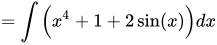
Suppose we want to integrate the function Failed to parse (MathML with SVG or PNG fallback (recommended for modern browsers and accessibility tools): Invalid response ("Math extension cannot connect to Restbase.") from server "https://wikimedia.org/api/rest_v1/":): {\displaystyle f(x)=x^4+1+2\sin(x)} . An application of the sum rule from above allows us to use the power rule and our rule for integrating Failed to parse (MathML with SVG or PNG fallback (recommended for modern browsers and accessibility tools): Invalid response ("Math extension cannot connect to Restbase.") from server "https://wikimedia.org/api/rest_v1/":): {\displaystyle \sin(x)} as follows,
Failed to parse (MathML with SVG or PNG fallback (recommended for modern browsers and accessibility tools): Invalid response ("Math extension cannot connect to Restbase.") from server "https://wikimedia.org/api/rest_v1/":): {\displaystyle =\frac{x^5}{5}+x-2\cos(x)+C} .


The Substitution Rule
The substitution rule is a valuable asset in the toolbox of any integration greasemonkey. It is essentially the chain rule (a differentiation technique you should be familiar with) in reverse. First, let's take a look at an example:
Preliminary Example
Suppose we want to find Failed to parse (MathML with SVG or PNG fallback (recommended for modern browsers and accessibility tools): Invalid response ("Math extension cannot connect to Restbase.") from server "https://wikimedia.org/api/rest_v1/":): {\displaystyle \int x\cos(x^2)dx} . That is, we want to find a function such that its derivative equals Failed to parse (MathML with SVG or PNG fallback (recommended for modern browsers and accessibility tools): Invalid response ("Math extension cannot connect to Restbase.") from server "https://wikimedia.org/api/rest_v1/":): {\displaystyle x\cos(x^2)} . Stated yet another way, we want to find an antiderivative of Failed to parse (MathML with SVG or PNG fallback (recommended for modern browsers and accessibility tools): Invalid response ("Math extension cannot connect to Restbase.") from server "https://wikimedia.org/api/rest_v1/":): {\displaystyle f(x)=x\cos(x^2)} . Since Failed to parse (MathML with SVG or PNG fallback (recommended for modern browsers and accessibility tools): Invalid response ("Math extension cannot connect to Restbase.") from server "https://wikimedia.org/api/rest_v1/":): {\displaystyle \sin(x)} differentiates to Failed to parse (MathML with SVG or PNG fallback (recommended for modern browsers and accessibility tools): Invalid response ("Math extension cannot connect to Restbase.") from server "https://wikimedia.org/api/rest_v1/":): {\displaystyle \cos(x)} , as a first guess we might try the function Failed to parse (MathML with SVG or PNG fallback (recommended for modern browsers and accessibility tools): Invalid response ("Math extension cannot connect to Restbase.") from server "https://wikimedia.org/api/rest_v1/":): {\displaystyle \sin(x^2)} . But by the Chain Rule,
- Failed to parse (MathML with SVG or PNG fallback (recommended for modern browsers and accessibility tools): Invalid response ("Math extension cannot connect to Restbase.") from server "https://wikimedia.org/api/rest_v1/":): {\displaystyle \frac{d}{dx}\sin(x^2)=\cos(x^2)\cdot\frac{d}{dx}x^2=\cos(x^2)\cdot 2x=2x\cos(x^2)}
Which is almost what we want apart from the fact that there is an extra factor of 2 in front. But this is easily dealt with because we can divide by a constant (in this case 2). So,
- Failed to parse (MathML with SVG or PNG fallback (recommended for modern browsers and accessibility tools): Invalid response ("Math extension cannot connect to Restbase.") from server "https://wikimedia.org/api/rest_v1/":): {\displaystyle \frac{d}{dx}\frac{\sin(x^2)}{2}=\frac{1}{2}\cdot\frac{d}{dx}\sin(x^2)=\frac{1}{2}\cdot 2\cos(x^2)x=x\cos(x^2)=f(x)}
Thus, we have discovered a function, Failed to parse (MathML with SVG or PNG fallback (recommended for modern browsers and accessibility tools): Invalid response ("Math extension cannot connect to Restbase.") from server "https://wikimedia.org/api/rest_v1/":): {\displaystyle F(x)=\frac{\sin(x^2)}{2}} , whose derivative is Failed to parse (MathML with SVG or PNG fallback (recommended for modern browsers and accessibility tools): Invalid response ("Math extension cannot connect to Restbase.") from server "https://wikimedia.org/api/rest_v1/":): {\displaystyle x\cos(x^2)} . That is, Failed to parse (MathML with SVG or PNG fallback (recommended for modern browsers and accessibility tools): Invalid response ("Math extension cannot connect to Restbase.") from server "https://wikimedia.org/api/rest_v1/":): {\displaystyle F} is an antiderivative of Failed to parse (MathML with SVG or PNG fallback (recommended for modern browsers and accessibility tools): Invalid response ("Math extension cannot connect to Restbase.") from server "https://wikimedia.org/api/rest_v1/":): {\displaystyle f(x)=x\cos(x^2)} . This gives us
- Failed to parse (MathML with SVG or PNG fallback (recommended for modern browsers and accessibility tools): Invalid response ("Math extension cannot connect to Restbase.") from server "https://wikimedia.org/api/rest_v1/":): {\displaystyle \int x\cos(x^2)dx=\frac{\sin(x^2)}{2}+C}
Generalization
In fact, this technique will work for more general integrands. Suppose Failed to parse (MathML with SVG or PNG fallback (recommended for modern browsers and accessibility tools): Invalid response ("Math extension cannot connect to Restbase.") from server "https://wikimedia.org/api/rest_v1/":): {\displaystyle u} is a differentiable function. Then to evaluate Failed to parse (MathML with SVG or PNG fallback (recommended for modern browsers and accessibility tools): Invalid response ("Math extension cannot connect to Restbase.") from server "https://wikimedia.org/api/rest_v1/":): {\displaystyle \int u'(x)\cos\bigl(u(x)\bigr)dx} we just have to notice that by the Chain Rule
- Failed to parse (MathML with SVG or PNG fallback (recommended for modern browsers and accessibility tools): Invalid response ("Math extension cannot connect to Restbase.") from server "https://wikimedia.org/api/rest_v1/":): {\displaystyle \frac{d}{dx}\sin\bigl(u(x)\bigr)=\cos\bigl(u(x)\bigr)\frac{du}{dx}=u'(x)\cos\bigl(u(x)\bigr)}
As long as Failed to parse (MathML with SVG or PNG fallback (recommended for modern browsers and accessibility tools): Invalid response ("Math extension cannot connect to Restbase.") from server "https://wikimedia.org/api/rest_v1/":): {\displaystyle u'} is continuous we have that
- Failed to parse (MathML with SVG or PNG fallback (recommended for modern browsers and accessibility tools): Invalid response ("Math extension cannot connect to Restbase.") from server "https://wikimedia.org/api/rest_v1/":): {\displaystyle \int\cos\bigl(u(x)\bigr)u'(x)dx=\sin\bigl(u(x)\bigr)+C}
Now the right hand side of this equation is just the integral of Failed to parse (MathML with SVG or PNG fallback (recommended for modern browsers and accessibility tools): Invalid response ("Math extension cannot connect to Restbase.") from server "https://wikimedia.org/api/rest_v1/":): {\displaystyle \cos(u)} but with respect to Failed to parse (MathML with SVG or PNG fallback (recommended for modern browsers and accessibility tools): Invalid response ("Math extension cannot connect to Restbase.") from server "https://wikimedia.org/api/rest_v1/":): {\displaystyle u} . If we write Failed to parse (MathML with SVG or PNG fallback (recommended for modern browsers and accessibility tools): Invalid response ("Math extension cannot connect to Restbase.") from server "https://wikimedia.org/api/rest_v1/":): {\displaystyle u} instead of Failed to parse (MathML with SVG or PNG fallback (recommended for modern browsers and accessibility tools): Invalid response ("Math extension cannot connect to Restbase.") from server "https://wikimedia.org/api/rest_v1/":): {\displaystyle u(x)} this becomes Failed to parse (MathML with SVG or PNG fallback (recommended for modern browsers and accessibility tools): Invalid response ("Math extension cannot connect to Restbase.") from server "https://wikimedia.org/api/rest_v1/":): {\displaystyle \int\cos(u(x))u'(x)dx=\sin(u)+C=\int\cos(u)du}
So, for instance, if Failed to parse (MathML with SVG or PNG fallback (recommended for modern browsers and accessibility tools): Invalid response ("Math extension cannot connect to Restbase.") from server "https://wikimedia.org/api/rest_v1/":): {\displaystyle u(x)=x^3} we have worked out that
- Failed to parse (MathML with SVG or PNG fallback (recommended for modern browsers and accessibility tools): Invalid response ("Math extension cannot connect to Restbase.") from server "https://wikimedia.org/api/rest_v1/":): {\displaystyle \int\bigl(\cos(x^3)\cdot 3x^2\bigr)dx=\sin(x^3)+C}
General Substitution Rule
Now there was nothing special about using the cosine function in the discussion above, and it could be replaced by any other function. Doing this gives us the substitution rule for indefinite integrals:
Substitution rule for indefinite integrals
Assume Failed to parse (MathML with SVG or PNG fallback (recommended for modern browsers and accessibility tools): Invalid response ("Math extension cannot connect to Restbase.") from server "https://wikimedia.org/api/rest_v1/":): {\displaystyle u}
is differentiable with continuous derivative and that Failed to parse (MathML with SVG or PNG fallback (recommended for modern browsers and accessibility tools): Invalid response ("Math extension cannot connect to Restbase.") from server "https://wikimedia.org/api/rest_v1/":): {\displaystyle f}
is continuous on the range of Failed to parse (MathML with SVG or PNG fallback (recommended for modern browsers and accessibility tools): Invalid response ("Math extension cannot connect to Restbase.") from server "https://wikimedia.org/api/rest_v1/":): {\displaystyle u}
. Then
Failed to parse (MathML with SVG or PNG fallback (recommended for modern browsers and accessibility tools): Invalid response ("Math extension cannot connect to Restbase.") from server "https://wikimedia.org/api/rest_v1/":): {\displaystyle \int f\bigl(u(x)\bigr)\frac{du}{dx}dx=\int f(u)du}
Notice that it looks like you can "cancel" in the expression Failed to parse (MathML with SVG or PNG fallback (recommended for modern browsers and accessibility tools): Invalid response ("Math extension cannot connect to Restbase.") from server "https://wikimedia.org/api/rest_v1/":): {\displaystyle \frac{du}{dx}dx} to leave just a Failed to parse (MathML with SVG or PNG fallback (recommended for modern browsers and accessibility tools): Invalid response ("Math extension cannot connect to Restbase.") from server "https://wikimedia.org/api/rest_v1/":): {\displaystyle du} . This does not really make any sense because Failed to parse (MathML with SVG or PNG fallback (recommended for modern browsers and accessibility tools): Invalid response ("Math extension cannot connect to Restbase.") from server "https://wikimedia.org/api/rest_v1/":): {\displaystyle \frac{du}{dx}} is not a fraction. But it's a good way to remember the substitution rule.
Examples
The following example shows how powerful a technique substitution can be. At first glance the following integral seems intractable, but after a little simplification, it's possible to tackle using substitution.
Example
We will show that
- Failed to parse (MathML with SVG or PNG fallback (recommended for modern browsers and accessibility tools): Invalid response ("Math extension cannot connect to Restbase.") from server "https://wikimedia.org/api/rest_v1/":): {\displaystyle \int\frac{dx}{(x^2+a^2)\sqrt{x^2+a^2}}=\frac{x}{a^2\sqrt{x^2+a^2}}+C}
First, we re-write the integral:
Failed to parse (MathML with SVG or PNG fallback (recommended for modern browsers and accessibility tools): Invalid response ("Math extension cannot connect to Restbase.") from server "https://wikimedia.org/api/rest_v1/":): {\displaystyle \int\frac{dx}{(x^2+a^2)\sqrt{x^2+a^2}}} Failed to parse (MathML with SVG or PNG fallback (recommended for modern browsers and accessibility tools): Invalid response ("Math extension cannot connect to Restbase.") from server "https://wikimedia.org/api/rest_v1/":): {\displaystyle =\int (x^2+a^2)^{-\frac32}dx} Failed to parse (MathML with SVG or PNG fallback (recommended for modern browsers and accessibility tools): Invalid response ("Math extension cannot connect to Restbase.") from server "https://wikimedia.org/api/rest_v1/":): {\displaystyle =\int\left(x^2\left(1+\tfrac{a^2}{x^2}\right)\right)^{-\frac32} dx} Failed to parse (MathML with SVG or PNG fallback (recommended for modern browsers and accessibility tools): Invalid response ("Math extension cannot connect to Restbase.") from server "https://wikimedia.org/api/rest_v1/":): {\displaystyle =\int x^{-3}\left(1+\tfrac{a^2}{x^2}\right)^{-\frac32} dx} Failed to parse (MathML with SVG or PNG fallback (recommended for modern browsers and accessibility tools): Invalid response ("Math extension cannot connect to Restbase.") from server "https://wikimedia.org/api/rest_v1/":): {\displaystyle =\int \left(1+\tfrac{a^2}{x^2}\right)^{-\frac32} \left(x^{-3} dx\right)}
Now we perform the following substitution:
- Failed to parse (MathML with SVG or PNG fallback (recommended for modern browsers and accessibility tools): Invalid response ("Math extension cannot connect to Restbase.") from server "https://wikimedia.org/api/rest_v1/":): {\displaystyle u=1+\frac{a^2}{x^2}}
- Failed to parse (MathML with SVG or PNG fallback (recommended for modern browsers and accessibility tools): Invalid response ("Math extension cannot connect to Restbase.") from server "https://wikimedia.org/api/rest_v1/":): {\displaystyle \frac{du}{dx}=-2a^2x^{-3}\ \implies\ x^{-3}dx=-\frac{du}{2a^2}}
Which yields:
- Failed to parse (MathML with SVG or PNG fallback (recommended for modern browsers and accessibility tools): Invalid response ("Math extension cannot connect to Restbase.") from server "https://wikimedia.org/api/rest_v1/":): {\displaystyle \int\left(1+\tfrac{a^2}{x^2}\right)^{-\frac32} \left(x^{-3}dx\right)=}
- Failed to parse (MathML with SVG or PNG fallback (recommended for modern browsers and accessibility tools): Invalid response ("Math extension cannot connect to Restbase.") from server "https://wikimedia.org/api/rest_v1/":): {\displaystyle =\int u^{-\frac32}\left(-\frac{du}{2a^2}\right)}
- Failed to parse (MathML with SVG or PNG fallback (recommended for modern browsers and accessibility tools): Invalid response ("Math extension cannot connect to Restbase.") from server "https://wikimedia.org/api/rest_v1/":): {\displaystyle =-\frac{1}{2a^2}\int u^{-\frac32}du}
- Failed to parse (MathML with SVG or PNG fallback (recommended for modern browsers and accessibility tools): Invalid response ("Math extension cannot connect to Restbase.") from server "https://wikimedia.org/api/rest_v1/":): {\displaystyle =-\frac{1}{2a^2}\left(-\frac{2}{\sqrt u}\right)+C}
- Failed to parse (MathML with SVG or PNG fallback (recommended for modern browsers and accessibility tools): Invalid response ("Math extension cannot connect to Restbase.") from server "https://wikimedia.org/api/rest_v1/":): {\displaystyle =\frac{1}{a^2 \sqrt{1+\frac{a^2}{x^2}}}+C}
- Failed to parse (MathML with SVG or PNG fallback (recommended for modern browsers and accessibility tools): Invalid response ("Math extension cannot connect to Restbase.") from server "https://wikimedia.org/api/rest_v1/":): {\displaystyle =\left(\frac{x}{x}\right) \frac{1}{a^2 \sqrt{1+\frac{a^2}{x^2}}} + C}
- Failed to parse (MathML with SVG or PNG fallback (recommended for modern browsers and accessibility tools): Invalid response ("Math extension cannot connect to Restbase.") from server "https://wikimedia.org/api/rest_v1/":): {\displaystyle =\frac{x}{a^2 \sqrt{x^2+a^2}}+C}
Integration by Parts
Integration by parts is another powerful tool for integration. It was mentioned above that one could consider integration by substitution as an application of the chain rule in reverse. In a similar manner, one may consider integration by parts as the product rule in reverse.
Preliminary Example
General Integration by Parts
Integration by parts for indefinite integrals
Suppose and are differentiable and their derivatives are continuous. Then



it is also very important to notice that
Failed to parse (MathML with SVG or PNG fallback (recommended for modern browsers and accessibility tools): Invalid response ("Math extension cannot connect to Restbase.") from server "https://wikimedia.org/api/rest_v1/":): {\displaystyle \int f(x)g(x)dx=f(x)\int g(x)dx-\int\left(f'(x)\int g(x)dx\right)dx}
is not equal to
Failed to parse (MathML with SVG or PNG fallback (recommended for modern browsers and accessibility tools): Invalid response ("Math extension cannot connect to Restbase.") from server "https://wikimedia.org/api/rest_v1/":): {\displaystyle \int f(x)g(x)dx=g(x)\int f(x)dx-\int\left(g'(x)\int f(x)dx\right)dx}
to set the Failed to parse (MathML with SVG or PNG fallback (recommended for modern browsers and accessibility tools): Invalid response ("Math extension cannot connect to Restbase.") from server "https://wikimedia.org/api/rest_v1/":): {\displaystyle f(x)}
and Failed to parse (MathML with SVG or PNG fallback (recommended for modern browsers and accessibility tools): Invalid response ("Math extension cannot connect to Restbase.") from server "https://wikimedia.org/api/rest_v1/":): {\displaystyle g(x)}
we need to follow the rule called I.L.A.T.E.
ILATE defines the order in which we must set the Failed to parse (MathML with SVG or PNG fallback (recommended for modern browsers and accessibility tools): Invalid response ("Math extension cannot connect to Restbase.") from server "https://wikimedia.org/api/rest_v1/":): {\displaystyle f(x)}
- I for inverse trigonometric function
- L for log functions
- A for algebraic functions
- T for trigonometric functions
- E for exponential function
f(x) and g(x) must be in the order of ILATE or else your final answers will not match with the main key
Examples
Example
Find Failed to parse (MathML with SVG or PNG fallback (recommended for modern browsers and accessibility tools): Invalid response ("Math extension cannot connect to Restbase.") from server "https://wikimedia.org/api/rest_v1/":): {\displaystyle \int x\cos(x)dx}
Here we let:
- Failed to parse (MathML with SVG or PNG fallback (recommended for modern browsers and accessibility tools): Invalid response ("Math extension cannot connect to Restbase.") from server "https://wikimedia.org/api/rest_v1/":): {\displaystyle u=x} , so that Failed to parse (MathML with SVG or PNG fallback (recommended for modern browsers and accessibility tools): Invalid response ("Math extension cannot connect to Restbase.") from server "https://wikimedia.org/api/rest_v1/":): {\displaystyle du=dx} ,
- Failed to parse (MathML with SVG or PNG fallback (recommended for modern browsers and accessibility tools): Invalid response ("Math extension cannot connect to Restbase.") from server "https://wikimedia.org/api/rest_v1/":): {\displaystyle dv=\cos(x)dx} , so that Failed to parse (MathML with SVG or PNG fallback (recommended for modern browsers and accessibility tools): Invalid response ("Math extension cannot connect to Restbase.") from server "https://wikimedia.org/api/rest_v1/":): {\displaystyle v=\sin(x)} .
Then:
Failed to parse (MathML with SVG or PNG fallback (recommended for modern browsers and accessibility tools): Invalid response ("Math extension cannot connect to Restbase.") from server "https://wikimedia.org/api/rest_v1/":): {\displaystyle \int x\cos(x)dx} Failed to parse (MathML with SVG or PNG fallback (recommended for modern browsers and accessibility tools): Invalid response ("Math extension cannot connect to Restbase.") from server "https://wikimedia.org/api/rest_v1/":): {\displaystyle =\int u\,dv} Failed to parse (MathML with SVG or PNG fallback (recommended for modern browsers and accessibility tools): Invalid response ("Math extension cannot connect to Restbase.") from server "https://wikimedia.org/api/rest_v1/":): {\displaystyle =uv-\int v\,du} Failed to parse (MathML with SVG or PNG fallback (recommended for modern browsers and accessibility tools): Invalid response ("Math extension cannot connect to Restbase.") from server "https://wikimedia.org/api/rest_v1/":): {\displaystyle =x\sin(x)-\int\sin(x)dx} Failed to parse (MathML with SVG or PNG fallback (recommended for modern browsers and accessibility tools): Invalid response ("Math extension cannot connect to Restbase.") from server "https://wikimedia.org/api/rest_v1/":): {\displaystyle =x\sin(x)+\cos(x)+C}
Example
Find Failed to parse (MathML with SVG or PNG fallback (recommended for modern browsers and accessibility tools): Invalid response ("Math extension cannot connect to Restbase.") from server "https://wikimedia.org/api/rest_v1/":): {\displaystyle \int x^2e^xdx}
In this example we will have to use integration by parts twice.
Here we let
- Failed to parse (MathML with SVG or PNG fallback (recommended for modern browsers and accessibility tools): Invalid response ("Math extension cannot connect to Restbase.") from server "https://wikimedia.org/api/rest_v1/":): {\displaystyle u=x^2} , so that Failed to parse (MathML with SVG or PNG fallback (recommended for modern browsers and accessibility tools): Invalid response ("Math extension cannot connect to Restbase.") from server "https://wikimedia.org/api/rest_v1/":): {\displaystyle du=2xdx} ,
- Failed to parse (MathML with SVG or PNG fallback (recommended for modern browsers and accessibility tools): Invalid response ("Math extension cannot connect to Restbase.") from server "https://wikimedia.org/api/rest_v1/":): {\displaystyle dv=e^xdx} , so that Failed to parse (MathML with SVG or PNG fallback (recommended for modern browsers and accessibility tools): Invalid response ("Math extension cannot connect to Restbase.") from server "https://wikimedia.org/api/rest_v1/":): {\displaystyle v=e^x} .
Then:
Failed to parse (MathML with SVG or PNG fallback (recommended for modern browsers and accessibility tools): Invalid response ("Math extension cannot connect to Restbase.") from server "https://wikimedia.org/api/rest_v1/":): {\displaystyle \int x^2e^xdx} Failed to parse (MathML with SVG or PNG fallback (recommended for modern browsers and accessibility tools): Invalid response ("Math extension cannot connect to Restbase.") from server "https://wikimedia.org/api/rest_v1/":): {\displaystyle =\int u\,dv} Failed to parse (MathML with SVG or PNG fallback (recommended for modern browsers and accessibility tools): Invalid response ("Math extension cannot connect to Restbase.") from server "https://wikimedia.org/api/rest_v1/":): {\displaystyle = uv - \int v \,du} Failed to parse (MathML with SVG or PNG fallback (recommended for modern browsers and accessibility tools): Invalid response ("Math extension cannot connect to Restbase.") from server "https://wikimedia.org/api/rest_v1/":): {\displaystyle =x^2e^x-\int 2xe^xdx} Failed to parse (MathML with SVG or PNG fallback (recommended for modern browsers and accessibility tools): Invalid response ("Math extension cannot connect to Restbase.") from server "https://wikimedia.org/api/rest_v1/":): {\displaystyle =x^2e^x-2\int xe^xdx}
Now to calculate the last integral we use integration by parts again. Let
- Failed to parse (MathML with SVG or PNG fallback (recommended for modern browsers and accessibility tools): Invalid response ("Math extension cannot connect to Restbase.") from server "https://wikimedia.org/api/rest_v1/":): {\displaystyle u=x} , so that Failed to parse (MathML with SVG or PNG fallback (recommended for modern browsers and accessibility tools): Invalid response ("Math extension cannot connect to Restbase.") from server "https://wikimedia.org/api/rest_v1/":): {\displaystyle du=dx} ,
- Failed to parse (MathML with SVG or PNG fallback (recommended for modern browsers and accessibility tools): Invalid response ("Math extension cannot connect to Restbase.") from server "https://wikimedia.org/api/rest_v1/":): {\displaystyle dv=e^xdx} , so that Failed to parse (MathML with SVG or PNG fallback (recommended for modern browsers and accessibility tools): Invalid response ("Math extension cannot connect to Restbase.") from server "https://wikimedia.org/api/rest_v1/":): {\displaystyle v=e^x}
and integrating by parts gives
- Failed to parse (MathML with SVG or PNG fallback (recommended for modern browsers and accessibility tools): Invalid response ("Math extension cannot connect to Restbase.") from server "https://wikimedia.org/api/rest_v1/":): {\displaystyle \int xe^xdx=xe^x-\int e^xdx=e^x(x-1)}
So, finally we obtain
- Failed to parse (MathML with SVG or PNG fallback (recommended for modern browsers and accessibility tools): Invalid response ("Math extension cannot connect to Restbase.") from server "https://wikimedia.org/api/rest_v1/":): {\displaystyle \int x^2e^xdx=x^2e^x-2e^x(x-1)+C=e^x(x^2-2x+2)+C}
Example
Find Failed to parse (MathML with SVG or PNG fallback (recommended for modern browsers and accessibility tools): Invalid response ("Math extension cannot connect to Restbase.") from server "https://wikimedia.org/api/rest_v1/":): {\displaystyle \int\ln(x)dx}
The trick here is to write this integral as
- Failed to parse (MathML with SVG or PNG fallback (recommended for modern browsers and accessibility tools): Invalid response ("Math extension cannot connect to Restbase.") from server "https://wikimedia.org/api/rest_v1/":): {\displaystyle \int\ln(x)\cdot 1\,dx}
Now let
- Failed to parse (MathML with SVG or PNG fallback (recommended for modern browsers and accessibility tools): Invalid response ("Math extension cannot connect to Restbase.") from server "https://wikimedia.org/api/rest_v1/":): {\displaystyle u=\ln(x)} so Failed to parse (MathML with SVG or PNG fallback (recommended for modern browsers and accessibility tools): Invalid response ("Math extension cannot connect to Restbase.") from server "https://wikimedia.org/api/rest_v1/":): {\displaystyle du=\frac{dx}{x}} ,
- Failed to parse (MathML with SVG or PNG fallback (recommended for modern browsers and accessibility tools): Invalid response ("Math extension cannot connect to Restbase.") from server "https://wikimedia.org/api/rest_v1/":): {\displaystyle v=x} so Failed to parse (MathML with SVG or PNG fallback (recommended for modern browsers and accessibility tools): Invalid response ("Math extension cannot connect to Restbase.") from server "https://wikimedia.org/api/rest_v1/":): {\displaystyle dv=1\,dx} .
Then using integration by parts,
Failed to parse (MathML with SVG or PNG fallback (recommended for modern browsers and accessibility tools): Invalid response ("Math extension cannot connect to Restbase.") from server "https://wikimedia.org/api/rest_v1/":): {\displaystyle \int\ln(x)dx} Failed to parse (MathML with SVG or PNG fallback (recommended for modern browsers and accessibility tools): Invalid response ("Math extension cannot connect to Restbase.") from server "https://wikimedia.org/api/rest_v1/":): {\displaystyle =x\ln(x)-\int\frac{x}{x}dx} Failed to parse (MathML with SVG or PNG fallback (recommended for modern browsers and accessibility tools): Invalid response ("Math extension cannot connect to Restbase.") from server "https://wikimedia.org/api/rest_v1/":): {\displaystyle =x\ln(x)-\int 1\,dx} Failed to parse (MathML with SVG or PNG fallback (recommended for modern browsers and accessibility tools): Invalid response ("Math extension cannot connect to Restbase.") from server "https://wikimedia.org/api/rest_v1/":): {\displaystyle =x\ln(x)-x+C} Failed to parse (MathML with SVG or PNG fallback (recommended for modern browsers and accessibility tools): Invalid response ("Math extension cannot connect to Restbase.") from server "https://wikimedia.org/api/rest_v1/":): {\displaystyle =x\bigl(\ln(x)-1\bigr)+C}
Example
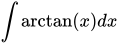
Find Failed to parse (MathML with SVG or PNG fallback (recommended for modern browsers and accessibility tools): Invalid response ("Math extension cannot connect to Restbase.") from server "https://wikimedia.org/api/rest_v1/":): {\displaystyle \int\arctan(x)dx}
Again the trick here is to write the integrand as Failed to parse (MathML with SVG or PNG fallback (recommended for modern browsers and accessibility tools): Invalid response ("Math extension cannot connect to Restbase.") from server "https://wikimedia.org/api/rest_v1/":): {\displaystyle \arctan(x)=\arctan(x)\cdot 1} . Then let
- Failed to parse (MathML with SVG or PNG fallback (recommended for modern browsers and accessibility tools): Invalid response ("Math extension cannot connect to Restbase.") from server "https://wikimedia.org/api/rest_v1/":): {\displaystyle u=\arctan(x)} so Failed to parse (MathML with SVG or PNG fallback (recommended for modern browsers and accessibility tools): Invalid response ("Math extension cannot connect to Restbase.") from server "https://wikimedia.org/api/rest_v1/":): {\displaystyle du=\frac{dx}{1+x^2}}
- Failed to parse (MathML with SVG or PNG fallback (recommended for modern browsers and accessibility tools): Invalid response ("Math extension cannot connect to Restbase.") from server "https://wikimedia.org/api/rest_v1/":): {\displaystyle v=x} so

so using integration by parts,
Failed to parse (MathML with SVG or PNG fallback (recommended for modern browsers and accessibility tools): Invalid response ("Math extension cannot connect to Restbase.") from server "https://wikimedia.org/api/rest_v1/":): {\displaystyle =x\arctan(x)-\int\frac{x}{1+x^2}dx} Failed to parse (MathML with SVG or PNG fallback (recommended for modern browsers and accessibility tools): Invalid response ("Math extension cannot connect to Restbase.") from server "https://wikimedia.org/api/rest_v1/":): {\displaystyle =x\arctan(x)-\tfrac12\ln(1+x^2)+C}
Example
Find Failed to parse (MathML with SVG or PNG fallback (recommended for modern browsers and accessibility tools): Invalid response ("Math extension cannot connect to Restbase.") from server "https://wikimedia.org/api/rest_v1/":): {\displaystyle \int e^x\cos(x)dx}
This example uses integration by parts twice. First let,
- Failed to parse (MathML with SVG or PNG fallback (recommended for modern browsers and accessibility tools): Invalid response ("Math extension cannot connect to Restbase.") from server "https://wikimedia.org/api/rest_v1/":): {\displaystyle u=e^x} so Failed to parse (MathML with SVG or PNG fallback (recommended for modern browsers and accessibility tools): Invalid response ("Math extension cannot connect to Restbase.") from server "https://wikimedia.org/api/rest_v1/":): {\displaystyle du=e^xdx}
- Failed to parse (MathML with SVG or PNG fallback (recommended for modern browsers and accessibility tools): Invalid response ("Math extension cannot connect to Restbase.") from server "https://wikimedia.org/api/rest_v1/":): {\displaystyle dv=\cos(x)dx} so Failed to parse (MathML with SVG or PNG fallback (recommended for modern browsers and accessibility tools): Invalid response ("Math extension cannot connect to Restbase.") from server "https://wikimedia.org/api/rest_v1/":): {\displaystyle v=\sin(x)}
so
- Failed to parse (MathML with SVG or PNG fallback (recommended for modern browsers and accessibility tools): Invalid response ("Math extension cannot connect to Restbase.") from server "https://wikimedia.org/api/rest_v1/":): {\displaystyle \int e^x\cos(x)dx=e^x\sin(x)-\int e^x\sin(x)dx}
Now, to evaluate the remaining integral, we use integration by parts again, with
- Failed to parse (MathML with SVG or PNG fallback (recommended for modern browsers and accessibility tools): Invalid response ("Math extension cannot connect to Restbase.") from server "https://wikimedia.org/api/rest_v1/":): {\displaystyle u=e^x} so Failed to parse (MathML with SVG or PNG fallback (recommended for modern browsers and accessibility tools): Invalid response ("Math extension cannot connect to Restbase.") from server "https://wikimedia.org/api/rest_v1/":): {\displaystyle du=e^xdx}
- Failed to parse (MathML with SVG or PNG fallback (recommended for modern browsers and accessibility tools): Invalid response ("Math extension cannot connect to Restbase.") from server "https://wikimedia.org/api/rest_v1/":): {\displaystyle v=-\cos(x)} so Failed to parse (MathML with SVG or PNG fallback (recommended for modern browsers and accessibility tools): Invalid response ("Math extension cannot connect to Restbase.") from server "https://wikimedia.org/api/rest_v1/":): {\displaystyle dv=\sin(x)dx}
Then
Failed to parse (MathML with SVG or PNG fallback (recommended for modern browsers and accessibility tools): Invalid response ("Math extension cannot connect to Restbase.") from server "https://wikimedia.org/api/rest_v1/":): {\displaystyle \int e^x\sin(x)dx} Failed to parse (MathML with SVG or PNG fallback (recommended for modern browsers and accessibility tools): Invalid response ("Math extension cannot connect to Restbase.") from server "https://wikimedia.org/api/rest_v1/":): {\displaystyle =-e^x\cos(x)-\int -e^x\cos(x)dx} Failed to parse (MathML with SVG or PNG fallback (recommended for modern browsers and accessibility tools): Invalid response ("Math extension cannot connect to Restbase.") from server "https://wikimedia.org/api/rest_v1/":): {\displaystyle =-e^x\cos(x)+\int e^x\cos(x)dx}
Putting these together, we have
- Failed to parse (MathML with SVG or PNG fallback (recommended for modern browsers and accessibility tools): Invalid response ("Math extension cannot connect to Restbase.") from server "https://wikimedia.org/api/rest_v1/":): {\displaystyle \int e^x\cos(x)dx=e^x\sin(x)+e^x\cos(x)-\int e^x\cos(x)dx}
Notice that the same integral shows up on both sides of this equation, but with opposite signs. The integral does not cancel; it doubles when we add the integral to both sides to get
- Failed to parse (MathML with SVG or PNG fallback (recommended for modern browsers and accessibility tools): Invalid response ("Math extension cannot connect to Restbase.") from server "https://wikimedia.org/api/rest_v1/":): {\displaystyle 2\int e^x\cos(x)dx=e^x\bigl(\sin(x)+\cos(x)\bigr)}
- Failed to parse (MathML with SVG or PNG fallback (recommended for modern browsers and accessibility tools): Invalid response ("Math extension cannot connect to Restbase.") from server "https://wikimedia.org/api/rest_v1/":): {\displaystyle \int e^x\cos(x)dx=\frac{e^x\bigl(\sin(x)+\cos(x)\bigr)}{2}}
Resources
- Distance Definite Integral (Slides 23-38). PowerPoint file created by Professor Cynthia Roberts, UTSA.
- Definite Integral & Antiderivatives. PowerPoint file created by Professor Cynthia Roberts, UTSA.
- Antiderivatives PowerPoint file created by Dr. Sara Shirinkam, UTSA.
Licensing
Content obtained and/or adapted from:
- Indefinite integral, Wikibooks: Calculus under a CC BY-SA license

