Difference between revisions of "Derivatives Rates of Change"
(Added video links) |
|||
| Line 1: | Line 1: | ||
| + | ==Average Rate of Change== | ||
| + | Rate of Change is used to describe the ratio of a change in one variable compare to a change of another variable | ||
| + | |||
| + | If there is a function <math>f(x)=y</math> then the rate of change of the function <math>f(x)</math> correspond to the rate of change of variable z is | ||
| + | :<math>\frac{\Delta y}{\Delta x}=\frac{\Delta f(x)}{\Delta x}</math> | ||
| + | |||
| + | For example, if there are two points <math>(1,3)</math> and <math>(2,7)</math>, then | ||
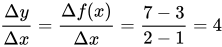
| + | :<math>\frac{\Delta y}{\Delta x}=\frac{\Delta f(x)}{\Delta x}=\frac{7-3}{2-1}=4</math> | ||
| + | |||
| + | ==The Rate of Change of a Function at a Point== | ||
| + | Consider the formula for average velocity in the <math>x</math> direction, <math>\frac{\Delta x}{\Delta t}</math> , where <math>\Delta x</math> is the change in <math>x</math> over the time interval <math>\Delta t</math> . This formula gives the average velocity over a period of time, but suppose we want to define the instantaneous velocity. To this end we look at the '''change in position as the change in time approaches 0'''. Mathematically this is written as: | ||
| + | <math>\lim_{\Delta t\to 0}\frac{\Delta x}{\Delta t}</math> , which we abbreviate by the symbol <math>\frac{dx}{dt}</math> . (The idea of this notation is that the letter <math>d</math> denotes change.) Compare the symbol <math>d</math> with <math>\Delta</math> . The idea is that both indicate a difference between two numbers, but <math>\Delta</math> denotes a finite difference while <math>d</math> denotes an infinitesimal difference. Please note that the symbols <math>dx</math> and <math>dt</math> have no rigorous meaning on their own, since <math>\lim_{\Delta t\to 0}\Delta t=0</math> , and we can't divide by 0. | ||
| + | |||
| + | (Note that the letter <math>s</math> is often used to denote distance, which would yield <math>\frac{ds}{dt}</math> . The letter <math>d</math> is often avoided in denoting distance due to the potential confusion resulting from the expression <math>\frac{dd}{dt}</math>.) | ||
| + | |||
| + | |||
| + | ==Resources== | ||
* [https://mathresearch.utsa.edu/wikiFiles/MAT1214/Derivatives%20as%20Rates%20of%20Change/MAT1214-3.4TheDerivativeAsARateOfChangePwPt.pptx Derivatives as Rates of Change ] PowerPoint file created by Dr. Sara Shirinkam, UTSA. | * [https://mathresearch.utsa.edu/wikiFiles/MAT1214/Derivatives%20as%20Rates%20of%20Change/MAT1214-3.4TheDerivativeAsARateOfChangePwPt.pptx Derivatives as Rates of Change ] PowerPoint file created by Dr. Sara Shirinkam, UTSA. | ||
* [https://mathresearch.utsa.edu/wikiFiles/MAT1214/Derivatives%20as%20Rates%20of%20Change/MAT1214-3.4TheDerivativeAsARateOfChangeWS1.pdf Derivatives as Rates of Change Worksheet] | * [https://mathresearch.utsa.edu/wikiFiles/MAT1214/Derivatives%20as%20Rates%20of%20Change/MAT1214-3.4TheDerivativeAsARateOfChangeWS1.pdf Derivatives as Rates of Change Worksheet] | ||
| − | |||
| − | |||
* [https://youtu.be/4Up5gsDeluw Average and Instantaneous Rate of Change of a function over an interval & a point - Calculus] by The Organic Chemistry Tutor | * [https://youtu.be/4Up5gsDeluw Average and Instantaneous Rate of Change of a function over an interval & a point - Calculus] by The Organic Chemistry Tutor | ||
* [https://youtu.be/jlihNi_Mkos Finding Instantaneous Rates of Change Using Def'n of Derivative] by patrickJMT | * [https://youtu.be/jlihNi_Mkos Finding Instantaneous Rates of Change Using Def'n of Derivative] by patrickJMT | ||
Revision as of 13:55, 30 September 2021
Average Rate of Change
Rate of Change is used to describe the ratio of a change in one variable compare to a change of another variable
If there is a function Failed to parse (MathML with SVG or PNG fallback (recommended for modern browsers and accessibility tools): Invalid response ("Math extension cannot connect to Restbase.") from server "https://wikimedia.org/api/rest_v1/":): {\displaystyle f(x)=y} then the rate of change of the function correspond to the rate of change of variable z is


For example, if there are two points and , then


The Rate of Change of a Function at a Point
Consider the formula for average velocity in the direction, , where is the change in over the time interval . This formula gives the average velocity over a period of time, but suppose we want to define the instantaneous velocity. To this end we look at the change in position as the change in time approaches 0. Mathematically this is written as: , which we abbreviate by the symbol Failed to parse (MathML with SVG or PNG fallback (recommended for modern browsers and accessibility tools): Invalid response ("Math extension cannot connect to Restbase.") from server "https://wikimedia.org/api/rest_v1/":): {\displaystyle \frac{dx}{dt}} . (The idea of this notation is that the letter Failed to parse (MathML with SVG or PNG fallback (recommended for modern browsers and accessibility tools): Invalid response ("Math extension cannot connect to Restbase.") from server "https://wikimedia.org/api/rest_v1/":): {\displaystyle d} denotes change.) Compare the symbol Failed to parse (MathML with SVG or PNG fallback (recommended for modern browsers and accessibility tools): Invalid response ("Math extension cannot connect to Restbase.") from server "https://wikimedia.org/api/rest_v1/":): {\displaystyle d} with Failed to parse (MathML with SVG or PNG fallback (recommended for modern browsers and accessibility tools): Invalid response ("Math extension cannot connect to Restbase.") from server "https://wikimedia.org/api/rest_v1/":): {\displaystyle \Delta} . The idea is that both indicate a difference between two numbers, but Failed to parse (MathML with SVG or PNG fallback (recommended for modern browsers and accessibility tools): Invalid response ("Math extension cannot connect to Restbase.") from server "https://wikimedia.org/api/rest_v1/":): {\displaystyle \Delta} denotes a finite difference while Failed to parse (MathML with SVG or PNG fallback (recommended for modern browsers and accessibility tools): Invalid response ("Math extension cannot connect to Restbase.") from server "https://wikimedia.org/api/rest_v1/":): {\displaystyle d} denotes an infinitesimal difference. Please note that the symbols Failed to parse (MathML with SVG or PNG fallback (recommended for modern browsers and accessibility tools): Invalid response ("Math extension cannot connect to Restbase.") from server "https://wikimedia.org/api/rest_v1/":): {\displaystyle dx} and Failed to parse (MathML with SVG or PNG fallback (recommended for modern browsers and accessibility tools): Invalid response ("Math extension cannot connect to Restbase.") from server "https://wikimedia.org/api/rest_v1/":): {\displaystyle dt} have no rigorous meaning on their own, since Failed to parse (MathML with SVG or PNG fallback (recommended for modern browsers and accessibility tools): Invalid response ("Math extension cannot connect to Restbase.") from server "https://wikimedia.org/api/rest_v1/":): {\displaystyle \lim_{\Delta t\to 0}\Delta t=0} , and we can't divide by 0.


(Note that the letter Failed to parse (MathML with SVG or PNG fallback (recommended for modern browsers and accessibility tools): Invalid response ("Math extension cannot connect to Restbase.") from server "https://wikimedia.org/api/rest_v1/":): {\displaystyle s} is often used to denote distance, which would yield Failed to parse (MathML with SVG or PNG fallback (recommended for modern browsers and accessibility tools): Invalid response ("Math extension cannot connect to Restbase.") from server "https://wikimedia.org/api/rest_v1/":): {\displaystyle \frac{ds}{dt}} . The letter Failed to parse (MathML with SVG or PNG fallback (recommended for modern browsers and accessibility tools): Invalid response ("Math extension cannot connect to Restbase.") from server "https://wikimedia.org/api/rest_v1/":): {\displaystyle d} is often avoided in denoting distance due to the potential confusion resulting from the expression Failed to parse (MathML with SVG or PNG fallback (recommended for modern browsers and accessibility tools): Invalid response ("Math extension cannot connect to Restbase.") from server "https://wikimedia.org/api/rest_v1/":): {\displaystyle \frac{dd}{dt}} .)
Resources
- Derivatives as Rates of Change PowerPoint file created by Dr. Sara Shirinkam, UTSA.
- Average and Instantaneous Rate of Change of a function over an interval & a point - Calculus by The Organic Chemistry Tutor

