Difference between revisions of "Function Notation"
m |
|||
| Line 1: | Line 1: | ||
| + | See [[Functions]] for more information. | ||
| + | |||
| + | Functions are used so much that there is a special notation for them. The notation is somewhat ambiguous, so familiarity with it is important in order to understand the intention of an equation or formula. | ||
| + | |||
| + | Though there are no strict rules for naming a function, it is standard practice to use the letters <math>f</math> , <math>g</math> , and <math>h</math> to denote functions, and the variable <math>x</math> to denote an independent variable. <math>y</math> is used for both dependent and independent variables. | ||
| + | |||
| + | When discussing or working with a function <math>f</math> , it's important to know not only the function, but also its independent variable <math>x</math> . Thus, when referring to a function <math>f</math>, you usually do not write <math>f</math>, but instead <math>f(x)</math> . The function is now referred to as "<math>f</math> of <math>x</math>". The name of the function is adjacent to the independent variable (in parentheses). This is useful for indicating the value of the function at a particular value of the independent variable. For instance, if | ||
| + | :<math>f(x)=7x+1</math> , | ||
| + | and if we want to use the value of <math>f</math> for <math>x</math> equal to <math>2</math> , then we would substitute 2 for <math>x</math> on both sides of the definition above and write | ||
| + | :<math>f(2)=7(2)+1=14+1=15</math> | ||
| + | |||
| + | This notation is more informative than leaving off the independent variable and writing simply '<math>f</math>' , but can be ambiguous since the parentheses next to <math>f</math> can be misinterpreted as multiplication, <math>2f</math>. To make sure nobody is too confused, follow this procedure: | ||
| + | |||
| + | # Define the function <math>f</math> by equating it to some expression. | ||
| + | # Give a sentence like the following: "At <math>x=c</math>, the function <math>f</math> is..." | ||
| + | # Evaluate the function. | ||
| + | |||
| + | === Function Description === | ||
| + | There are many ways which people describe functions. In the examples above, a verbal descriptions is given (the height of the ball above the earth as a function of time). Here is a list of ways to describe functions. The top three listed approaches to describing functions are the most popular. | ||
| + | |||
| + | # A function is given a name (such as <math>f</math>) and a formula for the function is also given. For example, <math>f(x)=3x+2</math> describes a function. We refer to the input as the '''argument''' of the function (or the '''independent variable'''), and to the output as the '''value''' of the function at the given argument. | ||
| + | # A function is described using an equation and two variables. One variable is for the input of the function and one is for the output of the function. The variable for the input is called the '''independent variable'''. The variable for the output is called the '''dependent variable'''. For example, <math>y=3x+2</math> describes a function. The dependent variable appears by itself on the left hand side of equal sign. | ||
| + | # A verbal description of the function. | ||
| + | |||
| + | When a function is given a name (like in number 1 above), the name of the function is usually a single letter of the alphabet (such as <math>f</math> or <math>g</math>). Some functions whose names are multiple letters (like the sine function <math>y=\sin(x)</math> | ||
| + | |||
| + | ===Plugging a value into a function=== | ||
| + | If we write <math>f(x)=3x+2</math> , then we know that | ||
| + | |||
| + | *The function <math>f</math> is a function of <math>x</math> . | ||
| + | *To evaluate the function at a certain number, replace the <math>x</math> with that number. | ||
| + | *Replacing <math>x</math> with that number in the right side of the function will produce the function's output for that certain input. | ||
| + | *In English, the definition of <math>f</math> is interpreted, "Given a number, <math>f</math> will return ''two more than the triple of that number''." | ||
| + | |||
| + | How would we know the value of the function <math>f</math> at 3? | ||
| + | We would have the following three thoughts: | ||
| + | |||
| + | # <math>f(3)=3(3)+2</math> | ||
| + | # <math>3(3)+2=9+2</math> | ||
| + | # <math>9+2=11</math> | ||
| + | and we would write | ||
| + | |||
| + | <math>f(3)=3(3)+2=9+2=11</math>. | ||
| + | |||
| + | The value of <math>f</math> at 3 is 11. | ||
| + | |||
| + | Note that <math>f(3)</math> means the value of the dependent variable when <math>x</math> takes on the value of 3. So we see that the number ''11'' is the output of the function when we give the number ''3'' as the input. People often summarize the work above by writing "the value of <math>f</math> at three is eleven", or simply "<math>f</math> of three equals eleven". | ||
| + | |||
==Resources== | ==Resources== | ||
* [https://mathresearch.utsa.edu/wikiFiles/MAT1053/Function_and_Function_Notation/MAT1053_M1.1Functions_and_Function_Notation.pdf Function and Function Notation],Book Chapter | * [https://mathresearch.utsa.edu/wikiFiles/MAT1053/Function_and_Function_Notation/MAT1053_M1.1Functions_and_Function_Notation.pdf Function and Function Notation],Book Chapter | ||
* [https://mathresearch.utsa.edu/wikiFiles/MAT1053/Function_and_Function_Notation/MAT1053_M1.1_Functions_and_Function_NotationGN.pdf Function and Function Notation Guided Notes] | * [https://mathresearch.utsa.edu/wikiFiles/MAT1053/Function_and_Function_Notation/MAT1053_M1.1_Functions_and_Function_NotationGN.pdf Function and Function Notation Guided Notes] | ||
Revision as of 10:50, 4 October 2021
See Functions for more information.
Functions are used so much that there is a special notation for them. The notation is somewhat ambiguous, so familiarity with it is important in order to understand the intention of an equation or formula.
Though there are no strict rules for naming a function, it is standard practice to use the letters , , and to denote functions, and the variable to denote an independent variable. is used for both dependent and independent variables.


When discussing or working with a function , it's important to know not only the function, but also its independent variable . Thus, when referring to a function , you usually do not write , but instead . The function is now referred to as " of ". The name of the function is adjacent to the independent variable (in parentheses). This is useful for indicating the value of the function at a particular value of the independent variable. For instance, if

- ,
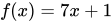
and if we want to use the value of for equal to , then we would substitute 2 for on both sides of the definition above and write


This notation is more informative than leaving off the independent variable and writing simply '' , but can be ambiguous since the parentheses next to can be misinterpreted as multiplication, . To make sure nobody is too confused, follow this procedure:

- Define the function by equating it to some expression.
- Give a sentence like the following: "At , the function is..."
- Evaluate the function.

Function Description
There are many ways which people describe functions. In the examples above, a verbal descriptions is given (the height of the ball above the earth as a function of time). Here is a list of ways to describe functions. The top three listed approaches to describing functions are the most popular.
- A function is given a name (such as ) and a formula for the function is also given. For example, describes a function. We refer to the input as the argument of the function (or the independent variable), and to the output as the value of the function at the given argument.
- A function is described using an equation and two variables. One variable is for the input of the function and one is for the output of the function. The variable for the input is called the independent variable. The variable for the output is called the dependent variable. For example, describes a function. The dependent variable appears by itself on the left hand side of equal sign.
- A verbal description of the function.
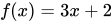

When a function is given a name (like in number 1 above), the name of the function is usually a single letter of the alphabet (such as or ). Some functions whose names are multiple letters (like the sine function

Plugging a value into a function
If we write , then we know that
- The function is a function of .
- To evaluate the function at a certain number, replace the with that number.
- Replacing with that number in the right side of the function will produce the function's output for that certain input.
- In English, the definition of is interpreted, "Given a number, will return two more than the triple of that number."
How would we know the value of the function at 3? We would have the following three thoughts:



and we would write
Failed to parse (MathML with SVG or PNG fallback (recommended for modern browsers and accessibility tools): Invalid response ("Math extension cannot connect to Restbase.") from server "https://wikimedia.org/api/rest_v1/":): {\displaystyle f(3)=3(3)+2=9+2=11} .
The value of Failed to parse (MathML with SVG or PNG fallback (recommended for modern browsers and accessibility tools): Invalid response ("Math extension cannot connect to Restbase.") from server "https://wikimedia.org/api/rest_v1/":): {\displaystyle f} at 3 is 11.
Note that Failed to parse (MathML with SVG or PNG fallback (recommended for modern browsers and accessibility tools): Invalid response ("Math extension cannot connect to Restbase.") from server "https://wikimedia.org/api/rest_v1/":): {\displaystyle f(3)} means the value of the dependent variable when Failed to parse (MathML with SVG or PNG fallback (recommended for modern browsers and accessibility tools): Invalid response ("Math extension cannot connect to Restbase.") from server "https://wikimedia.org/api/rest_v1/":): {\displaystyle x} takes on the value of 3. So we see that the number 11 is the output of the function when we give the number 3 as the input. People often summarize the work above by writing "the value of Failed to parse (MathML with SVG or PNG fallback (recommended for modern browsers and accessibility tools): Invalid response ("Math extension cannot connect to Restbase.") from server "https://wikimedia.org/api/rest_v1/":): {\displaystyle f} at three is eleven", or simply "Failed to parse (MathML with SVG or PNG fallback (recommended for modern browsers and accessibility tools): Invalid response ("Math extension cannot connect to Restbase.") from server "https://wikimedia.org/api/rest_v1/":): {\displaystyle f} of three equals eleven".

