Difference between revisions of "Derivatives of the Trigonometric Functions"
(Added links for PowerPoint and worksheet) |
|||
| Line 1: | Line 1: | ||
| + | |||
| + | Sine, cosine, tangent, cosecant, secant, cotangent. These are functions that crop up continuously in mathematics and engineering and have a lot of practical applications. They also appear in more advanced mathematics, particularly when dealing with things such as line integrals with complex numbers and alternate representations of space like spherical and cylindrical coordinate systems. | ||
| + | |||
| + | We use the definition of the derivative, i.e., | ||
| + | :<math>f'(x)=\lim_{h\to 0}\frac{f(x+h)-f(x)}{h}</math> , | ||
| + | to work these first two out. | ||
| + | |||
| + | Let us find the derivative of sin(''x''), using the above definition. | ||
| + | |||
| + | {| WIDTH="75%"; style="background-color: #FFFFFF; border: solid 1px #D6D6FF; padding: 1em;" valign="top" | | ||
| + | |- | ||
| + | |<math>f(x)=\sin(x)</math> | ||
| + | |- | ||
| + | |<math>f'(x)=\lim_{h\to 0}\frac{\sin(x+h)-\sin(x)}{h}</math>|| Definition of derivative | ||
| + | |- | ||
| + | |<math>=\lim_{h\to 0}\frac{\cos(x)\sin(h)+\cos(h)\sin(x)-\sin(x)}{h}</math>|| trigonometric identity | ||
| + | |- | ||
| + | |<math>=\lim_{h\to 0}\frac{\cos(x)\sin(h)+(\cos(h)-1)\sin(x)}{h}</math>|| factoring | ||
| + | |- | ||
| + | |<math>=\lim_{h\to 0}\frac{\cos(x)\sin(h)}{h}+\lim_{h\to 0}\frac{(\cos(h)-1)\sin(x)}{h}</math>|| separation of terms | ||
| + | |- | ||
| + | |<math>=\cos(x)\times 1+\sin(x)\times 0</math>|| application of limit | ||
| + | |- | ||
| + | |<math>=\cos(x)</math>|| solution | ||
| + | |- | ||
| + | |} | ||
| + | |||
| + | Now for the case of cos(''x''). | ||
| + | {| WIDTH="75%"; style="background-color: #FFFFFF; border: solid 1px #D6D6FF; padding: 1em;" valign="top" | | ||
| + | |- | ||
| + | |<math>f(x)=\cos(x)</math> | ||
| + | |- | ||
| + | |<math>f'(x)=\lim_{h\to 0}\frac{\cos(x+h)-\cos(x)}{h}</math>|| Definition of derivative | ||
| + | |- | ||
| + | |<math>=\lim_{h\to 0}\frac{\cos(x)\cos(h)-\sin(h)\sin(x)-\cos(x)}{h}</math>|| trigonometric identity | ||
| + | |- | ||
| + | |<math>=\lim_{h\to 0}\frac{\cos(x)(\cos(h)-1)-\sin(x)\sin(h)}{h}</math>|| factoring | ||
| + | |- | ||
| + | |<math>=\lim_{h\to 0}\frac{\cos(x)(\cos(h)-1)}{h}-\lim_{h\to 0}\frac{\sin(x)\sin(h)}{h}</math>|| separation of terms | ||
| + | |- | ||
| + | |<math>=\cos(x)\times 0-\sin(x)\times 1</math>|| application of limit | ||
| + | |- | ||
| + | |<math>=-\sin(x)</math>||solution | ||
| + | |} | ||
| + | |||
| + | Therefore we have established | ||
| + | |||
| + | {| WIDTH="75%" | ||
| + | |- | ||
| + | | style="background-color: #FFFFFF; border: solid 1px #D6D6FF; padding: 1em;" valign="top" | | ||
| + | <center>'''Derivative of Sine and Cosine'''<br> | ||
| + | <math>\frac{d}{dx}\sin(x)=\cos(x)</math><br> | ||
| + | <math>\frac{d}{dx}\cos(x)=-\sin(x)</math><br> | ||
| + | </center> | ||
| + | |} | ||
| + | |||
| + | |||
| + | |||
| + | To find the derivative of the tangent, we just remember that: | ||
| + | |||
| + | <math>\tan(x)=\frac{\sin(x)}{\cos(x)}</math> | ||
| + | |||
| + | which is a quotient. Applying the quotient rule, we get: | ||
| + | |||
| + | <math>\frac{d}{dx}\tan(x)=\frac{\cos^2(x)+\sin^2(x)}{\cos^2(x)}</math> | ||
| + | |||
| + | Then, remembering that <math>\cos^2(x)+\sin^2(x)=1</math> , we simplify: | ||
| + | {| | ||
| + | |- | ||
| + | |<math>\frac{\cos^2(x)+\sin^2(x)}{\cos^2(x)}</math> | ||
| + | |<math>=\frac{1}{\cos^2(x)}</math> | ||
| + | |- | ||
| + | | | ||
| + | |<math>=\sec^2(x)</math> | ||
| + | |- | ||
| + | |} | ||
| + | |||
| + | |||
| + | {| WIDTH="75%" | ||
| + | |- | ||
| + | | style="background-color: #FFFFFF; border: solid 1px #D6D6FF; padding: 1em;" valign="top" | | ||
| + | <center>'''Derivative of the Tangent'''<br> | ||
| + | <math>\frac{d}{dx}\tan(x)=\sec^2(x)</math><br> | ||
| + | </center> | ||
| + | |} | ||
| + | |||
| + | For secants, we again apply the quotient rule. | ||
| + | |||
| + | :<math>\sec(x)=\frac{1}{\cos(x)}</math> | ||
| + | :<math>\begin{align}\frac{d}{dx}\sec(x)&=\frac{d}{dx}\frac{1}{\cos(x)}\\ | ||
| + | &=\frac{\cos(x)\frac{d 1}{dx}-1\frac{d\cos(x)}{dx}}{\cos(x)^2}\\ | ||
| + | &=\frac{\cos(x)0-1(-\sin(x))}{\cos(x)^2} | ||
| + | \end{align}</math> | ||
| + | |||
| + | Leaving us with: | ||
| + | |||
| + | :<math>\frac{d}{dx}\sec(x)=\frac{\sin(x)}{\cos^2(x)}</math> | ||
| + | |||
| + | Simplifying, we get: | ||
| + | |||
| + | |||
| + | {| WIDTH="75%" | ||
| + | |- | ||
| + | | style="background-color: #FFFFFF; border: solid 1px #D6D6FF; padding: 1em;" valign="top" | | ||
| + | <center>'''Derivative of the Secant'''<br> | ||
| + | <math>\frac{d}{dx}\sec(x)=\sec(x)\tan(x)</math><br> | ||
| + | </center> | ||
| + | |} | ||
| + | |||
| + | Using the same procedure on cosecants: | ||
| + | :<math>\csc(x)=\frac{1}{\sin(x)}</math> | ||
| + | |||
| + | We get: | ||
| + | |||
| + | |||
| + | {| WIDTH="75%" | ||
| + | |- | ||
| + | | style="background-color: #FFFFFF; border: solid 1px #D6D6FF; padding: 1em;" valign="top" | | ||
| + | <center>'''Derivative of the Cosecant'''<br> | ||
| + | <math>\frac{d}{dx}\csc(x)=-\csc(x)\cot(x)</math><br> | ||
| + | </center> | ||
| + | |} | ||
| + | |||
| + | Using the same procedure for the cotangent that we used for the tangent, we get: | ||
| + | |||
| + | |||
| + | {| WIDTH="75%" | ||
| + | |- | ||
| + | | style="background-color: #FFFFFF; border: solid 1px #D6D6FF; padding: 1em;" valign="top" | | ||
| + | <center>'''Derivative of the Cotangent'''<br> | ||
| + | <math>\frac{d}{dx}\cot(x)=-\csc^2(x)</math><br> | ||
| + | </center> | ||
| + | |} | ||
| + | |||
| + | ==Resources== | ||
* [https://mathresearch.utsa.edu/wikiFiles/MAT1214/Derivatives%20of%20the%20Trigonometric%20Functions/MAT1214-3.5TheDerivativesOfTheTrigonometricFunctionsPwPt.pptx The Derivatives of the Trigonometric Functions] PowerPoint file created by Dr. Sara Shirinkam, UTSA. | * [https://mathresearch.utsa.edu/wikiFiles/MAT1214/Derivatives%20of%20the%20Trigonometric%20Functions/MAT1214-3.5TheDerivativesOfTheTrigonometricFunctionsPwPt.pptx The Derivatives of the Trigonometric Functions] PowerPoint file created by Dr. Sara Shirinkam, UTSA. | ||
* [https://mathresearch.utsa.edu/wikiFiles/MAT1214/Derivatives%20of%20the%20Trigonometric%20Functions/MAT1214-3.5TheDerivativesOfTheTrigonometricFunctionsWS1.pdf The Derivatives of the Trigonometric Functions Worksheet] PowerPoint file created by Dr. Sara Shirinkam, UTSA. | * [https://mathresearch.utsa.edu/wikiFiles/MAT1214/Derivatives%20of%20the%20Trigonometric%20Functions/MAT1214-3.5TheDerivativesOfTheTrigonometricFunctionsWS1.pdf The Derivatives of the Trigonometric Functions Worksheet] PowerPoint file created by Dr. Sara Shirinkam, UTSA. | ||
Revision as of 11:26, 10 October 2021
Sine, cosine, tangent, cosecant, secant, cotangent. These are functions that crop up continuously in mathematics and engineering and have a lot of practical applications. They also appear in more advanced mathematics, particularly when dealing with things such as line integrals with complex numbers and alternate representations of space like spherical and cylindrical coordinate systems.
We use the definition of the derivative, i.e.,
- Failed to parse (MathML with SVG or PNG fallback (recommended for modern browsers and accessibility tools): Invalid response ("Math extension cannot connect to Restbase.") from server "https://wikimedia.org/api/rest_v1/":): {\displaystyle f'(x)=\lim_{h\to 0}\frac{f(x+h)-f(x)}{h}} ,
to work these first two out.
Let us find the derivative of sin(x), using the above definition.
| Failed to parse (MathML with SVG or PNG fallback (recommended for modern browsers and accessibility tools): Invalid response ("Math extension cannot connect to Restbase.") from server "https://wikimedia.org/api/rest_v1/":): {\displaystyle f(x)=\sin(x)} | |
| Failed to parse (MathML with SVG or PNG fallback (recommended for modern browsers and accessibility tools): Invalid response ("Math extension cannot connect to Restbase.") from server "https://wikimedia.org/api/rest_v1/":): {\displaystyle f'(x)=\lim_{h\to 0}\frac{\sin(x+h)-\sin(x)}{h}} | Definition of derivative |
| Failed to parse (MathML with SVG or PNG fallback (recommended for modern browsers and accessibility tools): Invalid response ("Math extension cannot connect to Restbase.") from server "https://wikimedia.org/api/rest_v1/":): {\displaystyle =\lim_{h\to 0}\frac{\cos(x)\sin(h)+\cos(h)\sin(x)-\sin(x)}{h}} | trigonometric identity |
| Failed to parse (MathML with SVG or PNG fallback (recommended for modern browsers and accessibility tools): Invalid response ("Math extension cannot connect to Restbase.") from server "https://wikimedia.org/api/rest_v1/":): {\displaystyle =\lim_{h\to 0}\frac{\cos(x)\sin(h)+(\cos(h)-1)\sin(x)}{h}} | factoring |
| Failed to parse (MathML with SVG or PNG fallback (recommended for modern browsers and accessibility tools): Invalid response ("Math extension cannot connect to Restbase.") from server "https://wikimedia.org/api/rest_v1/":): {\displaystyle =\lim_{h\to 0}\frac{\cos(x)\sin(h)}{h}+\lim_{h\to 0}\frac{(\cos(h)-1)\sin(x)}{h}} | separation of terms |
| Failed to parse (MathML with SVG or PNG fallback (recommended for modern browsers and accessibility tools): Invalid response ("Math extension cannot connect to Restbase.") from server "https://wikimedia.org/api/rest_v1/":): {\displaystyle =\cos(x)\times 1+\sin(x)\times 0} | application of limit |
| Failed to parse (MathML with SVG or PNG fallback (recommended for modern browsers and accessibility tools): Invalid response ("Math extension cannot connect to Restbase.") from server "https://wikimedia.org/api/rest_v1/":): {\displaystyle =\cos(x)} | solution |
Now for the case of cos(x).
| Failed to parse (MathML with SVG or PNG fallback (recommended for modern browsers and accessibility tools): Invalid response ("Math extension cannot connect to Restbase.") from server "https://wikimedia.org/api/rest_v1/":): {\displaystyle f(x)=\cos(x)} | |
| Failed to parse (MathML with SVG or PNG fallback (recommended for modern browsers and accessibility tools): Invalid response ("Math extension cannot connect to Restbase.") from server "https://wikimedia.org/api/rest_v1/":): {\displaystyle f'(x)=\lim_{h\to 0}\frac{\cos(x+h)-\cos(x)}{h}} | Definition of derivative |
| Failed to parse (MathML with SVG or PNG fallback (recommended for modern browsers and accessibility tools): Invalid response ("Math extension cannot connect to Restbase.") from server "https://wikimedia.org/api/rest_v1/":): {\displaystyle =\lim_{h\to 0}\frac{\cos(x)\cos(h)-\sin(h)\sin(x)-\cos(x)}{h}} | trigonometric identity |
| Failed to parse (MathML with SVG or PNG fallback (recommended for modern browsers and accessibility tools): Invalid response ("Math extension cannot connect to Restbase.") from server "https://wikimedia.org/api/rest_v1/":): {\displaystyle =\lim_{h\to 0}\frac{\cos(x)(\cos(h)-1)-\sin(x)\sin(h)}{h}} | factoring |
| Failed to parse (MathML with SVG or PNG fallback (recommended for modern browsers and accessibility tools): Invalid response ("Math extension cannot connect to Restbase.") from server "https://wikimedia.org/api/rest_v1/":): {\displaystyle =\lim_{h\to 0}\frac{\cos(x)(\cos(h)-1)}{h}-\lim_{h\to 0}\frac{\sin(x)\sin(h)}{h}} | separation of terms |
| Failed to parse (MathML with SVG or PNG fallback (recommended for modern browsers and accessibility tools): Invalid response ("Math extension cannot connect to Restbase.") from server "https://wikimedia.org/api/rest_v1/":): {\displaystyle =\cos(x)\times 0-\sin(x)\times 1} | application of limit |
| Failed to parse (MathML with SVG or PNG fallback (recommended for modern browsers and accessibility tools): Invalid response ("Math extension cannot connect to Restbase.") from server "https://wikimedia.org/api/rest_v1/":): {\displaystyle =-\sin(x)} | solution |
Therefore we have established
|
Failed to parse (MathML with SVG or PNG fallback (recommended for modern browsers and accessibility tools): Invalid response ("Math extension cannot connect to Restbase.") from server "https://wikimedia.org/api/rest_v1/":): {\displaystyle \frac{d}{dx}\sin(x)=\cos(x)}
|
To find the derivative of the tangent, we just remember that:
Failed to parse (MathML with SVG or PNG fallback (recommended for modern browsers and accessibility tools): Invalid response ("Math extension cannot connect to Restbase.") from server "https://wikimedia.org/api/rest_v1/":): {\displaystyle \tan(x)=\frac{\sin(x)}{\cos(x)}}
which is a quotient. Applying the quotient rule, we get:
Failed to parse (MathML with SVG or PNG fallback (recommended for modern browsers and accessibility tools): Invalid response ("Math extension cannot connect to Restbase.") from server "https://wikimedia.org/api/rest_v1/":): {\displaystyle \frac{d}{dx}\tan(x)=\frac{\cos^2(x)+\sin^2(x)}{\cos^2(x)}}
Then, remembering that Failed to parse (MathML with SVG or PNG fallback (recommended for modern browsers and accessibility tools): Invalid response ("Math extension cannot connect to Restbase.") from server "https://wikimedia.org/api/rest_v1/":): {\displaystyle \cos^2(x)+\sin^2(x)=1} , we simplify:
| Failed to parse (MathML with SVG or PNG fallback (recommended for modern browsers and accessibility tools): Invalid response ("Math extension cannot connect to Restbase.") from server "https://wikimedia.org/api/rest_v1/":): {\displaystyle \frac{\cos^2(x)+\sin^2(x)}{\cos^2(x)}} | Failed to parse (MathML with SVG or PNG fallback (recommended for modern browsers and accessibility tools): Invalid response ("Math extension cannot connect to Restbase.") from server "https://wikimedia.org/api/rest_v1/":): {\displaystyle =\frac{1}{\cos^2(x)}} |
| Failed to parse (MathML with SVG or PNG fallback (recommended for modern browsers and accessibility tools): Invalid response ("Math extension cannot connect to Restbase.") from server "https://wikimedia.org/api/rest_v1/":): {\displaystyle =\sec^2(x)} |
|
Failed to parse (MathML with SVG or PNG fallback (recommended for modern browsers and accessibility tools): Invalid response ("Math extension cannot connect to Restbase.") from server "https://wikimedia.org/api/rest_v1/":): {\displaystyle \frac{d}{dx}\tan(x)=\sec^2(x)}
|
For secants, we again apply the quotient rule.
- Failed to parse (MathML with SVG or PNG fallback (recommended for modern browsers and accessibility tools): Invalid response ("Math extension cannot connect to Restbase.") from server "https://wikimedia.org/api/rest_v1/":): {\displaystyle \sec(x)=\frac{1}{\cos(x)}}
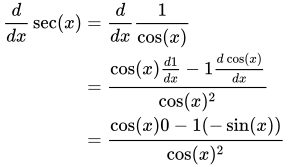
Leaving us with:
- Failed to parse (MathML with SVG or PNG fallback (recommended for modern browsers and accessibility tools): Invalid response ("Math extension cannot connect to Restbase.") from server "https://wikimedia.org/api/rest_v1/":): {\displaystyle \frac{d}{dx}\sec(x)=\frac{\sin(x)}{\cos^2(x)}}
Simplifying, we get:
|
Failed to parse (MathML with SVG or PNG fallback (recommended for modern browsers and accessibility tools): Invalid response ("Math extension cannot connect to Restbase.") from server "https://wikimedia.org/api/rest_v1/":): {\displaystyle \frac{d}{dx}\sec(x)=\sec(x)\tan(x)}
|
Using the same procedure on cosecants:
- Failed to parse (MathML with SVG or PNG fallback (recommended for modern browsers and accessibility tools): Invalid response ("Math extension cannot connect to Restbase.") from server "https://wikimedia.org/api/rest_v1/":): {\displaystyle \csc(x)=\frac{1}{\sin(x)}}
We get:
|
Failed to parse (MathML with SVG or PNG fallback (recommended for modern browsers and accessibility tools): Invalid response ("Math extension cannot connect to Restbase.") from server "https://wikimedia.org/api/rest_v1/":): {\displaystyle \frac{d}{dx}\csc(x)=-\csc(x)\cot(x)}
|
Using the same procedure for the cotangent that we used for the tangent, we get:
|
Failed to parse (MathML with SVG or PNG fallback (recommended for modern browsers and accessibility tools): Invalid response ("Math extension cannot connect to Restbase.") from server "https://wikimedia.org/api/rest_v1/":): {\displaystyle \frac{d}{dx}\cot(x)=-\csc^2(x)}
|
Resources
- The Derivatives of the Trigonometric Functions PowerPoint file created by Dr. Sara Shirinkam, UTSA.
- The Derivatives of the Trigonometric Functions Worksheet PowerPoint file created by Dr. Sara Shirinkam, UTSA.

