Exponential growth and decay models
Contents
The Natural Functions
The Natural Exponent Function
The base e is a transcendental function defined by an infinite series, which approximately is 2.71828:
Failed to parse (MathML with SVG or PNG fallback (recommended for modern browsers and accessibility tools): Invalid response ("Math extension cannot connect to Restbase.") from server "https://wikimedia.org/api/rest_v1/":): {\displaystyle e = \sum_{n = 0}^\infty \frac{1}{n!} = \frac{1}{0!} + \frac{1}{1!} + \frac{1}{2!} + \frac{1}{3!} + \frac{1}{4!} + \cdots} .
e is one of the most important number in mathematics because of its use in most natural growth processes calculations. Since it is an exponential function it follows all the laws of exponential functions. The natural exponent is the inverse function of natural logarithm, so that Failed to parse (MathML with SVG or PNG fallback (recommended for modern browsers and accessibility tools): Invalid response ("Math extension cannot connect to Restbase.") from server "https://wikimedia.org/api/rest_v1/":): {\displaystyle e^{\ln x} = x\,} . On the right is the graph of Failed to parse (MathML with SVG or PNG fallback (recommended for modern browsers and accessibility tools): Invalid response ("Math extension cannot connect to Restbase.") from server "https://wikimedia.org/api/rest_v1/":): {\displaystyle e^x\,} .
The Natural Logarithm
The natural log is a logarithmic function with the base e: Failed to parse (MathML with SVG or PNG fallback (recommended for modern browsers and accessibility tools): Invalid response ("Math extension cannot connect to Restbase.") from server "https://wikimedia.org/api/rest_v1/":): {\displaystyle \log_e x\,} . It has a special notation of Failed to parse (MathML with SVG or PNG fallback (recommended for modern browsers and accessibility tools): Invalid response ("Math extension cannot connect to Restbase.") from server "https://wikimedia.org/api/rest_v1/":): {\displaystyle \ln x\,} . Since the natural logarithm is a logarithmic function it follows all the laws of logarithmic functions. The natural logarithm is the inverse function of natural exponent, so that Failed to parse (MathML with SVG or PNG fallback (recommended for modern browsers and accessibility tools): Invalid response ("Math extension cannot connect to Restbase.") from server "https://wikimedia.org/api/rest_v1/":): {\displaystyle \ln e^x = x\,} . On the right is the graph of Failed to parse (MathML with SVG or PNG fallback (recommended for modern browsers and accessibility tools): Invalid response ("Math extension cannot connect to Restbase.") from server "https://wikimedia.org/api/rest_v1/":): {\displaystyle \ln x\,} .
Exponential growth and decay
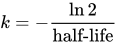
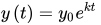
One of the primary usage of the natural functions is the calculation of natural growth or decay, which can be calculated using the following formula: Failed to parse (MathML with SVG or PNG fallback (recommended for modern browsers and accessibility tools): Invalid response ("Math extension cannot connect to Restbase.") from server "https://wikimedia.org/api/rest_v1/":): {\displaystyle y\left(t\right)=y_0e^{kt}\,} , where y(t) is the final value, Failed to parse (MathML with SVG or PNG fallback (recommended for modern browsers and accessibility tools): Invalid response ("Math extension cannot connect to Restbase.") from server "https://wikimedia.org/api/rest_v1/":): {\displaystyle y_0} is the initial value, k is the growth constant, t is the elapsed time. One special decay is the half life of an element there k is defined as: Failed to parse (MathML with SVG or PNG fallback (recommended for modern browsers and accessibility tools): Invalid response ("Math extension cannot connect to Restbase.") from server "https://wikimedia.org/api/rest_v1/":): {\displaystyle k = - \frac {\ln 2}{\mbox{half-life}}} . Exponential growth and decay have a very broad range of applications from measuring the growth bacteria colony to calculating involving interest.
Example of Exponential Growth
A bacterial colony was started with 200 bacteria, in 2 hours the colony has grown to 600 bacteria. Predict the quantity of bacteria in the colony in 6 hours?
From this we know:
- y(t) = 600
- Failed to parse (MathML with SVG or PNG fallback (recommended for modern browsers and accessibility tools): Invalid response ("Math extension cannot connect to Restbase.") from server "https://wikimedia.org/api/rest_v1/":): {\displaystyle y_0} = 200
- k = x
- t = 2
Now we substitute the values into the formula:

Failed to parse (MathML with SVG or PNG fallback (recommended for modern browsers and accessibility tools): Invalid response ("Math extension cannot connect to Restbase.") from server "https://wikimedia.org/api/rest_v1/":): {\displaystyle 600 = 200e^{2k}\,}
Now we ensure that e is alone:
Failed to parse (MathML with SVG or PNG fallback (recommended for modern browsers and accessibility tools): Invalid response ("Math extension cannot connect to Restbase.") from server "https://wikimedia.org/api/rest_v1/":): {\displaystyle \frac {600}{200} = e^{2x}\,}
Since ln is the inverse function we use it to remove the base e.
Failed to parse (MathML with SVG or PNG fallback (recommended for modern browsers and accessibility tools): Invalid response ("Math extension cannot connect to Restbase.") from server "https://wikimedia.org/api/rest_v1/":): {\displaystyle \ln 3 = \ln e^{2x}\,}
We can now solve for x.
Failed to parse (MathML with SVG or PNG fallback (recommended for modern browsers and accessibility tools): Invalid response ("Math extension cannot connect to Restbase.") from server "https://wikimedia.org/api/rest_v1/":): {\displaystyle 1.1 \approx 2x\,} , so the growth factor for the colony is approximately .55
Now we can predict the quantity of bacteria after 6 hours.

Failed to parse (MathML with SVG or PNG fallback (recommended for modern browsers and accessibility tools): Invalid response ("Math extension cannot connect to Restbase.") from server "https://wikimedia.org/api/rest_v1/":): {\displaystyle x = 200e^{6\times.55}\,}
Failed to parse (MathML with SVG or PNG fallback (recommended for modern browsers and accessibility tools): Invalid response ("Math extension cannot connect to Restbase.") from server "https://wikimedia.org/api/rest_v1/":): {\displaystyle x = 5423\ bacteria\,}
Example of Half-life decay
The element Carbon-14 has a half-life of 5730 years. When will a 100 gram sample of C-14 be reduced to 20% C-14 and 80% C-12?
- y(t) = 20% * 100 = 20
- Failed to parse (MathML with SVG or PNG fallback (recommended for modern browsers and accessibility tools): Invalid response ("Math extension cannot connect to Restbase.") from server "https://wikimedia.org/api/rest_v1/":): {\displaystyle y_0} = 100
- half-life = 5730
- t = x
We substitute all knows into the function. Note the special formula for the growth constant.
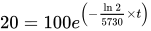
Failed to parse (MathML with SVG or PNG fallback (recommended for modern browsers and accessibility tools): Invalid response ("Math extension cannot connect to Restbase.") from server "https://wikimedia.org/api/rest_v1/":): {\displaystyle 20 = 100e^{\left( - \frac { \ln 2}{5730} \times t \right)}}
Now we ensure e is alone:
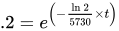
Failed to parse (MathML with SVG or PNG fallback (recommended for modern browsers and accessibility tools): Invalid response ("Math extension cannot connect to Restbase.") from server "https://wikimedia.org/api/rest_v1/":): {\displaystyle .2 = e^{\left(- \frac { \ln 2}{5730} \times t\right)}}
Since ln is the inverse function we use it to remove the base e.

Failed to parse (MathML with SVG or PNG fallback (recommended for modern browsers and accessibility tools): Invalid response ("Math extension cannot connect to Restbase.") from server "https://wikimedia.org/api/rest_v1/":): {\displaystyle \ln .2 =\ln e^{\left(- \frac { \ln 2}{5730} \times t\right)}}
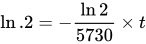
Failed to parse (MathML with SVG or PNG fallback (recommended for modern browsers and accessibility tools): Invalid response ("Math extension cannot connect to Restbase.") from server "https://wikimedia.org/api/rest_v1/":): {\displaystyle \ln .2 =- \frac { \ln 2}{5730} \times t}
Now we rearrange the equation to isolate t.
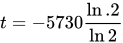
Failed to parse (MathML with SVG or PNG fallback (recommended for modern browsers and accessibility tools): Invalid response ("Math extension cannot connect to Restbase.") from server "https://wikimedia.org/api/rest_v1/":): {\displaystyle t =-5730 \frac { \ln .2}{\ln 2}}
Solving for t we get that the sample will be reduced to 20% C-14 and 80% C-12 after about 13304.6 years.

Failed to parse (MathML with SVG or PNG fallback (recommended for modern browsers and accessibility tools): Invalid response ("Math extension cannot connect to Restbase.") from server "https://wikimedia.org/api/rest_v1/":): {\displaystyle t \approx 13304.6\ years}
Resources
- Special Functions and Transformations, Wikibooks: A-level Mathematics
- Exponential growth and decay models. Written notes created by Professor Esparza, UTSA.
- Exponential growth and decay models Continued. Written notes created by Professor Esparza, UTSA.