Models and basic operation with decimals

From Department of Mathematics at UTSA
Jump to navigation Jump to search

Decimals

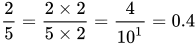
Decimals are basically fractions expressed without a denominator, rather replaced by a power of ten, and then the decimal point is inserted into the numerator at a position corresponding to the power of ten of the denominator. It is usual to add a leading zero to the left of the decimal point when the number is less than one.
Adding Decimal Numbers

Add decimal numbers much the same way you would add integers. Line up decimal points, and then proceed to add each column and carry at the top. The decimal point in the answer should line up with all of the others. Here is an example:

Subtracting Decimal Numbers

Subtract as you would do with whole numbers, but remember to follow all the rules from addition of decimals.

Failed to parse (MathML with SVG or PNG fallback (recommended for modern browsers and accessibility tools): Invalid response ("Math extension cannot connect to Restbase.") from server "https://wikimedia.org/api/rest_v1/":): {\displaystyle \begin{align} {36.36}\\ -\underline{ 11.11}\\ {25.25} \end{align}}

Converting Fractions to Decimal Numbers

To convert a fraction to a decimal number, divide the numerator by the denominator.

  • Failed to parse (MathML with SVG or PNG fallback (recommended for modern browsers and accessibility tools): Invalid response ("Math extension cannot connect to Restbase.") from server "https://wikimedia.org/api/rest_v1/":): {\displaystyle \frac{3}{4} = 0.75}
  • Failed to parse (MathML with SVG or PNG fallback (recommended for modern browsers and accessibility tools): Invalid response ("Math extension cannot connect to Restbase.") from server "https://wikimedia.org/api/rest_v1/":): {\displaystyle \frac{10}{3} = 3.333333333333333...}

Repeating and Terminating Decimals

A repeating decimal is a decimal that is infinite. For instance, the 3.33... in the second example above. The threes just keep repeating.

Instead of writing many 3's, you can draw a line above the number that is repeating.

Failed to parse (MathML with SVG or PNG fallback (recommended for modern browsers and accessibility tools): Invalid response ("Math extension cannot connect to Restbase.") from server "https://wikimedia.org/api/rest_v1/":): {\displaystyle \frac{10}{3} = {3.}\overline{3}}

When there are two numbers repeating, such as .232323, you have to draw a line above the 2 and the 3.

Failed to parse (MathML with SVG or PNG fallback (recommended for modern browsers and accessibility tools): Invalid response ("Math extension cannot connect to Restbase.") from server "https://wikimedia.org/api/rest_v1/":): {\displaystyle {0.}\overline{23}}

A terminating decimal is a decimal that ends at one point and does not go on forever. ex. 1.25

Multiplying Decimal Numbers

Multiplying decimal numbers can be tricky at times, but most of the time, it is similar to multiplying any integers. Although there are easier methods of multiplying, this is one of the methods.

You can make both decimal numbers have same multiple of a power of ten.

Failed to parse (MathML with SVG or PNG fallback (recommended for modern browsers and accessibility tools): Invalid response ("Math extension cannot connect to Restbase.") from server "https://wikimedia.org/api/rest_v1/":): {\displaystyle 0.6 \times 0.75 = (60 \times 10^{-2}) \times (75 \times 10^{-2})}
Then multiply the first terms together, and the second terms.
Failed to parse (MathML with SVG or PNG fallback (recommended for modern browsers and accessibility tools): Invalid response ("Math extension cannot connect to Restbase.") from server "https://wikimedia.org/api/rest_v1/":): {\displaystyle (60 \times 75) \times (10^{-2} \times 10^{-2}) = 4500 \times (10^{-4})}
Then insert the decimal point into a corresponding power of ten.

Failed to parse (MathML with SVG or PNG fallback (recommended for modern browsers and accessibility tools): Invalid response ("Math extension cannot connect to Restbase.") from server "https://wikimedia.org/api/rest_v1/":): {\displaystyle 4500 \times (10^{-4}) = 450 \times (10^{-3}) = 45 \times (10^{-2}) = 4.5 \times (10^{-1}) = .45 \times (10^{0}) = .45 \times (1) = .45 }

Dividing Decimal Numbers

Dividing decimal numbers is similar to multiplying them.

Make both decimal numbers have same multiple of a power of ten.

Failed to parse (MathML with SVG or PNG fallback (recommended for modern browsers and accessibility tools): Invalid response ("Math extension cannot connect to Restbase.") from server "https://wikimedia.org/api/rest_v1/":): {\displaystyle 0.3 / 0.4 = (3 \times 10^{-1}) / (4 \times 10^{-1})}
Then divide the first terms together, and the second terms.

Failed to parse (MathML with SVG or PNG fallback (recommended for modern browsers and accessibility tools): Invalid response ("Math extension cannot connect to Restbase.") from server "https://wikimedia.org/api/rest_v1/":): {\displaystyle (3 \times 10^{-1}) / (4 \times 10^{-1}) = (3/4) / 10^{0}}
Then insert the decimal point into a corresponding power of ten.

Failed to parse (MathML with SVG or PNG fallback (recommended for modern browsers and accessibility tools): Invalid response ("Math extension cannot connect to Restbase.") from server "https://wikimedia.org/api/rest_v1/":): {\displaystyle (3/4) / 10^{0} = 0.75 / 1 = 0.75\,\!}

Alternatively, you can make the numbers integers (if the decimal is finite) and perform a simple division.

Failed to parse (MathML with SVG or PNG fallback (recommended for modern browsers and accessibility tools): Invalid response ("Math extension cannot connect to Restbase.") from server "https://wikimedia.org/api/rest_v1/":): {\displaystyle 0.3 / 0.4 = (0.3 \times 10) / (0.4 \times 10) = 3/4 = 0.75}

Licensing

Content obtained and/or adapted from: