Proportional reasoning
Vocabulary
Ratio: The comparison of two numbers.
Reciprocal: The multiplicative inverse of a number -- when the numerator and denominator of a fraction are switched around.
Equivalent Ratios: Two ratios that reduce to the same ratio.
Proportion: An equation stating two ratios are equal.
To Cross-multiply: see below.
Lesson
There are several ways to express a "ratio". Let's compare the number of boys with the number of girls in a particular classroom. Let's say that our classroom has 25 students, 10 of whom are boys. That means there are 15 girls. So, the ratio of boys to girls is 10 to 15.
Writing a Ratio
There are three ways of expressing a ratio. You can simply use words like we did above, or you can separate the two numbers using a colon or a fraction (the mathematician's choice).
10:15 or 10/15 or Failed to parse (MathML with SVG or PNG fallback (recommended for modern browsers and accessibility tools): Invalid response ("Math extension cannot connect to Restbase.") from server "https://wikimedia.org/api/rest_v1/":): {\displaystyle \frac{10}{15}}
In mathematics, we always use fractions to represent ratios. In this classroom example, many other ratios that can be made:
, the number of boys out of the total number of students
, the number of girls out of the total number of students
, the number of girls to the number of boys
Simplifying a Ratio
Since we're using a fraction to represent ratios, the ratios can sometimes be reduced. For example, the ratio of boys to girls in our hypothetical classroom is , but can be reduced to . So, if we would be correct we said that the ratio of boys to girls in our hypothetical classroom is 2:3, or two boys for every 3 girls.
Proportions
The following equation is a proportion:
Any proportion is simply an equation the states two ratios are equal to one another. Sometimes, a proportion may contain variables:
If we wish to solve such an equation, we can use a process called cross-multiplication.
Solving Proportions using Cross-Multiplication
If , then the products that are formed by diagonals across the equal sign are also equal: . Note that this would be equivalent to saying .
Example Problems
1) Is the ratio equal to the ratio ?
We can test by cross-multiplying. If the cross-products are equal, then so are the original two ratios.
?=
?= Failed to parse (MathML with SVG or PNG fallback (recommended for modern browsers and accessibility tools): Invalid response ("Math extension cannot connect to Restbase.") from server "https://wikimedia.org/api/rest_v1/":): {\displaystyle 72}
No, Failed to parse (MathML with SVG or PNG fallback (recommended for modern browsers and accessibility tools): Invalid response ("Math extension cannot connect to Restbase.") from server "https://wikimedia.org/api/rest_v1/":): {\displaystyle 64 \not= 72} , so Failed to parse (MathML with SVG or PNG fallback (recommended for modern browsers and accessibility tools): Invalid response ("Math extension cannot connect to Restbase.") from server "https://wikimedia.org/api/rest_v1/":): {\displaystyle \frac{4}{6} \not= \frac{12}{16}} .
2) Solve the following proportion for x.
Failed to parse (MathML with SVG or PNG fallback (recommended for modern browsers and accessibility tools): Invalid response ("Math extension cannot connect to Restbase.") from server "https://wikimedia.org/api/rest_v1/":): {\displaystyle \frac{3}{4} = \frac{x}{10}}
Cross-multiply.
Failed to parse (MathML with SVG or PNG fallback (recommended for modern browsers and accessibility tools): Invalid response ("Math extension cannot connect to Restbase.") from server "https://wikimedia.org/api/rest_v1/":): {\displaystyle 3 \cdot 10 = 4x}
Failed to parse (MathML with SVG or PNG fallback (recommended for modern browsers and accessibility tools): Invalid response ("Math extension cannot connect to Restbase.") from server "https://wikimedia.org/api/rest_v1/":): {\displaystyle 30 = 4x }
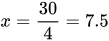
Solve for x by dividing both sides of the equation by 4. Your result: Failed to parse (MathML with SVG or PNG fallback (recommended for modern browsers and accessibility tools): Invalid response ("Math extension cannot connect to Restbase.") from server "https://wikimedia.org/api/rest_v1/":): {\displaystyle x = \frac{30}{4} = 7.5} .
3) Solve for x:
Failed to parse (MathML with SVG or PNG fallback (recommended for modern browsers and accessibility tools): Invalid response ("Math extension cannot connect to Restbase.") from server "https://wikimedia.org/api/rest_v1/":): {\displaystyle \frac{x + 1}{4} = \frac{3}{8}}
Cross multiply:
Failed to parse (MathML with SVG or PNG fallback (recommended for modern browsers and accessibility tools): Invalid response ("Math extension cannot connect to Restbase.") from server "https://wikimedia.org/api/rest_v1/":): {\displaystyle 8 \cdot (x+1) = 3 \cdot 4}
Failed to parse (MathML with SVG or PNG fallback (recommended for modern browsers and accessibility tools): Invalid response ("Math extension cannot connect to Restbase.") from server "https://wikimedia.org/api/rest_v1/":): {\displaystyle 8x + 8 = 12}
Now, solve for x:
Subtract 8 from both sides: Failed to parse (MathML with SVG or PNG fallback (recommended for modern browsers and accessibility tools): Invalid response ("Math extension cannot connect to Restbase.") from server "https://wikimedia.org/api/rest_v1/":): {\displaystyle 8x = 4}
Divide both sides by 8: Failed to parse (MathML with SVG or PNG fallback (recommended for modern browsers and accessibility tools): Invalid response ("Math extension cannot connect to Restbase.") from server "https://wikimedia.org/api/rest_v1/":): {\displaystyle x = \frac{1}{2}}
4) A 9th-grade algebra classroom has a ratio of boys to girls of \frac{1} {2}. If there are 14 girls, how many boys are in the class?
We can create a proportion that compares the ratios of boys to girls, where x is the number of boys in the class:
Failed to parse (MathML with SVG or PNG fallback (recommended for modern browsers and accessibility tools): Invalid response ("Math extension cannot connect to Restbase.") from server "https://wikimedia.org/api/rest_v1/":): {\displaystyle \frac{1}{2} = \frac{x}{14} }
Solve the proportion by cross-multiplying:
Failed to parse (MathML with SVG or PNG fallback (recommended for modern browsers and accessibility tools): Invalid response ("Math extension cannot connect to Restbase.") from server "https://wikimedia.org/api/rest_v1/":): {\displaystyle 2x = 14 }
Failed to parse (MathML with SVG or PNG fallback (recommended for modern browsers and accessibility tools): Invalid response ("Math extension cannot connect to Restbase.") from server "https://wikimedia.org/api/rest_v1/":): {\displaystyle x = 7 }
There are 7 boys in the class.
Practice Problems
Use / as the fraction line and put spaces between wholes and fractions!
Licensing
Content obtained and/or adapted from:
- Proportions, Wikibooks under a CC BY-SA license