We will now look at a bunch of rules for differentiating vector-valued function, all of which are analogous to that of differentiating real-valued functions. We will not prove all parts of the following theorem, but the reader is encouraged to attempt the proofs.
- Theorem 1: Let Failed to parse (MathML with SVG or PNG fallback (recommended for modern browsers and accessibility tools): Invalid response ("Math extension cannot connect to Restbase.") from server "https://wikimedia.org/api/rest_v1/":): {\displaystyle \vec{u}(t) = (x_1(t), y_1(t), z_1(t))}
and
 be vector-valued functions that are differentiable for
  in the interval
  , let
, let  be a scalar, and let
  be a real-valued function that is differentiable on . Then:
- a)
 (Sum Rule).
- b)
 (Difference Rule).
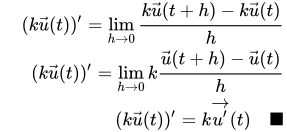
- c)
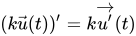 (Scalar Multiple Rule).
- d)
 (Product Rule for Real-Valued and Vector-Valued Functions).
- e)
 (Dot Product Rule).
- f)
 (Cross Product Rule).
- g)
 (Chain Rule).
![{\displaystyle {\begin{aligned}\quad ({\vec {u}}(t)+{\vec {v}}(t))'=\lim _{h\to 0}{\frac {[{\vec {u}}(t+h)+{\vec {v}}(t+h)]-[{\vec {u}}(t)+{\vec {v}}(t)]}{h}}\\\quad ({\vec {u}}(t)+{\vec {v}}(t))'=\lim _{h\to 0}{\frac {[{\vec {u}}(t+h)-{\vec {u}}(t)]+[{\vec {v}}(t+h)-{\vec {v}}(t)]}{h}}\\\quad ({\vec {u}}(t)+{\vec {v}}(t))'=\lim _{h\to 0}{\frac {{\vec {u}}(t+h)-{\vec {u}}(t)}{h}}+\lim _{h\to 0}{\frac {{\vec {v}}(t+h)-{\vec {v}}(t)}{h}}\\\quad ({\vec {u}}(t)+{\vec {v}}(t))'={\vec {u'}}(t)+{\vec {v'}}(t)\quad \blacksquare \end{aligned}}}](https://wikimedia.org/api/rest_v1/media/math/render/svg/671cdfbe0477b2fd1d15908c2757dfff4924c02f)
![{\displaystyle {\begin{aligned}\quad (f(t){\vec {u}}(t))'=\lim _{h\to 0}{\frac {f(t+h){\vec {u}}(t+h)-f(t){\vec {u}}(t)}{h}}\\\quad (f(t){\vec {u}}(t))'=\lim _{h\to 0}{\frac {f(t+h){\vec {u}}(t+h)-f(t+h){\vec {u}}(t)+f(t+h){\vec {u}}(t)-f(t){\vec {u}}(t)}{h}}\\\quad (f(t){\vec {u}}(t))'=\lim _{h\to 0}{\frac {f(t+h)[{\vec {u}}(t+h)-{\vec {u}}(t)]+{\vec {u}}(t)[f(t+h)-f(t)]}{h}}\\\quad (f(t){\vec {u}}(t))'=\lim _{h\to 0}{\frac {f(t+h)[{\vec {u}}(t+h)-{\vec {u}}(t)]}{h}}+\lim _{h\to 0}{\frac {{\vec {u}}(t)[f(t+h)-f(t)]}{h}}\\\quad (f(t){\vec {u}}(t))'=\lim _{h\to 0}f(t+h)\left({\frac {{\vec {u}}(t+h)-{\vec {u}}(t)}{h}}\right)+\lim _{h\to 0}{\vec {u}}(t)\left({\frac {[f(t+h)-f(t)]}{h}}\right)\\\quad (f(t){\vec {u}}(t))'=f(t){\vec {u'}}(t)+{\vec {u}}f'(t)\\\quad (f(t){\vec {u}}(t))'=f'(t){\vec {u}}+f(t){\vec {u'}}(t)\quad \blacksquare \end{aligned}}}](https://wikimedia.org/api/rest_v1/media/math/render/svg/ab2a292b4309306200e127393cb020a4693544ad)
Theorem 2: Let  be a vector-valued function that traces the curve Failed to parse (MathML with SVG or PNG fallback (recommended for modern browsers and accessibility tools): Invalid response ("Math extension cannot connect to Restbase.") from server "https://wikimedia.org/api/rest_v1/":): {\displaystyle C}
for Failed to parse (MathML with SVG or PNG fallback (recommended for modern browsers and accessibility tools): Invalid response ("Math extension cannot connect to Restbase.") from server "https://wikimedia.org/api/rest_v1/":): {\displaystyle t \in I}
. If Failed to parse (MathML with SVG or PNG fallback (recommended for modern browsers and accessibility tools): Invalid response ("Math extension cannot connect to Restbase.") from server "https://wikimedia.org/api/rest_v1/":): {\displaystyle \| \vec{r}(t) \| = c}
where Failed to parse (MathML with SVG or PNG fallback (recommended for modern browsers and accessibility tools): Invalid response ("Math extension cannot connect to Restbase.") from server "https://wikimedia.org/api/rest_v1/":): {\displaystyle c}
is a constant, then for all Failed to parse (MathML with SVG or PNG fallback (recommended for modern browsers and accessibility tools): Invalid response ("Math extension cannot connect to Restbase.") from server "https://wikimedia.org/api/rest_v1/":): {\displaystyle t \in I}
, Failed to parse (MathML with SVG or PNG fallback (recommended for modern browsers and accessibility tools): Invalid response ("Math extension cannot connect to Restbase.") from server "https://wikimedia.org/api/rest_v1/":): {\displaystyle \vec{r}(t) \perp \vec{r'}(t)}
.
be a vector-valued function that traces the curve Failed to parse (MathML with SVG or PNG fallback (recommended for modern browsers and accessibility tools): Invalid response ("Math extension cannot connect to Restbase.") from server "https://wikimedia.org/api/rest_v1/":): {\displaystyle C}
for Failed to parse (MathML with SVG or PNG fallback (recommended for modern browsers and accessibility tools): Invalid response ("Math extension cannot connect to Restbase.") from server "https://wikimedia.org/api/rest_v1/":): {\displaystyle t \in I}
. If Failed to parse (MathML with SVG or PNG fallback (recommended for modern browsers and accessibility tools): Invalid response ("Math extension cannot connect to Restbase.") from server "https://wikimedia.org/api/rest_v1/":): {\displaystyle \| \vec{r}(t) \| = c}
where Failed to parse (MathML with SVG or PNG fallback (recommended for modern browsers and accessibility tools): Invalid response ("Math extension cannot connect to Restbase.") from server "https://wikimedia.org/api/rest_v1/":): {\displaystyle c}
is a constant, then for all Failed to parse (MathML with SVG or PNG fallback (recommended for modern browsers and accessibility tools): Invalid response ("Math extension cannot connect to Restbase.") from server "https://wikimedia.org/api/rest_v1/":): {\displaystyle t \in I}
, Failed to parse (MathML with SVG or PNG fallback (recommended for modern browsers and accessibility tools): Invalid response ("Math extension cannot connect to Restbase.") from server "https://wikimedia.org/api/rest_v1/":): {\displaystyle \vec{r}(t) \perp \vec{r'}(t)}
.
- Proof: We note that Failed to parse (MathML with SVG or PNG fallback (recommended for modern browsers and accessibility tools): Invalid response ("Math extension cannot connect to Restbase.") from server "https://wikimedia.org/api/rest_v1/":): {\displaystyle \vec{r}(t) \cdot \vec{r}(t) = \| \vec{r}(t) \|^2 = c^2}
. Taking the derivative of both sides of this equation and applying the dot product rule, we get that:
Failed to parse (MathML with SVG or PNG fallback (recommended for modern browsers and accessibility tools): Invalid response ("Math extension cannot connect to Restbase.") from server "https://wikimedia.org/api/rest_v1/":): {\displaystyle \begin{align} \frac{d}{dt} \vec{r}(t) \cdot \vec{r}(t) = \frac{d}{dt} c^2 \\ \vec{r}(t) \cdot \vec{r'}(t) + \vec{r'}(t) \cdot \vec{r}(t) = 0 \\ 2 \vec{r}(t) \cdot \vec{r'}(t) = 0 \\ \vec{r}(t) \cdot \vec{r'}(t) = 0 \end{align}}
- Therefore Failed to parse (MathML with SVG or PNG fallback (recommended for modern browsers and accessibility tools): Invalid response ("Math extension cannot connect to Restbase.") from server "https://wikimedia.org/api/rest_v1/":): {\displaystyle \vec{r}(t) \perp \vec{r'}(t)}
. Failed to parse (MathML with SVG or PNG fallback (recommended for modern browsers and accessibility tools): Invalid response ("Math extension cannot connect to Restbase.") from server "https://wikimedia.org/api/rest_v1/":): {\displaystyle \blacksquare}
Licensing
Content obtained and/or adapted from:

