Logarithmic Functions
In mathematics you can find the inverse of an exponential function by switching x and y around: Failed to parse (MathML with SVG or PNG fallback (recommended for modern browsers and accessibility tools): Invalid response ("Math extension cannot connect to Restbase.") from server "https://wikimedia.org/api/rest_v1/":): {\displaystyle y = b^x\,} becomes . The problem arises on how to find the value of y. The logarithmic function solved this problem. All conversions of logarithmic function into an exponential function follow the same pattern: becomes . If a log is given without a written b then b=10. Also with logarithmic functions, b > 0 and . There are 2 cases where the log is equal to x: and .
Laws of Logarithmic Functions
When X and Y are positive.

Change of Base
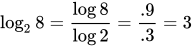
When x and b are positive real numbers and are not equal to 1. Then you can write as Failed to parse (MathML with SVG or PNG fallback (recommended for modern browsers and accessibility tools): Invalid response ("Math extension cannot connect to Restbase.") from server "https://wikimedia.org/api/rest_v1/":): {\displaystyle \frac { \log_b x}{ \log_b a}} . This works for the natural log as well. here is an example:
Failed to parse (MathML with SVG or PNG fallback (recommended for modern browsers and accessibility tools): Invalid response ("Math extension cannot connect to Restbase.") from server "https://wikimedia.org/api/rest_v1/":): {\displaystyle \log_2 8 = \frac { \log 8}{ \log 2} = \frac {.9}{.3} = 3\,} now check Failed to parse (MathML with SVG or PNG fallback (recommended for modern browsers and accessibility tools): Invalid response ("Math extension cannot connect to Restbase.") from server "https://wikimedia.org/api/rest_v1/":): {\displaystyle 2^3 = 8\,}
Resources
- Logarithmic Functions, Book Chapter
- Guided Notes