Properties of the Trigonometric Functions

From Department of Mathematics at UTSA
Jump to navigation Jump to search

Identities Based on the Pythagorean Theorem

Some of the most fundamental trigonometric identities are those derived from the Pythagorean Theorem. These are defined using a right triangle:

right triangle

At this stage in the course the Pythagorean Theorem should be second nature to you. If you have not yet learned it, learn it now.

Failed to parse (MathML with SVG or PNG fallback (recommended for modern browsers and accessibility tools): Invalid response ("Math extension cannot connect to Restbase.") from server "https://wikimedia.org/api/rest_v1/":): {\displaystyle a^2+b^2=c^2}

Failed to parse (MathML with SVG or PNG fallback (recommended for modern browsers and accessibility tools): Invalid response ("Math extension cannot connect to Restbase.") from server "https://wikimedia.org/api/rest_v1/":): {\displaystyle a} and of course are the legs or the adjacent and opposite edges, and is the hypotenuse, the longest side, the side that does not include the right angle. This formula only works for a right angle triangle. If the angle shown as a right angle in the diagram were obtuse, larger than a right angle, then would be larger than the Pythagorean sum. If the angle shown as a right angle were smaller than a right angle, then would be smaller than .

Pythagorean Theorem in Terms of sine and cosine

The Pythagorean Theorem is the same thing as

We know this from the earlier in the book where we introduced and .

  • The is the adjacent side when the hypotenuse is one.
  • The is the opposite side when the hypotenuse is one.

The identity should be second nature to you too, but you should also be able to derive it from the Pythagorean relation.

We can see it's true from a right triangle that has a hypotenuse that is 'c' rather than one. Dividing the Pythagorean relation through by gives us
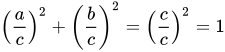
And we have already seen from soh-cah-toa that the sine of A is and the cosine of A is .

Identities based on Addition Formula

We saw the addition formula earlier.

Letters are Arbitrary

The letters in these equations and are arbitrary. We could equally use and . We're pointing this out because we happen to have a diagram on this page that has angles , and in it, and we want to make it clear that that was for Pythagoras and we're not talking about that diagram any more. In these equations you can also always substitute actual values, e.g. replace by and they'd still be true. Or you could replace by or and they'd still be true.

Addition Formula

The addition formula for cosine is:

and is worth learning. But don't learn the next one:

'Subtraction' Formula

Learning the second formula is extra effort that does not really gain you anything. You can get it instantly by replacing by in the first equation. The only things on the right hand side that will change are the terms that had in them. The is unchanged because . The minus sign before the second term changes because .

Checking the 'subtraction' formula

Now do a quick check. If then Failed to parse (MathML with SVG or PNG fallback (recommended for modern browsers and accessibility tools): Invalid response ("Math extension cannot connect to Restbase.") from server "https://wikimedia.org/api/rest_v1/":): {\displaystyle cos(A-B)} is Failed to parse (MathML with SVG or PNG fallback (recommended for modern browsers and accessibility tools): Invalid response ("Math extension cannot connect to Restbase.") from server "https://wikimedia.org/api/rest_v1/":): {\displaystyle \cos(0)} which is one, right? And on the right hand side we have Failed to parse (MathML with SVG or PNG fallback (recommended for modern browsers and accessibility tools): Invalid response ("Math extension cannot connect to Restbase.") from server "https://wikimedia.org/api/rest_v1/":): {\displaystyle \cos^2(A)+\sin^2(A)} , which is also one. Looks good.

It is much better to remember it this way, because you are doing less rote learning and you're also becoming more fluent with the algebra.

Double Angle Formula

  • Failed to parse (MathML with SVG or PNG fallback (recommended for modern browsers and accessibility tools): Invalid response ("Math extension cannot connect to Restbase.") from server "https://wikimedia.org/api/rest_v1/":): {\displaystyle \sin{(2x)} = 2\sin{x}\cos{x} }
  • Failed to parse (MathML with SVG or PNG fallback (recommended for modern browsers and accessibility tools): Invalid response ("Math extension cannot connect to Restbase.") from server "https://wikimedia.org/api/rest_v1/":): {\displaystyle \cos{(2x)} = \cos^2{x} - \sin^2{x} }
Failed to parse (MathML with SVG or PNG fallback (recommended for modern browsers and accessibility tools): Invalid response ("Math extension cannot connect to Restbase.") from server "https://wikimedia.org/api/rest_v1/":): {\displaystyle \;\;\;\;\;\;\;\;\;\;\;\;\; = 2\cos^2{x} - 1 }
Failed to parse (MathML with SVG or PNG fallback (recommended for modern browsers and accessibility tools): Invalid response ("Math extension cannot connect to Restbase.") from server "https://wikimedia.org/api/rest_v1/":): {\displaystyle \;\;\;\;\;\;\;\;\;\;\;\;\; = 1 - 2\sin^2{x} }
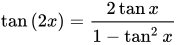
  • Failed to parse (MathML with SVG or PNG fallback (recommended for modern browsers and accessibility tools): Invalid response ("Math extension cannot connect to Restbase.") from server "https://wikimedia.org/api/rest_v1/":): {\displaystyle \tan{(2x)} = \frac{2\tan{x}}{1 - \tan^2{x}} }

Half Angle Formula

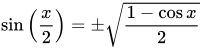
  • Failed to parse (MathML with SVG or PNG fallback (recommended for modern browsers and accessibility tools): Invalid response ("Math extension cannot connect to Restbase.") from server "https://wikimedia.org/api/rest_v1/":): {\displaystyle \sin{\left(\frac{x}{2}\right)} = \pm \sqrt{\frac{1 - \cos{x}}{2}} }
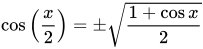
  • Failed to parse (MathML with SVG or PNG fallback (recommended for modern browsers and accessibility tools): Invalid response ("Math extension cannot connect to Restbase.") from server "https://wikimedia.org/api/rest_v1/":): {\displaystyle \cos{\left(\frac{x}{2}\right)} = \pm \sqrt{\frac{1 + \cos{x}}{2}} }
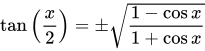
  • Failed to parse (MathML with SVG or PNG fallback (recommended for modern browsers and accessibility tools): Invalid response ("Math extension cannot connect to Restbase.") from server "https://wikimedia.org/api/rest_v1/":): {\displaystyle \tan{\left(\frac{x}{2}\right)} = \pm \sqrt{\frac{1 - \cos{x}}{1 + \cos{x}}} }
Failed to parse (MathML with SVG or PNG fallback (recommended for modern browsers and accessibility tools): Invalid response ("Math extension cannot connect to Restbase.") from server "https://wikimedia.org/api/rest_v1/":): {\displaystyle = \frac{\sin{x}}{1 + \cos{x}} }
Failed to parse (MathML with SVG or PNG fallback (recommended for modern browsers and accessibility tools): Invalid response ("Math extension cannot connect to Restbase.") from server "https://wikimedia.org/api/rest_v1/":): {\displaystyle = \frac{1 - \cos{x}}{\sin{x}} }

Product to Sum Formulas

Failed to parse (MathML with SVG or PNG fallback (recommended for modern browsers and accessibility tools): Invalid response ("Math extension cannot connect to Restbase.") from server "https://wikimedia.org/api/rest_v1/":): {\displaystyle sin(u)cos(v)=\frac{1}{2}[sin(u+v)+sin(u-v)]}

Failed to parse (MathML with SVG or PNG fallback (recommended for modern browsers and accessibility tools): Invalid response ("Math extension cannot connect to Restbase.") from server "https://wikimedia.org/api/rest_v1/":): {\displaystyle cos(u)sin(v)=\frac{1}{2}[sin(u+v)-sin(u-v)]}

Sum to Product Formula

Failed to parse (MathML with SVG or PNG fallback (recommended for modern browsers and accessibility tools): Invalid response ("Math extension cannot connect to Restbase.") from server "https://wikimedia.org/api/rest_v1/":): {\displaystyle sin(u)+sin(v)=2sin(\frac {u+v}{2})cos(\frac{u-v}{2})}

Failed to parse (MathML with SVG or PNG fallback (recommended for modern browsers and accessibility tools): Invalid response ("Math extension cannot connect to Restbase.") from server "https://wikimedia.org/api/rest_v1/":): {\displaystyle sin(u)-sin(v)=2cos(\frac {u+v}{2})sin(\frac{u-v}{2})}

Failed to parse (MathML with SVG or PNG fallback (recommended for modern browsers and accessibility tools): Invalid response ("Math extension cannot connect to Restbase.") from server "https://wikimedia.org/api/rest_v1/":): {\displaystyle cos(u)+cos(v)=2cos(\frac {u+v}{2})cos(\frac{u-v}{2})}

Failed to parse (MathML with SVG or PNG fallback (recommended for modern browsers and accessibility tools): Invalid response ("Math extension cannot connect to Restbase.") from server "https://wikimedia.org/api/rest_v1/":): {\displaystyle cos(u)-cos(v)=-2sin(\frac{u+v}{2})sin(\frac{u-v}{2})}

Sum of two shifted Cosines

For the next formula, you could just plough through the algebra...

Failed to parse (MathML with SVG or PNG fallback (recommended for modern browsers and accessibility tools): Invalid response ("Math extension cannot connect to Restbase.") from server "https://wikimedia.org/api/rest_v1/":): {\displaystyle \cos(x+\theta)+\cos(x-\theta)=\dots}

Waves in and out of phase

Before we do, notice that we are adding two cosine waves, the first shifted left and the second shifted right. We've seen this before when we looked at waves in and out of phase. We're going to get another sinusoidal wave. The expression is fairly symmetric, and actually we can quickly show that the expression gives an even function, that is that the value for Failed to parse (MathML with SVG or PNG fallback (recommended for modern browsers and accessibility tools): Invalid response ("Math extension cannot connect to Restbase.") from server "https://wikimedia.org/api/rest_v1/":): {\displaystyle -x} is the same as for Failed to parse (MathML with SVG or PNG fallback (recommended for modern browsers and accessibility tools): Invalid response ("Math extension cannot connect to Restbase.") from server "https://wikimedia.org/api/rest_v1/":): {\displaystyle x}  :

Failed to parse (MathML with SVG or PNG fallback (recommended for modern browsers and accessibility tools): Invalid response ("Math extension cannot connect to Restbase.") from server "https://wikimedia.org/api/rest_v1/":): {\displaystyle \cos(-x+\theta)+\cos(-x-\theta)=} using Failed to parse (MathML with SVG or PNG fallback (recommended for modern browsers and accessibility tools): Invalid response ("Math extension cannot connect to Restbase.") from server "https://wikimedia.org/api/rest_v1/":): {\displaystyle \cos(x)=\cos(-x)} we get to:
Failed to parse (MathML with SVG or PNG fallback (recommended for modern browsers and accessibility tools): Invalid response ("Math extension cannot connect to Restbase.") from server "https://wikimedia.org/api/rest_v1/":): {\displaystyle \cos(x-\theta)+\cos(x+\theta)=} and now swapping the two terms:
Failed to parse (MathML with SVG or PNG fallback (recommended for modern browsers and accessibility tools): Invalid response ("Math extension cannot connect to Restbase.") from server "https://wikimedia.org/api/rest_v1/":): {\displaystyle \cos(x+\theta)+\cos(x-\theta)} which is the original expression.

with practice you'll be able to see those steps and that the expression is an even function immediately.

A sinusoidal wave that is an even function - well it is something based on cosine. We're expecting the formula will simplify to give us something like:

Failed to parse (MathML with SVG or PNG fallback (recommended for modern browsers and accessibility tools): Invalid response ("Math extension cannot connect to Restbase.") from server "https://wikimedia.org/api/rest_v1/":): {\displaystyle A\cos(x)}

Where Failed to parse (MathML with SVG or PNG fallback (recommended for modern browsers and accessibility tools): Invalid response ("Math extension cannot connect to Restbase.") from server "https://wikimedia.org/api/rest_v1/":): {\displaystyle A} will depend on Failed to parse (MathML with SVG or PNG fallback (recommended for modern browsers and accessibility tools): Invalid response ("Math extension cannot connect to Restbase.") from server "https://wikimedia.org/api/rest_v1/":): {\displaystyle \theta} .

Values to Check With

When Failed to parse (MathML with SVG or PNG fallback (recommended for modern browsers and accessibility tools): Invalid response ("Math extension cannot connect to Restbase.") from server "https://wikimedia.org/api/rest_v1/":): {\displaystyle \theta=0^\circ} (try it in the original formula) we expect A to be 2. When Failed to parse (MathML with SVG or PNG fallback (recommended for modern browsers and accessibility tools): Invalid response ("Math extension cannot connect to Restbase.") from server "https://wikimedia.org/api/rest_v1/":): {\displaystyle \theta=90^\circ} we expect A to be 0, as the two cosine waves are Failed to parse (MathML with SVG or PNG fallback (recommended for modern browsers and accessibility tools): Invalid response ("Math extension cannot connect to Restbase.") from server "https://wikimedia.org/api/rest_v1/":): {\displaystyle 180^\circ} out of phase. So now to plough through the algebra:

Failed to parse (MathML with SVG or PNG fallback (recommended for modern browsers and accessibility tools): Invalid response ("Math extension cannot connect to Restbase.") from server "https://wikimedia.org/api/rest_v1/":): {\displaystyle \cos(x+\theta)+\cos(x-\theta)=}
Failed to parse (MathML with SVG or PNG fallback (recommended for modern browsers and accessibility tools): Invalid response ("Math extension cannot connect to Restbase.") from server "https://wikimedia.org/api/rest_v1/":): {\displaystyle \cos(x)\cos(\theta)-\sin(x)\sin(\theta)+\cos(x)\cos(-\theta)-\sin(x)\sin(-\theta)=}
Failed to parse (MathML with SVG or PNG fallback (recommended for modern browsers and accessibility tools): Invalid response ("Math extension cannot connect to Restbase.") from server "https://wikimedia.org/api/rest_v1/":): {\displaystyle \cos(x)\cos(\theta)-\sin(x)\sin(\theta)+\cos(x)\cos(\theta)+\sin(x)\sin(\theta)=}
Failed to parse (MathML with SVG or PNG fallback (recommended for modern browsers and accessibility tools): Invalid response ("Math extension cannot connect to Restbase.") from server "https://wikimedia.org/api/rest_v1/":): {\displaystyle \cos(x)\cos(\theta)+\cos(x)\cos(\theta)=}
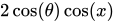
Failed to parse (MathML with SVG or PNG fallback (recommended for modern browsers and accessibility tools): Invalid response ("Math extension cannot connect to Restbase.") from server "https://wikimedia.org/api/rest_v1/":): {\displaystyle 2\cos(\theta)\cos(x)}

And to check we try with Failed to parse (MathML with SVG or PNG fallback (recommended for modern browsers and accessibility tools): Invalid response ("Math extension cannot connect to Restbase.") from server "https://wikimedia.org/api/rest_v1/":): {\displaystyle \theta=0^\circ} and get Failed to parse (MathML with SVG or PNG fallback (recommended for modern browsers and accessibility tools): Invalid response ("Math extension cannot connect to Restbase.") from server "https://wikimedia.org/api/rest_v1/":): {\displaystyle 2\cos(x)} , and we check with Failed to parse (MathML with SVG or PNG fallback (recommended for modern browsers and accessibility tools): Invalid response ("Math extension cannot connect to Restbase.") from server "https://wikimedia.org/api/rest_v1/":): {\displaystyle \theta=90^\circ} and get Failed to parse (MathML with SVG or PNG fallback (recommended for modern browsers and accessibility tools): Invalid response ("Math extension cannot connect to Restbase.") from server "https://wikimedia.org/api/rest_v1/":): {\displaystyle 0\times\cos(x)} , as we hoped.

Knowing roughly what we expected made it easier to get the algebraic steps right. We knew where we were going. We knew we weren't going to end up with four separate terms, some would have to cancel or combine in some other way.

Identities based on Sine and Cosine rules

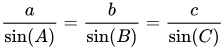
The Law of Sines

Failed to parse (MathML with SVG or PNG fallback (recommended for modern browsers and accessibility tools): Invalid response ("Math extension cannot connect to Restbase.") from server "https://wikimedia.org/api/rest_v1/":): {\displaystyle \frac{a}{\sin(A)}=\frac{b}{\sin(B)}=\frac{c}{\sin(C)}} .

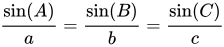
This is easy to remember because it is so symmetrical. You do not even need to remember which way up the ratios are as this is also true:

Failed to parse (MathML with SVG or PNG fallback (recommended for modern browsers and accessibility tools): Invalid response ("Math extension cannot connect to Restbase.") from server "https://wikimedia.org/api/rest_v1/":): {\displaystyle \frac{\sin(A)}{a}=\frac{\sin(B)}{b}=\frac{\sin(C)}{c}} .

What you do need to remember is how the triangle is labelled for it to be true.

The Law of Cosines

With the cosine law formula:

Failed to parse (MathML with SVG or PNG fallback (recommended for modern browsers and accessibility tools): Invalid response ("Math extension cannot connect to Restbase.") from server "https://wikimedia.org/api/rest_v1/":): {\displaystyle a^2+b^2-2ab\cos(\theta)=c^2}

It is best to think of it as a more general version of Pythagoras' theorem. The a and b have to be on equal footing, so ab as a multiplier is reasonable.

If you are familiar with 'units' in physics, then use the fact that units must match up. The quantities Failed to parse (MathML with SVG or PNG fallback (recommended for modern browsers and accessibility tools): Invalid response ("Math extension cannot connect to Restbase.") from server "https://wikimedia.org/api/rest_v1/":): {\displaystyle a,b,c} are measurements of length. It is no good adding Failed to parse (MathML with SVG or PNG fallback (recommended for modern browsers and accessibility tools): Invalid response ("Math extension cannot connect to Restbase.") from server "https://wikimedia.org/api/rest_v1/":): {\displaystyle a^2} to Failed to parse (MathML with SVG or PNG fallback (recommended for modern browsers and accessibility tools): Invalid response ("Math extension cannot connect to Restbase.") from server "https://wikimedia.org/api/rest_v1/":): {\displaystyle -2(a+b)\cos(\theta)} . One might have units Km2 the other units of Km. Adding Failed to parse (MathML with SVG or PNG fallback (recommended for modern browsers and accessibility tools): Invalid response ("Math extension cannot connect to Restbase.") from server "https://wikimedia.org/api/rest_v1/":): {\displaystyle a^2} to Failed to parse (MathML with SVG or PNG fallback (recommended for modern browsers and accessibility tools): Invalid response ("Math extension cannot connect to Restbase.") from server "https://wikimedia.org/api/rest_v1/":): {\displaystyle -2ab\cos(\theta)} the units, e.g: Km2, do match.

In some more detail, it has got to be minus for Failed to parse (MathML with SVG or PNG fallback (recommended for modern browsers and accessibility tools): Invalid response ("Math extension cannot connect to Restbase.") from server "https://wikimedia.org/api/rest_v1/":): {\displaystyle -2ab\cos(\theta)} . That's because for Failed to parse (MathML with SVG or PNG fallback (recommended for modern browsers and accessibility tools): Invalid response ("Math extension cannot connect to Restbase.") from server "https://wikimedia.org/api/rest_v1/":): {\displaystyle \theta<90^\circ} we need Failed to parse (MathML with SVG or PNG fallback (recommended for modern browsers and accessibility tools): Invalid response ("Math extension cannot connect to Restbase.") from server "https://wikimedia.org/api/rest_v1/":): {\displaystyle c^2} to be less than for Pythagoras' theorem.

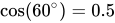
How can you remember and be sure the 2 is right? Think of an equilateral triangle with each side of length 1. The angle Failed to parse (MathML with SVG or PNG fallback (recommended for modern browsers and accessibility tools): Invalid response ("Math extension cannot connect to Restbase.") from server "https://wikimedia.org/api/rest_v1/":): {\displaystyle \theta=60^\circ} and Failed to parse (MathML with SVG or PNG fallback (recommended for modern browsers and accessibility tools): Invalid response ("Math extension cannot connect to Restbase.") from server "https://wikimedia.org/api/rest_v1/":): {\displaystyle \cos(60^\circ)=0.5} . We need the 2 to get the right answer 1 + 1 + 2x1x1x0.5 = 1.

Ratio identities
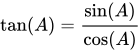
Failed to parse (MathML with SVG or PNG fallback (recommended for modern browsers and accessibility tools): Invalid response ("Math extension cannot connect to Restbase.") from server "https://wikimedia.org/api/rest_v1/":): {\displaystyle \tan(A)=\frac{\sin(A)}{\cos(A)}}

This is one definition of tan, and is something you should just learn.

Identities based on symmetry

These symmetry identities are best remembered by remembering the graphs for these functions. Have a look at the graphs again if you don't remember them.

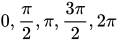
Failed to parse (MathML with SVG or PNG fallback (recommended for modern browsers and accessibility tools): Invalid response ("Math extension cannot connect to Restbase.") from server "https://wikimedia.org/api/rest_v1/":): {\displaystyle 0,\frac{\pi}{2},\pi,\frac{3\pi}{2},2\pi} are landmarks on the graphs of sine and cosine, and you should know what happens for both those functions at those landmarks. When you have that knowledge the following symmetry identities are easy to write down, because you can see them visually.
Shifting Left

Failed to parse (MathML with SVG or PNG fallback (recommended for modern browsers and accessibility tools): Invalid response ("Math extension cannot connect to Restbase.") from server "https://wikimedia.org/api/rest_v1/":): {\displaystyle \cos(\pi+A)=-\cos(A)\quad\sin(\pi+A)=-\sin(A)\quad\tan(\pi+A)=\tan(A)}

The identities above are visualised as shifting the graph left by Failed to parse (MathML with SVG or PNG fallback (recommended for modern browsers and accessibility tools): Invalid response ("Math extension cannot connect to Restbase.") from server "https://wikimedia.org/api/rest_v1/":): {\displaystyle \pi} . It's a half cycle, and both cosine and sine change signs - and hence tan does not change sign, because when it is expressed as a ratio of sine over cosine both the top and bottom change signs.

Reflecting in Failed to parse (MathML with SVG or PNG fallback (recommended for modern browsers and accessibility tools): Invalid response ("Math extension cannot connect to Restbase.") from server "https://wikimedia.org/api/rest_v1/":): {\displaystyle x=\frac{\pi}{2}}

Failed to parse (MathML with SVG or PNG fallback (recommended for modern browsers and accessibility tools): Invalid response ("Math extension cannot connect to Restbase.") from server "https://wikimedia.org/api/rest_v1/":): {\displaystyle \cos(\pi-A)=-\cos(A)\quad\sin(\pi-A)=\sin(A)\quad\tan(\pi-A)=-\tan(A)}

In the above we are reflecting the graph about the vertical line . Spend enough time looking at this on the graph to see that that is true. It is important to do that to remember this trick for remembering what happens.

Now sine has a maximum at Failed to parse (MathML with SVG or PNG fallback (recommended for modern browsers and accessibility tools): Invalid response ("Math extension cannot connect to Restbase.") from server "https://wikimedia.org/api/rest_v1/":): {\displaystyle x=\frac{\pi}{2}} (it has the value one) and it is symmetric about that x value, so Failed to parse (MathML with SVG or PNG fallback (recommended for modern browsers and accessibility tools): Invalid response ("Math extension cannot connect to Restbase.") from server "https://wikimedia.org/api/rest_v1/":): {\displaystyle \sin(\pi-A)=\sin(A)} . Cosine is zero at Failed to parse (MathML with SVG or PNG fallback (recommended for modern browsers and accessibility tools): Invalid response ("Math extension cannot connect to Restbase.") from server "https://wikimedia.org/api/rest_v1/":): {\displaystyle x=\frac{\pi}{2}} . Reflecting cosine in the line Failed to parse (MathML with SVG or PNG fallback (recommended for modern browsers and accessibility tools): Invalid response ("Math extension cannot connect to Restbase.") from server "https://wikimedia.org/api/rest_v1/":): {\displaystyle x=\frac{\pi}{2}} reverses the sign. Failed to parse (MathML with SVG or PNG fallback (recommended for modern browsers and accessibility tools): Invalid response ("Math extension cannot connect to Restbase.") from server "https://wikimedia.org/api/rest_v1/":): {\displaystyle \cos(\pi-A)=-\cos(A)}

Co-function identities

Failed to parse (MathML with SVG or PNG fallback (recommended for modern browsers and accessibility tools): Invalid response ("Math extension cannot connect to Restbase.") from server "https://wikimedia.org/api/rest_v1/":): {\displaystyle \cos(A)=\sin\left(\frac{\pi}{2}-A\right)}
Failed to parse (MathML with SVG or PNG fallback (recommended for modern browsers and accessibility tools): Invalid response ("Math extension cannot connect to Restbase.") from server "https://wikimedia.org/api/rest_v1/":): {\displaystyle \sin(A)=\cos\left(\frac{\pi}{2}-A\right)}

The above two formulas are most easily seen from the right-triangle definition of cosine and sine. The two acute angles in such a triangle add up to Failed to parse (MathML with SVG or PNG fallback (recommended for modern browsers and accessibility tools): Invalid response ("Math extension cannot connect to Restbase.") from server "https://wikimedia.org/api/rest_v1/":): {\displaystyle \frac{\pi}{2}} , and we are just giving the ratios of sides lengths in terms of a different angle's trig function.

Failed to parse (MathML with SVG or PNG fallback (recommended for modern browsers and accessibility tools): Invalid response ("Math extension cannot connect to Restbase.") from server "https://wikimedia.org/api/rest_v1/":): {\displaystyle \cos(A)=\sin\left(\frac{\pi}{2}+A\right)}
Failed to parse (MathML with SVG or PNG fallback (recommended for modern browsers and accessibility tools): Invalid response ("Math extension cannot connect to Restbase.") from server "https://wikimedia.org/api/rest_v1/":): {\displaystyle \sin(A)=-\cos\left(\frac{\pi}{2}+A\right)}

These two formulae are 'the same' as the previous formulae. We get there in two steps. First subtracted pi from the angle on the right hand side, which inverts the sign, and inverted the sign to compensate. Next invert the sign of the angle on the right hand side. For cosine on the right we are done. For sine on the right we have to invert its sign since inverting the angle's sign changed the sign of the result.

Yes - keeping track of signs is tricky, and always needs care.


Resources

Licensing

Content obtained and/or adapted from: