Difference between revisions of "The Fundamental Theorem of Calculus"
(Added links for PowerPoint and rearranged list) |
|||
| (16 intermediate revisions by 4 users not shown) | |||
| Line 1: | Line 1: | ||
| − | * [ | + | The fundamental theorem of calculus is a critical portion of calculus because it links the concept of a derivative to that of an integral. As a result, we can use our knowledge of derivatives to find the area under the curve, which is often quicker and simpler than using the definition of the integral. |
| + | |||
| + | ==Mean Value Theorem for Integration== | ||
| + | We will need the following theorem in the discussion of the Fundamental Theorem of Calculus. | ||
| + | |||
| + | Suppose <math>f(x)</math> is continuous on <math>[a,b]</math> . Then <math>\frac{1}{b-a}\int\limits_a^b f(x)dx=f(c)</math> for some <math>c\in[a,b]</math>. | ||
| + | |||
| + | ===Proof of the Mean Value Theorem for Integration=== | ||
| + | <math>f(x)</math> satisfies the requirements of the Extreme Value Theorem, so it has a minimum <math>m</math> and a maximum <math>M</math> in <math>[a,b]</math>. Since | ||
| + | |||
| + | :<math>\int\limits_a^b f(x)dx=\lim_{n\to\infty}\sum_{k=1}^n f(x_k^*)\cdot\frac{b-a}{n}=\lim_{n\to\infty}\frac{b-a}{n}\cdot\sum_{k=1}^n f(x_k^*)</math> | ||
| + | |||
| + | and since | ||
| + | |||
| + | :<math>m\le f(x_k^*)\le M</math> for all <math>x_k^*\in[a,b]</math> | ||
| + | |||
| + | we have | ||
| + | |||
| + | :<math>\begin{align} | ||
| + | &\lim_{n\to\infty}\frac{b-a}{n}\cdot\sum_{k=1}^nm\le\lim_{n\to\infty}\frac{b-a}{n}\cdot\sum_{k=1}^n f(x_k^*)\le\lim_{n\to\infty}\frac{b-a}{n}\cdot\sum_{k=1}^n M\\ | ||
| + | |||
| + | &\lim_{n\to\infty}mn\cdot\frac{b-a}{n}\le\int\limits_a^b f(x)dx\le\lim_{n\to\infty}Mn\cdot\frac{b-a}{n}\\ | ||
| + | |||
| + | &\lim_{n\to\infty}m(b-a)\le\int\limits_a^b f(x)dx\le\lim_{n\to\infty}M(b-a)\\ | ||
| + | |||
| + | &m(b-a)\le\int\limits_a^b f(x)dx\le M(b-a)\\ | ||
| + | |||
| + | &m\le\frac{1}{b-a}\int\limits_a^b f(x)dx\le M\end{align}</math> | ||
| + | |||
| + | Since <math>f</math> is continuous, by the Intermediate Value Theorem there is some <math>f(c)</math> with <math>c\in[a,b]</math> such that | ||
| + | |||
| + | :<math>\frac{1}{b-a}\int\limits_a^b f(x)dx=f(c)</math> | ||
| + | |||
| + | ==Fundamental Theorem of Calculus== | ||
| + | ===Statement of the Fundamental Theorem=== | ||
| + | Suppose that <math>f</math> is continuous on <math>[a,b]</math> . We can define a function <math>F</math> by | ||
| + | |||
| + | :<math>F(x)=\int\limits_a^x f(t)dt\quad\text{for }x\in[a,b]</math> | ||
| + | |||
| + | Suppose <math>f</math> is continuous on <math>[a,b]</math> and <math>F</math> is defined by | ||
| + | :<math>F(x)=\int\limits_a^x f(t)dt</math> | ||
| + | Then <math>F</math> is differentiable on <math>(a,b)</math> and for all <math>x\in(a,b)</math>, | ||
| + | :<math>F'(x)=f(x)</math> | ||
| + | |||
| + | When we have such functions <math>F</math> and <math>f</math> where <math>F'(x)=f(x)</math> for every <math>x</math> in some interval <math>I</math> we say that <math>F</math> is the '''antiderivative''' of <math>f</math> on <math>I</math>. | ||
| + | |||
| + | Suppose that <math>f</math> is continuous on <math>[a,b]</math> and that <math>F</math> is any antiderivative of <math>f</math> . | ||
| + | Then | ||
| + | :<math>\int\limits_a^b f(x)dx=F(b)-F(a)</math> | ||
| + | |||
| + | [[Image:Fundamental-theorem-1.png|thumb|350px|right|Figure 1]] | ||
| + | |||
| + | Note: a minority of mathematicians refer to part one as two and part two as one. All mathematicians refer to what is stated here as part 2 as The Fundamental Theorem of Calculus. | ||
| + | |||
| + | ===Proofs=== | ||
| + | ====Proof of Fundamental Theorem of Calculus Part I==== | ||
| + | Suppose <math>x\in(a,b)</math> . Pick <math>\Delta x</math> so that <math>x+\Delta x\in(a,b)</math> . Then | ||
| + | :<math>F(x)=\int\limits_a^x f(t)dt</math> | ||
| + | and | ||
| + | :<math>F(x+\Delta x)=\int\limits_a^{x+\Delta x}f(t)dt</math> | ||
| + | |||
| + | Subtracting the two equations gives | ||
| + | :<math>F(x+\Delta x)-F(x)=\int\limits_a^{x+\Delta x}f(t)dt-\int\limits_a^x f(t)dt</math> | ||
| + | |||
| + | Now | ||
| + | :<math>\int\limits_a^{x+\Delta x}f(t)dt=\int\limits_a^x f(t)dt+\int\limits_x^{x+\Delta x}f(t)dt</math> | ||
| + | so rearranging this we have | ||
| + | :<math>F(x+\Delta x)-F(x)=\int\limits_x^{x+\Delta x}f(t)dt</math> | ||
| + | |||
| + | According to the Mean Value Theorem for Integration, there exists a <math>c\in[x,x+\Delta x]</math> such that | ||
| + | :<math>\int\limits_x^{x+\Delta x}f(t)dt=f(c)\cdot\Delta x</math> | ||
| + | Notice that <math>c</math> depends on <math>\Delta x</math> . Anyway what we have shown is that | ||
| + | :<math>F(x+\Delta x)-F(x)=f(c)\cdot\Delta x</math> | ||
| + | and dividing both sides by <math>\Delta x</math> gives | ||
| + | :<math>\frac{F(x+\Delta x)-F(x)}{\Delta x}=f(c)</math> | ||
| + | |||
| + | Take the limit as <math>\Delta x\to0</math> we get the definition of the derivative of <math>F</math> at <math>x</math> so we have | ||
| + | :<math>F'(x)=\lim_{\Delta x\to0}\frac{F(x+\Delta x)-F(x)}{\Delta x}=\lim_{\Delta x\to0}f(c)</math> | ||
| + | |||
| + | To find the other limit, we will use the '''squeeze theorem'''. <math>c\in[x,x+\Delta x]</math> , so <math>x\le c\le x+\Delta x</math> . Hence, | ||
| + | :<math>\lim_{\Delta x\to0}\Big[x+\Delta x\Big]=x\quad\Rightarrow\quad\lim_{\Delta x\to0}c=x</math> | ||
| + | |||
| + | As <math>f</math> is continuous we have | ||
| + | :<math>F'(x)=\lim_{\Delta x\to0}f(c)=f\left(\lim_{\Delta x\to0}c\right)=f(x)</math> | ||
| + | which completes the proof. | ||
| + | |||
| + | <math>\blacksquare</math> | ||
| + | |||
| + | ====Proof of Fundamental Theorem of Calculus Part II==== | ||
| + | Define <math>P(x)=\int\limits_a^x f(t)dt</math> . Then by the Fundamental Theorem of Calculus part I we know that <math>P</math> is differentiable on <math>(a,b)</math> and for all <math>x\in(a,b)</math> | ||
| + | :<math>P'(x)=f(x)</math> | ||
| + | So <math>P</math> is an antiderivative of <math>f</math> . Since we were assuming that <math>F</math> was also an antiderivative for all <math>x\in(a,b)</math> , | ||
| + | :<math>\begin{align}&P'(x)=F'(x)\\&P'(x)-F'(x)=0\\&\Big(P(x)-F(x)\Big)'=0\end{align}</math> | ||
| + | |||
| + | Let <math>g(x)=P(x)-F(x)</math> . The Mean Value Theorem applied to <math>g(x)</math> on <math>[a,\xi]</math> with <math>a<\xi<b</math> says that | ||
| + | :<math>\frac{g(\xi)-g(a)}{\xi-a}=g'(c)</math> | ||
| + | for some <math>c</math> in <math>(a,\xi)</math> . But since <math>g'(x)=0</math> for all <math>x</math> in <math>[a,b]</math> , <math>g(\xi)</math> must equal <math>g(a)</math> for all <math>\xi</math> in <math>(a,b)</math> , i.e. g(x) is constant on <math>(a,b)</math> . | ||
| + | |||
| + | This implies there is a constant <math>C=g(a)=P(a)-F(a)=-F(a)</math> such that for all <math>x\in(a,b)</math> , | ||
| + | :<math>P(x)=F(x)+C</math> | ||
| + | and as <math>g</math> is continuous we see this holds when <math>x=a</math> and <math>x=b</math> as well. And putting <math>x=b</math> gives | ||
| + | :<math>\int\limits_a^b f(t)dx=P(b)=F(b)+C=F(b)-F(a)</math> | ||
| + | |||
| + | <math>\blacksquare</math> | ||
| + | |||
| + | ==Notation for Evaluating Definite Integrals== | ||
| + | The second part of the Fundamental Theorem of Calculus gives us a way to calculate definite integrals. Just find an antiderivative of the integrand, and subtract the value of the antiderivative at the lower bound from the value of the antiderivative at the upper bound. That is | ||
| + | :<math>\int\limits_a^b f(x)dx=F(b)-F(a)</math> | ||
| + | where <math>F'(x)=f(x)</math> . As a convenience, we use the notation | ||
| + | :<math>F(x)\bigg|_a^b</math> | ||
| + | to represent <math>F(b)-F(a)</math> | ||
| + | |||
| + | ==Integration of Polynomials== | ||
| + | Using the power rule for differentiation we can find a formula for the integral of a power using the Fundamental Theorem of Calculus. Let <math>f(x)=x^n</math> . We want to find an antiderivative for <math>f</math> . Since the differentiation rule for powers lowers the power by 1 we have that | ||
| + | :<math>\frac{d}{dx}x^{n+1}=(n+1)x^n</math> | ||
| + | As long as <math>n+1\ne0</math> we can divide by <math>n+1</math> to get | ||
| + | :<math>\frac{d}{dx}\left(\frac{x^{n+1}}{n+1}\right)=x^n=f(x)</math> | ||
| + | So the function <math>F(x)=\frac{x^{n+1}}{n+1}</math> is an antiderivative of <math>f</math> . If <math>0\notin[a,b]</math> then <math>F</math> is continuous on <math>[a,b]</math> and, by applying the Fundamental Theorem of Calculus, we can calculate the integral of <math>f</math> to get the following rule. | ||
| + | |||
| + | <blockquote style="background: white; border: 1px solid black; padding: 1em;"> | ||
| + | :'''Power Rule of Integration I''' | ||
| + | :<math>\int\limits_a^b x^ndx=\frac{x^{n+1}}{n+1}\Bigg|_a^b=\frac{b^{n+1}-a^{n+1}}{n+1}</math> as long as <math>n\ne-1</math> and <math>0\notin[a,b]</math> . | ||
| + | </blockquote> | ||
| + | |||
| + | Notice that we allow all values of <math>n</math> , even negative or fractional. If <math>n>0</math> then this works even if <math>[a,b]</math> includes <math>0</math> . | ||
| + | |||
| + | <blockquote style="background: white; border: 1px solid black; padding: 1em;"> | ||
| + | :'''Power Rule of Integration II''' | ||
| + | :<math>\int\limits_a^b x^ndx=\frac{x^{n+1}}{n+1}\Bigg|_a^b=\frac{b^{n+1}-a^{n+1}}{n+1}</math> as long as <math>n>0</math> . | ||
| + | </blockquote> | ||
| + | |||
| + | ;Examples | ||
| + | |||
| + | *To find <math>\int\limits_1^2x^3dx</math> we raise the power by 1 and have to divide by 4. So | ||
| + | :<math>\int\limits_1^2x^3dx=\frac{x^4}{4}\Bigg|_1^2=\frac{2^4}{4}-\frac{1^4}{4}=\frac{15}{4}</math> | ||
| − | * | + | *The power rule also works for negative powers. For instance |
| + | :<math>\int\limits_1^3\frac{dx}{x^3}=\int\limits_1^3x^{-3}dx=\frac{x^{-2}}{-2}\Bigg|_1^3=\frac{1}{-2}\left(3^{-2}-1^{-2}\right)=-\frac12\left(\frac{1}{3^2}-1\right)=-\frac12\left(\frac19-1\right)=\frac12\cdot\frac89=\frac49</math> | ||
| − | * | + | *We can also use the power rule for fractional powers. For instance |
| + | :<math>\int\limits_0^5\sqrt{x}dx=\int\limits_0^5x^\frac12dx=\frac{x\sqrt{x}}{\frac32}\Bigg|_0^5=\frac23\left(5^\frac32-0^\frac32\right)=\frac{10\sqrt5}{3}</math> | ||
| − | * | + | *Using linearity the power rule can also be thought of as applying to constants. For example, |
| + | :<math>=\int\limits_3^{11}7dx=\int\limits_3^{11}7x^0dx=7\int\limits_3^{11}x^0dx=7x\Bigg|_3^{11}=7(11-3)=56</math> | ||
| − | * | + | *Using the linearity rule we can now integrate any polynomial. For example |
| + | :<math>\int\limits_0^3(3x^2+4x+2)dx=(x^3+2x^2+2x)\Bigg|_0^3=3^3+2\cdot 3^2+2\cdot3-0=27+18+6=51</math> | ||
| − | + | ==Exercises== | |
| + | ===Questions=== | ||
| + | # Evaluate <math>\int\limits_0^1x^6dx</math> | ||
| + | # Evaluate <math>\int\limits_1^2x^6dx</math> | ||
| + | # Evaluate <math>\int\limits_0^2x^6dx</math> | ||
| − | + | ===Solutions=== | |
| + | # <math>\frac17=0.\overline{142857}</math> | ||
| + | # <math>\frac{127}{7}=18.\overline{142857}</math> | ||
| + | # <math>\frac{128}{7}=18.\overline{285714}</math> | ||
| − | + | ==Resources== | |
| + | <strong>The Fundamental Theorem of Calculus, Part 1</strong> | ||
| − | * [https:// | + | * [https://mathresearch.utsa.edu/wikiFiles/MAT1193/The%20Fundamental%20Theorem%20of%20Calculus/Presentation12_DefiniteIntegral%20&%20Antiderivatives.pptx Definite Integral & Antiderivatives] (Slides 6&7). PowerPoint file created by Professor Cynthia Roberts, UTSA. |
| + | * [https://mathresearch.utsa.edu/wikiFiles/MAT1193/The%20Fundamental%20Theorem%20of%20Calculus/Presentation13_FTC%20Part%20I.pptx Fundamental Theorem of Calculus Part 1]. PowerPoint file created by Professor Cynthia Roberts, UTSA. | ||
| + | * [https://mathresearch.utsa.edu/wikiFiles/MAT1214/The%20Fundamental%20Theorem%20of%20Calculus_/MAT1214-TheFundamentalTheoremPwPt.pptx The Fundamental Theorem of Calculus] PowerPoint file created by Dr. Sara Shirinkam, UTSA. | ||
| − | * [https://youtu.be/X5ke8bUiiQM Ex 3: The Second Fundamental Theorem of Calculus] | + | * [https://youtu.be/PGmVvIglZx8 Fundamental Theorem of Calculus Part 1] by patrickJMT |
| + | * [https://youtu.be/yrQ6PnE6D8w PART 1 OF THE DREADED FUNDAMENTAL THEOREM OF CALCULUS!] by Krista King | ||
| + | * [https://youtu.be/aeB5BWY0RlE Fundamental Theorem of Calculus Part 1] by The Organic Chemistry Tutor | ||
| + | * [https://youtu.be/jyRdHbHeUuU The Second Fundamental Theorem of Calculus] by James Sousa, Math is Power 4U | ||
| + | * [https://youtu.be/YE9jpfxEFYk Ex 1: The Second Fundamental Theorem of Calculus] by James Sousa, Math is Power 4U | ||
| + | * [https://youtu.be/gJtkTRjqM6I Ex 2: The Second Fundamental Theorem of Calculus (Reverse Order)] by James Sousa, Math is Power 4U | ||
| + | * [https://youtu.be/X5ke8bUiiQM Ex 3: The Second Fundamental Theorem of Calculus] by James Sousa, Math is Power 4U | ||
| + | * [https://youtu.be/ep52C-MUzDY Ex 4: The Second Fundamental Theorem of Calculus with Chain Rule] by James Sousa, Math is Power 4U | ||
| + | * [https://youtu.be/8IrK5JcjMvM Ex 5: The Second Fundamental Theorem of Calculus with Chain Rule] by James Sousa, Math is Power 4U | ||
| + | * [https://youtu.be/6p5NQwAeZRc Ex 6: Second Fundamental Theorem of Calculus with Chain Rule] by James Sousa, Math is Power 4U | ||
| + | * [https://youtu.be/18qhfQ2IeLU Ex 7: Second Fundamental Theorem of Calculus with Chain Rule] by James Sousa, Math is Power 4U | ||
| − | |||
| − | + | <strong>The Fundamental Theorem of Calculus, Part 2</strong> | |
| − | * [https://youtu.be/ | + | * [https://youtu.be/7AteFyUCyZo The Fundamental Theorem of Calculus] by James Sousa, Math is Power 4U |
| + | * [https://youtu.be/nHnZVFeQvNQ The Fundamental Theorem of Calculus Part 2] by patrickJMT | ||
| + | * [https://youtu.be/T-J7SkiE39Y PART 2 OF THE FUNDAMENTAL THEOREM OF CALCULUS!] by Krista King | ||
| + | * [https://youtu.be/ns8N1UuXl4w The Fundamental Theorem of Calculus Part 2] by The Organic Chemistry Tutor | ||
| − | * [https:// | + | ==Licensing== |
| + | Content obtained and/or adapted from: | ||
| + | * [https://en.wikibooks.org/wiki/Calculus/Fundamental_Theorem_of_Calculus Fundamental Theorem of Calculus, Wikibooks: Calculus] under a CC BY-SA license | ||
Latest revision as of 15:20, 28 October 2021
The fundamental theorem of calculus is a critical portion of calculus because it links the concept of a derivative to that of an integral. As a result, we can use our knowledge of derivatives to find the area under the curve, which is often quicker and simpler than using the definition of the integral.
Contents
Mean Value Theorem for Integration
We will need the following theorem in the discussion of the Fundamental Theorem of Calculus.
Suppose Failed to parse (MathML with SVG or PNG fallback (recommended for modern browsers and accessibility tools): Invalid response ("Math extension cannot connect to Restbase.") from server "https://wikimedia.org/api/rest_v1/":): {\displaystyle f(x)} is continuous on Failed to parse (MathML with SVG or PNG fallback (recommended for modern browsers and accessibility tools): Invalid response ("Math extension cannot connect to Restbase.") from server "https://wikimedia.org/api/rest_v1/":): {\displaystyle [a,b]} . Then Failed to parse (MathML with SVG or PNG fallback (recommended for modern browsers and accessibility tools): Invalid response ("Math extension cannot connect to Restbase.") from server "https://wikimedia.org/api/rest_v1/":): {\displaystyle \frac{1}{b-a}\int\limits_a^b f(x)dx=f(c)} for some Failed to parse (MathML with SVG or PNG fallback (recommended for modern browsers and accessibility tools): Invalid response ("Math extension cannot connect to Restbase.") from server "https://wikimedia.org/api/rest_v1/":): {\displaystyle c\in[a,b]} .
Proof of the Mean Value Theorem for Integration
Failed to parse (MathML with SVG or PNG fallback (recommended for modern browsers and accessibility tools): Invalid response ("Math extension cannot connect to Restbase.") from server "https://wikimedia.org/api/rest_v1/":): {\displaystyle f(x)} satisfies the requirements of the Extreme Value Theorem, so it has a minimum Failed to parse (MathML with SVG or PNG fallback (recommended for modern browsers and accessibility tools): Invalid response ("Math extension cannot connect to Restbase.") from server "https://wikimedia.org/api/rest_v1/":): {\displaystyle m} and a maximum Failed to parse (MathML with SVG or PNG fallback (recommended for modern browsers and accessibility tools): Invalid response ("Math extension cannot connect to Restbase.") from server "https://wikimedia.org/api/rest_v1/":): {\displaystyle M} in Failed to parse (MathML with SVG or PNG fallback (recommended for modern browsers and accessibility tools): Invalid response ("Math extension cannot connect to Restbase.") from server "https://wikimedia.org/api/rest_v1/":): {\displaystyle [a,b]} . Since
- Failed to parse (MathML with SVG or PNG fallback (recommended for modern browsers and accessibility tools): Invalid response ("Math extension cannot connect to Restbase.") from server "https://wikimedia.org/api/rest_v1/":): {\displaystyle \int\limits_a^b f(x)dx=\lim_{n\to\infty}\sum_{k=1}^n f(x_k^*)\cdot\frac{b-a}{n}=\lim_{n\to\infty}\frac{b-a}{n}\cdot\sum_{k=1}^n f(x_k^*)}
and since
- Failed to parse (MathML with SVG or PNG fallback (recommended for modern browsers and accessibility tools): Invalid response ("Math extension cannot connect to Restbase.") from server "https://wikimedia.org/api/rest_v1/":): {\displaystyle m\le f(x_k^*)\le M} for all Failed to parse (MathML with SVG or PNG fallback (recommended for modern browsers and accessibility tools): Invalid response ("Math extension cannot connect to Restbase.") from server "https://wikimedia.org/api/rest_v1/":): {\displaystyle x_k^*\in[a,b]}
we have
- Failed to parse (MathML with SVG or PNG fallback (recommended for modern browsers and accessibility tools): Invalid response ("Math extension cannot connect to Restbase.") from server "https://wikimedia.org/api/rest_v1/":): {\displaystyle \begin{align} &\lim_{n\to\infty}\frac{b-a}{n}\cdot\sum_{k=1}^nm\le\lim_{n\to\infty}\frac{b-a}{n}\cdot\sum_{k=1}^n f(x_k^*)\le\lim_{n\to\infty}\frac{b-a}{n}\cdot\sum_{k=1}^n M\\ &\lim_{n\to\infty}mn\cdot\frac{b-a}{n}\le\int\limits_a^b f(x)dx\le\lim_{n\to\infty}Mn\cdot\frac{b-a}{n}\\ &\lim_{n\to\infty}m(b-a)\le\int\limits_a^b f(x)dx\le\lim_{n\to\infty}M(b-a)\\ &m(b-a)\le\int\limits_a^b f(x)dx\le M(b-a)\\ &m\le\frac{1}{b-a}\int\limits_a^b f(x)dx\le M\end{align}}
Since Failed to parse (MathML with SVG or PNG fallback (recommended for modern browsers and accessibility tools): Invalid response ("Math extension cannot connect to Restbase.") from server "https://wikimedia.org/api/rest_v1/":): {\displaystyle f} is continuous, by the Intermediate Value Theorem there is some Failed to parse (MathML with SVG or PNG fallback (recommended for modern browsers and accessibility tools): Invalid response ("Math extension cannot connect to Restbase.") from server "https://wikimedia.org/api/rest_v1/":): {\displaystyle f(c)} with Failed to parse (MathML with SVG or PNG fallback (recommended for modern browsers and accessibility tools): Invalid response ("Math extension cannot connect to Restbase.") from server "https://wikimedia.org/api/rest_v1/":): {\displaystyle c\in[a,b]} such that
- Failed to parse (MathML with SVG or PNG fallback (recommended for modern browsers and accessibility tools): Invalid response ("Math extension cannot connect to Restbase.") from server "https://wikimedia.org/api/rest_v1/":): {\displaystyle \frac{1}{b-a}\int\limits_a^b f(x)dx=f(c)}
Fundamental Theorem of Calculus
Statement of the Fundamental Theorem
Suppose that Failed to parse (MathML with SVG or PNG fallback (recommended for modern browsers and accessibility tools): Invalid response ("Math extension cannot connect to Restbase.") from server "https://wikimedia.org/api/rest_v1/":): {\displaystyle f} is continuous on Failed to parse (MathML with SVG or PNG fallback (recommended for modern browsers and accessibility tools): Invalid response ("Math extension cannot connect to Restbase.") from server "https://wikimedia.org/api/rest_v1/":): {\displaystyle [a,b]} . We can define a function Failed to parse (MathML with SVG or PNG fallback (recommended for modern browsers and accessibility tools): Invalid response ("Math extension cannot connect to Restbase.") from server "https://wikimedia.org/api/rest_v1/":): {\displaystyle F} by
- Failed to parse (MathML with SVG or PNG fallback (recommended for modern browsers and accessibility tools): Invalid response ("Math extension cannot connect to Restbase.") from server "https://wikimedia.org/api/rest_v1/":): {\displaystyle F(x)=\int\limits_a^x f(t)dt\quad\text{for }x\in[a,b]}
Suppose Failed to parse (MathML with SVG or PNG fallback (recommended for modern browsers and accessibility tools): Invalid response ("Math extension cannot connect to Restbase.") from server "https://wikimedia.org/api/rest_v1/":): {\displaystyle f} is continuous on Failed to parse (MathML with SVG or PNG fallback (recommended for modern browsers and accessibility tools): Invalid response ("Math extension cannot connect to Restbase.") from server "https://wikimedia.org/api/rest_v1/":): {\displaystyle [a,b]} and Failed to parse (MathML with SVG or PNG fallback (recommended for modern browsers and accessibility tools): Invalid response ("Math extension cannot connect to Restbase.") from server "https://wikimedia.org/api/rest_v1/":): {\displaystyle F} is defined by
- Failed to parse (MathML with SVG or PNG fallback (recommended for modern browsers and accessibility tools): Invalid response ("Math extension cannot connect to Restbase.") from server "https://wikimedia.org/api/rest_v1/":): {\displaystyle F(x)=\int\limits_a^x f(t)dt}
Then Failed to parse (MathML with SVG or PNG fallback (recommended for modern browsers and accessibility tools): Invalid response ("Math extension cannot connect to Restbase.") from server "https://wikimedia.org/api/rest_v1/":): {\displaystyle F} is differentiable on and for all Failed to parse (MathML with SVG or PNG fallback (recommended for modern browsers and accessibility tools): Invalid response ("Math extension cannot connect to Restbase.") from server "https://wikimedia.org/api/rest_v1/":): {\displaystyle x\in(a,b)} ,

- Failed to parse (MathML with SVG or PNG fallback (recommended for modern browsers and accessibility tools): Invalid response ("Math extension cannot connect to Restbase.") from server "https://wikimedia.org/api/rest_v1/":): {\displaystyle F'(x)=f(x)}
When we have such functions Failed to parse (MathML with SVG or PNG fallback (recommended for modern browsers and accessibility tools): Invalid response ("Math extension cannot connect to Restbase.") from server "https://wikimedia.org/api/rest_v1/":): {\displaystyle F} and Failed to parse (MathML with SVG or PNG fallback (recommended for modern browsers and accessibility tools): Invalid response ("Math extension cannot connect to Restbase.") from server "https://wikimedia.org/api/rest_v1/":): {\displaystyle f} where Failed to parse (MathML with SVG or PNG fallback (recommended for modern browsers and accessibility tools): Invalid response ("Math extension cannot connect to Restbase.") from server "https://wikimedia.org/api/rest_v1/":): {\displaystyle F'(x)=f(x)} for every Failed to parse (MathML with SVG or PNG fallback (recommended for modern browsers and accessibility tools): Invalid response ("Math extension cannot connect to Restbase.") from server "https://wikimedia.org/api/rest_v1/":): {\displaystyle x} in some interval Failed to parse (MathML with SVG or PNG fallback (recommended for modern browsers and accessibility tools): Invalid response ("Math extension cannot connect to Restbase.") from server "https://wikimedia.org/api/rest_v1/":): {\displaystyle I} we say that Failed to parse (MathML with SVG or PNG fallback (recommended for modern browsers and accessibility tools): Invalid response ("Math extension cannot connect to Restbase.") from server "https://wikimedia.org/api/rest_v1/":): {\displaystyle F} is the antiderivative of Failed to parse (MathML with SVG or PNG fallback (recommended for modern browsers and accessibility tools): Invalid response ("Math extension cannot connect to Restbase.") from server "https://wikimedia.org/api/rest_v1/":): {\displaystyle f} on Failed to parse (MathML with SVG or PNG fallback (recommended for modern browsers and accessibility tools): Invalid response ("Math extension cannot connect to Restbase.") from server "https://wikimedia.org/api/rest_v1/":): {\displaystyle I} .
Suppose that Failed to parse (MathML with SVG or PNG fallback (recommended for modern browsers and accessibility tools): Invalid response ("Math extension cannot connect to Restbase.") from server "https://wikimedia.org/api/rest_v1/":): {\displaystyle f} is continuous on Failed to parse (MathML with SVG or PNG fallback (recommended for modern browsers and accessibility tools): Invalid response ("Math extension cannot connect to Restbase.") from server "https://wikimedia.org/api/rest_v1/":): {\displaystyle [a,b]} and that Failed to parse (MathML with SVG or PNG fallback (recommended for modern browsers and accessibility tools): Invalid response ("Math extension cannot connect to Restbase.") from server "https://wikimedia.org/api/rest_v1/":): {\displaystyle F} is any antiderivative of Failed to parse (MathML with SVG or PNG fallback (recommended for modern browsers and accessibility tools): Invalid response ("Math extension cannot connect to Restbase.") from server "https://wikimedia.org/api/rest_v1/":): {\displaystyle f} . Then
- Failed to parse (MathML with SVG or PNG fallback (recommended for modern browsers and accessibility tools): Invalid response ("Math extension cannot connect to Restbase.") from server "https://wikimedia.org/api/rest_v1/":): {\displaystyle \int\limits_a^b f(x)dx=F(b)-F(a)}

Note: a minority of mathematicians refer to part one as two and part two as one. All mathematicians refer to what is stated here as part 2 as The Fundamental Theorem of Calculus.
Proofs
Proof of Fundamental Theorem of Calculus Part I
Suppose Failed to parse (MathML with SVG or PNG fallback (recommended for modern browsers and accessibility tools): Invalid response ("Math extension cannot connect to Restbase.") from server "https://wikimedia.org/api/rest_v1/":): {\displaystyle x\in(a,b)} . Pick Failed to parse (MathML with SVG or PNG fallback (recommended for modern browsers and accessibility tools): Invalid response ("Math extension cannot connect to Restbase.") from server "https://wikimedia.org/api/rest_v1/":): {\displaystyle \Delta x} so that Failed to parse (MathML with SVG or PNG fallback (recommended for modern browsers and accessibility tools): Invalid response ("Math extension cannot connect to Restbase.") from server "https://wikimedia.org/api/rest_v1/":): {\displaystyle x+\Delta x\in(a,b)} . Then
- Failed to parse (MathML with SVG or PNG fallback (recommended for modern browsers and accessibility tools): Invalid response ("Math extension cannot connect to Restbase.") from server "https://wikimedia.org/api/rest_v1/":): {\displaystyle F(x)=\int\limits_a^x f(t)dt}
and
- Failed to parse (MathML with SVG or PNG fallback (recommended for modern browsers and accessibility tools): Invalid response ("Math extension cannot connect to Restbase.") from server "https://wikimedia.org/api/rest_v1/":): {\displaystyle F(x+\Delta x)=\int\limits_a^{x+\Delta x}f(t)dt}
Subtracting the two equations gives
- Failed to parse (MathML with SVG or PNG fallback (recommended for modern browsers and accessibility tools): Invalid response ("Math extension cannot connect to Restbase.") from server "https://wikimedia.org/api/rest_v1/":): {\displaystyle F(x+\Delta x)-F(x)=\int\limits_a^{x+\Delta x}f(t)dt-\int\limits_a^x f(t)dt}
Now
- Failed to parse (MathML with SVG or PNG fallback (recommended for modern browsers and accessibility tools): Invalid response ("Math extension cannot connect to Restbase.") from server "https://wikimedia.org/api/rest_v1/":): {\displaystyle \int\limits_a^{x+\Delta x}f(t)dt=\int\limits_a^x f(t)dt+\int\limits_x^{x+\Delta x}f(t)dt}
so rearranging this we have
- Failed to parse (MathML with SVG or PNG fallback (recommended for modern browsers and accessibility tools): Invalid response ("Math extension cannot connect to Restbase.") from server "https://wikimedia.org/api/rest_v1/":): {\displaystyle F(x+\Delta x)-F(x)=\int\limits_x^{x+\Delta x}f(t)dt}
According to the Mean Value Theorem for Integration, there exists a Failed to parse (MathML with SVG or PNG fallback (recommended for modern browsers and accessibility tools): Invalid response ("Math extension cannot connect to Restbase.") from server "https://wikimedia.org/api/rest_v1/":): {\displaystyle c\in[x,x+\Delta x]} such that
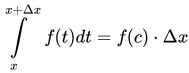
Notice that depends on . Anyway what we have shown is that


- Failed to parse (MathML with SVG or PNG fallback (recommended for modern browsers and accessibility tools): Invalid response ("Math extension cannot connect to Restbase.") from server "https://wikimedia.org/api/rest_v1/":): {\displaystyle F(x+\Delta x)-F(x)=f(c)\cdot\Delta x}
and dividing both sides by Failed to parse (MathML with SVG or PNG fallback (recommended for modern browsers and accessibility tools): Invalid response ("Math extension cannot connect to Restbase.") from server "https://wikimedia.org/api/rest_v1/":): {\displaystyle \Delta x} gives
- Failed to parse (MathML with SVG or PNG fallback (recommended for modern browsers and accessibility tools): Invalid response ("Math extension cannot connect to Restbase.") from server "https://wikimedia.org/api/rest_v1/":): {\displaystyle \frac{F(x+\Delta x)-F(x)}{\Delta x}=f(c)}
Take the limit as Failed to parse (MathML with SVG or PNG fallback (recommended for modern browsers and accessibility tools): Invalid response ("Math extension cannot connect to Restbase.") from server "https://wikimedia.org/api/rest_v1/":): {\displaystyle \Delta x\to0} we get the definition of the derivative of Failed to parse (MathML with SVG or PNG fallback (recommended for modern browsers and accessibility tools): Invalid response ("Math extension cannot connect to Restbase.") from server "https://wikimedia.org/api/rest_v1/":): {\displaystyle F} at Failed to parse (MathML with SVG or PNG fallback (recommended for modern browsers and accessibility tools): Invalid response ("Math extension cannot connect to Restbase.") from server "https://wikimedia.org/api/rest_v1/":): {\displaystyle x} so we have
- Failed to parse (MathML with SVG or PNG fallback (recommended for modern browsers and accessibility tools): Invalid response ("Math extension cannot connect to Restbase.") from server "https://wikimedia.org/api/rest_v1/":): {\displaystyle F'(x)=\lim_{\Delta x\to0}\frac{F(x+\Delta x)-F(x)}{\Delta x}=\lim_{\Delta x\to0}f(c)}
To find the other limit, we will use the squeeze theorem. Failed to parse (MathML with SVG or PNG fallback (recommended for modern browsers and accessibility tools): Invalid response ("Math extension cannot connect to Restbase.") from server "https://wikimedia.org/api/rest_v1/":): {\displaystyle c\in[x,x+\Delta x]} , so Failed to parse (MathML with SVG or PNG fallback (recommended for modern browsers and accessibility tools): Invalid response ("Math extension cannot connect to Restbase.") from server "https://wikimedia.org/api/rest_v1/":): {\displaystyle x\le c\le x+\Delta x} . Hence,
- Failed to parse (MathML with SVG or PNG fallback (recommended for modern browsers and accessibility tools): Invalid response ("Math extension cannot connect to Restbase.") from server "https://wikimedia.org/api/rest_v1/":): {\displaystyle \lim_{\Delta x\to0}\Big[x+\Delta x\Big]=x\quad\Rightarrow\quad\lim_{\Delta x\to0}c=x}
As Failed to parse (MathML with SVG or PNG fallback (recommended for modern browsers and accessibility tools): Invalid response ("Math extension cannot connect to Restbase.") from server "https://wikimedia.org/api/rest_v1/":): {\displaystyle f} is continuous we have
- Failed to parse (MathML with SVG or PNG fallback (recommended for modern browsers and accessibility tools): Invalid response ("Math extension cannot connect to Restbase.") from server "https://wikimedia.org/api/rest_v1/":): {\displaystyle F'(x)=\lim_{\Delta x\to0}f(c)=f\left(\lim_{\Delta x\to0}c\right)=f(x)}
which completes the proof.
Failed to parse (MathML with SVG or PNG fallback (recommended for modern browsers and accessibility tools): Invalid response ("Math extension cannot connect to Restbase.") from server "https://wikimedia.org/api/rest_v1/":): {\displaystyle \blacksquare}
Proof of Fundamental Theorem of Calculus Part II
Define Failed to parse (MathML with SVG or PNG fallback (recommended for modern browsers and accessibility tools): Invalid response ("Math extension cannot connect to Restbase.") from server "https://wikimedia.org/api/rest_v1/":): {\displaystyle P(x)=\int\limits_a^x f(t)dt} . Then by the Fundamental Theorem of Calculus part I we know that Failed to parse (MathML with SVG or PNG fallback (recommended for modern browsers and accessibility tools): Invalid response ("Math extension cannot connect to Restbase.") from server "https://wikimedia.org/api/rest_v1/":): {\displaystyle P} is differentiable on Failed to parse (MathML with SVG or PNG fallback (recommended for modern browsers and accessibility tools): Invalid response ("Math extension cannot connect to Restbase.") from server "https://wikimedia.org/api/rest_v1/":): {\displaystyle (a,b)} and for all Failed to parse (MathML with SVG or PNG fallback (recommended for modern browsers and accessibility tools): Invalid response ("Math extension cannot connect to Restbase.") from server "https://wikimedia.org/api/rest_v1/":): {\displaystyle x\in(a,b)}
- Failed to parse (MathML with SVG or PNG fallback (recommended for modern browsers and accessibility tools): Invalid response ("Math extension cannot connect to Restbase.") from server "https://wikimedia.org/api/rest_v1/":): {\displaystyle P'(x)=f(x)}
So Failed to parse (MathML with SVG or PNG fallback (recommended for modern browsers and accessibility tools): Invalid response ("Math extension cannot connect to Restbase.") from server "https://wikimedia.org/api/rest_v1/":): {\displaystyle P} is an antiderivative of Failed to parse (MathML with SVG or PNG fallback (recommended for modern browsers and accessibility tools): Invalid response ("Math extension cannot connect to Restbase.") from server "https://wikimedia.org/api/rest_v1/":): {\displaystyle f} . Since we were assuming that Failed to parse (MathML with SVG or PNG fallback (recommended for modern browsers and accessibility tools): Invalid response ("Math extension cannot connect to Restbase.") from server "https://wikimedia.org/api/rest_v1/":): {\displaystyle F} was also an antiderivative for all Failed to parse (MathML with SVG or PNG fallback (recommended for modern browsers and accessibility tools): Invalid response ("Math extension cannot connect to Restbase.") from server "https://wikimedia.org/api/rest_v1/":): {\displaystyle x\in(a,b)} ,
- Failed to parse (MathML with SVG or PNG fallback (recommended for modern browsers and accessibility tools): Invalid response ("Math extension cannot connect to Restbase.") from server "https://wikimedia.org/api/rest_v1/":): {\displaystyle \begin{align}&P'(x)=F'(x)\\&P'(x)-F'(x)=0\\&\Big(P(x)-F(x)\Big)'=0\end{align}}
Let Failed to parse (MathML with SVG or PNG fallback (recommended for modern browsers and accessibility tools): Invalid response ("Math extension cannot connect to Restbase.") from server "https://wikimedia.org/api/rest_v1/":): {\displaystyle g(x)=P(x)-F(x)} . The Mean Value Theorem applied to Failed to parse (MathML with SVG or PNG fallback (recommended for modern browsers and accessibility tools): Invalid response ("Math extension cannot connect to Restbase.") from server "https://wikimedia.org/api/rest_v1/":): {\displaystyle g(x)} on Failed to parse (MathML with SVG or PNG fallback (recommended for modern browsers and accessibility tools): Invalid response ("Math extension cannot connect to Restbase.") from server "https://wikimedia.org/api/rest_v1/":): {\displaystyle [a,\xi]} with Failed to parse (MathML with SVG or PNG fallback (recommended for modern browsers and accessibility tools): Invalid response ("Math extension cannot connect to Restbase.") from server "https://wikimedia.org/api/rest_v1/":): {\displaystyle a<\xi<b} says that
- Failed to parse (MathML with SVG or PNG fallback (recommended for modern browsers and accessibility tools): Invalid response ("Math extension cannot connect to Restbase.") from server "https://wikimedia.org/api/rest_v1/":): {\displaystyle \frac{g(\xi)-g(a)}{\xi-a}=g'(c)}
for some Failed to parse (MathML with SVG or PNG fallback (recommended for modern browsers and accessibility tools): Invalid response ("Math extension cannot connect to Restbase.") from server "https://wikimedia.org/api/rest_v1/":): {\displaystyle c} in Failed to parse (MathML with SVG or PNG fallback (recommended for modern browsers and accessibility tools): Invalid response ("Math extension cannot connect to Restbase.") from server "https://wikimedia.org/api/rest_v1/":): {\displaystyle (a,\xi)} . But since Failed to parse (MathML with SVG or PNG fallback (recommended for modern browsers and accessibility tools): Invalid response ("Math extension cannot connect to Restbase.") from server "https://wikimedia.org/api/rest_v1/":): {\displaystyle g'(x)=0} for all Failed to parse (MathML with SVG or PNG fallback (recommended for modern browsers and accessibility tools): Invalid response ("Math extension cannot connect to Restbase.") from server "https://wikimedia.org/api/rest_v1/":): {\displaystyle x} in Failed to parse (MathML with SVG or PNG fallback (recommended for modern browsers and accessibility tools): Invalid response ("Math extension cannot connect to Restbase.") from server "https://wikimedia.org/api/rest_v1/":): {\displaystyle [a,b]} , Failed to parse (MathML with SVG or PNG fallback (recommended for modern browsers and accessibility tools): Invalid response ("Math extension cannot connect to Restbase.") from server "https://wikimedia.org/api/rest_v1/":): {\displaystyle g(\xi)} must equal Failed to parse (MathML with SVG or PNG fallback (recommended for modern browsers and accessibility tools): Invalid response ("Math extension cannot connect to Restbase.") from server "https://wikimedia.org/api/rest_v1/":): {\displaystyle g(a)} for all Failed to parse (MathML with SVG or PNG fallback (recommended for modern browsers and accessibility tools): Invalid response ("Math extension cannot connect to Restbase.") from server "https://wikimedia.org/api/rest_v1/":): {\displaystyle \xi} in Failed to parse (MathML with SVG or PNG fallback (recommended for modern browsers and accessibility tools): Invalid response ("Math extension cannot connect to Restbase.") from server "https://wikimedia.org/api/rest_v1/":): {\displaystyle (a,b)} , i.e. g(x) is constant on Failed to parse (MathML with SVG or PNG fallback (recommended for modern browsers and accessibility tools): Invalid response ("Math extension cannot connect to Restbase.") from server "https://wikimedia.org/api/rest_v1/":): {\displaystyle (a,b)} .
This implies there is a constant Failed to parse (MathML with SVG or PNG fallback (recommended for modern browsers and accessibility tools): Invalid response ("Math extension cannot connect to Restbase.") from server "https://wikimedia.org/api/rest_v1/":): {\displaystyle C=g(a)=P(a)-F(a)=-F(a)} such that for all Failed to parse (MathML with SVG or PNG fallback (recommended for modern browsers and accessibility tools): Invalid response ("Math extension cannot connect to Restbase.") from server "https://wikimedia.org/api/rest_v1/":): {\displaystyle x\in(a,b)} ,
- Failed to parse (MathML with SVG or PNG fallback (recommended for modern browsers and accessibility tools): Invalid response ("Math extension cannot connect to Restbase.") from server "https://wikimedia.org/api/rest_v1/":): {\displaystyle P(x)=F(x)+C}
and as Failed to parse (MathML with SVG or PNG fallback (recommended for modern browsers and accessibility tools): Invalid response ("Math extension cannot connect to Restbase.") from server "https://wikimedia.org/api/rest_v1/":): {\displaystyle g} is continuous we see this holds when Failed to parse (MathML with SVG or PNG fallback (recommended for modern browsers and accessibility tools): Invalid response ("Math extension cannot connect to Restbase.") from server "https://wikimedia.org/api/rest_v1/":): {\displaystyle x=a} and Failed to parse (MathML with SVG or PNG fallback (recommended for modern browsers and accessibility tools): Invalid response ("Math extension cannot connect to Restbase.") from server "https://wikimedia.org/api/rest_v1/":): {\displaystyle x=b} as well. And putting Failed to parse (MathML with SVG or PNG fallback (recommended for modern browsers and accessibility tools): Invalid response ("Math extension cannot connect to Restbase.") from server "https://wikimedia.org/api/rest_v1/":): {\displaystyle x=b} gives
- Failed to parse (MathML with SVG or PNG fallback (recommended for modern browsers and accessibility tools): Invalid response ("Math extension cannot connect to Restbase.") from server "https://wikimedia.org/api/rest_v1/":): {\displaystyle \int\limits_a^b f(t)dx=P(b)=F(b)+C=F(b)-F(a)}
Failed to parse (MathML with SVG or PNG fallback (recommended for modern browsers and accessibility tools): Invalid response ("Math extension cannot connect to Restbase.") from server "https://wikimedia.org/api/rest_v1/":): {\displaystyle \blacksquare}
Notation for Evaluating Definite Integrals
The second part of the Fundamental Theorem of Calculus gives us a way to calculate definite integrals. Just find an antiderivative of the integrand, and subtract the value of the antiderivative at the lower bound from the value of the antiderivative at the upper bound. That is
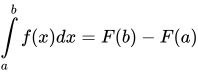
where . As a convenience, we use the notation

- Failed to parse (MathML with SVG or PNG fallback (recommended for modern browsers and accessibility tools): Invalid response ("Math extension cannot connect to Restbase.") from server "https://wikimedia.org/api/rest_v1/":): {\displaystyle F(x)\bigg|_a^b}
to represent Failed to parse (MathML with SVG or PNG fallback (recommended for modern browsers and accessibility tools): Invalid response ("Math extension cannot connect to Restbase.") from server "https://wikimedia.org/api/rest_v1/":): {\displaystyle F(b)-F(a)}
Integration of Polynomials
Using the power rule for differentiation we can find a formula for the integral of a power using the Fundamental Theorem of Calculus. Let Failed to parse (MathML with SVG or PNG fallback (recommended for modern browsers and accessibility tools): Invalid response ("Math extension cannot connect to Restbase.") from server "https://wikimedia.org/api/rest_v1/":): {\displaystyle f(x)=x^n} . We want to find an antiderivative for Failed to parse (MathML with SVG or PNG fallback (recommended for modern browsers and accessibility tools): Invalid response ("Math extension cannot connect to Restbase.") from server "https://wikimedia.org/api/rest_v1/":): {\displaystyle f} . Since the differentiation rule for powers lowers the power by 1 we have that
- Failed to parse (MathML with SVG or PNG fallback (recommended for modern browsers and accessibility tools): Invalid response ("Math extension cannot connect to Restbase.") from server "https://wikimedia.org/api/rest_v1/":): {\displaystyle \frac{d}{dx}x^{n+1}=(n+1)x^n}
As long as Failed to parse (MathML with SVG or PNG fallback (recommended for modern browsers and accessibility tools): Invalid response ("Math extension cannot connect to Restbase.") from server "https://wikimedia.org/api/rest_v1/":): {\displaystyle n+1\ne0} we can divide by Failed to parse (MathML with SVG or PNG fallback (recommended for modern browsers and accessibility tools): Invalid response ("Math extension cannot connect to Restbase.") from server "https://wikimedia.org/api/rest_v1/":): {\displaystyle n+1} to get
- Failed to parse (MathML with SVG or PNG fallback (recommended for modern browsers and accessibility tools): Invalid response ("Math extension cannot connect to Restbase.") from server "https://wikimedia.org/api/rest_v1/":): {\displaystyle \frac{d}{dx}\left(\frac{x^{n+1}}{n+1}\right)=x^n=f(x)}
So the function Failed to parse (MathML with SVG or PNG fallback (recommended for modern browsers and accessibility tools): Invalid response ("Math extension cannot connect to Restbase.") from server "https://wikimedia.org/api/rest_v1/":): {\displaystyle F(x)=\frac{x^{n+1}}{n+1}} is an antiderivative of Failed to parse (MathML with SVG or PNG fallback (recommended for modern browsers and accessibility tools): Invalid response ("Math extension cannot connect to Restbase.") from server "https://wikimedia.org/api/rest_v1/":): {\displaystyle f} . If Failed to parse (MathML with SVG or PNG fallback (recommended for modern browsers and accessibility tools): Invalid response ("Math extension cannot connect to Restbase.") from server "https://wikimedia.org/api/rest_v1/":): {\displaystyle 0\notin[a,b]} then Failed to parse (MathML with SVG or PNG fallback (recommended for modern browsers and accessibility tools): Invalid response ("Math extension cannot connect to Restbase.") from server "https://wikimedia.org/api/rest_v1/":): {\displaystyle F} is continuous on Failed to parse (MathML with SVG or PNG fallback (recommended for modern browsers and accessibility tools): Invalid response ("Math extension cannot connect to Restbase.") from server "https://wikimedia.org/api/rest_v1/":): {\displaystyle [a,b]} and, by applying the Fundamental Theorem of Calculus, we can calculate the integral of Failed to parse (MathML with SVG or PNG fallback (recommended for modern browsers and accessibility tools): Invalid response ("Math extension cannot connect to Restbase.") from server "https://wikimedia.org/api/rest_v1/":): {\displaystyle f} to get the following rule.
- Power Rule of Integration I
- Failed to parse (MathML with SVG or PNG fallback (recommended for modern browsers and accessibility tools): Invalid response ("Math extension cannot connect to Restbase.") from server "https://wikimedia.org/api/rest_v1/":): {\displaystyle \int\limits_a^b x^ndx=\frac{x^{n+1}}{n+1}\Bigg|_a^b=\frac{b^{n+1}-a^{n+1}}{n+1}} as long as Failed to parse (MathML with SVG or PNG fallback (recommended for modern browsers and accessibility tools): Invalid response ("Math extension cannot connect to Restbase.") from server "https://wikimedia.org/api/rest_v1/":): {\displaystyle n\ne-1} and Failed to parse (MathML with SVG or PNG fallback (recommended for modern browsers and accessibility tools): Invalid response ("Math extension cannot connect to Restbase.") from server "https://wikimedia.org/api/rest_v1/":): {\displaystyle 0\notin[a,b]} .
Notice that we allow all values of Failed to parse (MathML with SVG or PNG fallback (recommended for modern browsers and accessibility tools): Invalid response ("Math extension cannot connect to Restbase.") from server "https://wikimedia.org/api/rest_v1/":): {\displaystyle n} , even negative or fractional. If Failed to parse (MathML with SVG or PNG fallback (recommended for modern browsers and accessibility tools): Invalid response ("Math extension cannot connect to Restbase.") from server "https://wikimedia.org/api/rest_v1/":): {\displaystyle n>0} then this works even if Failed to parse (MathML with SVG or PNG fallback (recommended for modern browsers and accessibility tools): Invalid response ("Math extension cannot connect to Restbase.") from server "https://wikimedia.org/api/rest_v1/":): {\displaystyle [a,b]} includes Failed to parse (MathML with SVG or PNG fallback (recommended for modern browsers and accessibility tools): Invalid response ("Math extension cannot connect to Restbase.") from server "https://wikimedia.org/api/rest_v1/":): {\displaystyle 0} .
- Power Rule of Integration II
- Failed to parse (MathML with SVG or PNG fallback (recommended for modern browsers and accessibility tools): Invalid response ("Math extension cannot connect to Restbase.") from server "https://wikimedia.org/api/rest_v1/":): {\displaystyle \int\limits_a^b x^ndx=\frac{x^{n+1}}{n+1}\Bigg|_a^b=\frac{b^{n+1}-a^{n+1}}{n+1}} as long as Failed to parse (MathML with SVG or PNG fallback (recommended for modern browsers and accessibility tools): Invalid response ("Math extension cannot connect to Restbase.") from server "https://wikimedia.org/api/rest_v1/":): {\displaystyle n>0} .
- Examples
- To find Failed to parse (MathML with SVG or PNG fallback (recommended for modern browsers and accessibility tools): Invalid response ("Math extension cannot connect to Restbase.") from server "https://wikimedia.org/api/rest_v1/":): {\displaystyle \int\limits_1^2x^3dx} we raise the power by 1 and have to divide by 4. So
- Failed to parse (MathML with SVG or PNG fallback (recommended for modern browsers and accessibility tools): Invalid response ("Math extension cannot connect to Restbase.") from server "https://wikimedia.org/api/rest_v1/":): {\displaystyle \int\limits_1^2x^3dx=\frac{x^4}{4}\Bigg|_1^2=\frac{2^4}{4}-\frac{1^4}{4}=\frac{15}{4}}
- The power rule also works for negative powers. For instance
- Failed to parse (MathML with SVG or PNG fallback (recommended for modern browsers and accessibility tools): Invalid response ("Math extension cannot connect to Restbase.") from server "https://wikimedia.org/api/rest_v1/":): {\displaystyle \int\limits_1^3\frac{dx}{x^3}=\int\limits_1^3x^{-3}dx=\frac{x^{-2}}{-2}\Bigg|_1^3=\frac{1}{-2}\left(3^{-2}-1^{-2}\right)=-\frac12\left(\frac{1}{3^2}-1\right)=-\frac12\left(\frac19-1\right)=\frac12\cdot\frac89=\frac49}
- We can also use the power rule for fractional powers. For instance
- Failed to parse (MathML with SVG or PNG fallback (recommended for modern browsers and accessibility tools): Invalid response ("Math extension cannot connect to Restbase.") from server "https://wikimedia.org/api/rest_v1/":): {\displaystyle \int\limits_0^5\sqrt{x}dx=\int\limits_0^5x^\frac12dx=\frac{x\sqrt{x}}{\frac32}\Bigg|_0^5=\frac23\left(5^\frac32-0^\frac32\right)=\frac{10\sqrt5}{3}}
- Using linearity the power rule can also be thought of as applying to constants. For example,
- Failed to parse (MathML with SVG or PNG fallback (recommended for modern browsers and accessibility tools): Invalid response ("Math extension cannot connect to Restbase.") from server "https://wikimedia.org/api/rest_v1/":): {\displaystyle =\int\limits_3^{11}7dx=\int\limits_3^{11}7x^0dx=7\int\limits_3^{11}x^0dx=7x\Bigg|_3^{11}=7(11-3)=56}
- Using the linearity rule we can now integrate any polynomial. For example
- Failed to parse (MathML with SVG or PNG fallback (recommended for modern browsers and accessibility tools): Invalid response ("Math extension cannot connect to Restbase.") from server "https://wikimedia.org/api/rest_v1/":): {\displaystyle \int\limits_0^3(3x^2+4x+2)dx=(x^3+2x^2+2x)\Bigg|_0^3=3^3+2\cdot 3^2+2\cdot3-0=27+18+6=51}
Exercises
Questions
- Evaluate Failed to parse (MathML with SVG or PNG fallback (recommended for modern browsers and accessibility tools): Invalid response ("Math extension cannot connect to Restbase.") from server "https://wikimedia.org/api/rest_v1/":): {\displaystyle \int\limits_0^1x^6dx}
- Evaluate Failed to parse (MathML with SVG or PNG fallback (recommended for modern browsers and accessibility tools): Invalid response ("Math extension cannot connect to Restbase.") from server "https://wikimedia.org/api/rest_v1/":): {\displaystyle \int\limits_1^2x^6dx}
- Evaluate Failed to parse (MathML with SVG or PNG fallback (recommended for modern browsers and accessibility tools): Invalid response ("Math extension cannot connect to Restbase.") from server "https://wikimedia.org/api/rest_v1/":): {\displaystyle \int\limits_0^2x^6dx}
Solutions
- Failed to parse (MathML with SVG or PNG fallback (recommended for modern browsers and accessibility tools): Invalid response ("Math extension cannot connect to Restbase.") from server "https://wikimedia.org/api/rest_v1/":): {\displaystyle \frac17=0.\overline{142857}}
- Failed to parse (MathML with SVG or PNG fallback (recommended for modern browsers and accessibility tools): Invalid response ("Math extension cannot connect to Restbase.") from server "https://wikimedia.org/api/rest_v1/":): {\displaystyle \frac{127}{7}=18.\overline{142857}}
- Failed to parse (MathML with SVG or PNG fallback (recommended for modern browsers and accessibility tools): Invalid response ("Math extension cannot connect to Restbase.") from server "https://wikimedia.org/api/rest_v1/":): {\displaystyle \frac{128}{7}=18.\overline{285714}}
Resources
The Fundamental Theorem of Calculus, Part 1
- Definite Integral & Antiderivatives (Slides 6&7). PowerPoint file created by Professor Cynthia Roberts, UTSA.
- Fundamental Theorem of Calculus Part 1. PowerPoint file created by Professor Cynthia Roberts, UTSA.
- The Fundamental Theorem of Calculus PowerPoint file created by Dr. Sara Shirinkam, UTSA.
- Fundamental Theorem of Calculus Part 1 by patrickJMT
- PART 1 OF THE DREADED FUNDAMENTAL THEOREM OF CALCULUS! by Krista King
- Fundamental Theorem of Calculus Part 1 by The Organic Chemistry Tutor
- The Second Fundamental Theorem of Calculus by James Sousa, Math is Power 4U
- Ex 1: The Second Fundamental Theorem of Calculus by James Sousa, Math is Power 4U
- Ex 2: The Second Fundamental Theorem of Calculus (Reverse Order) by James Sousa, Math is Power 4U
- Ex 3: The Second Fundamental Theorem of Calculus by James Sousa, Math is Power 4U
- Ex 4: The Second Fundamental Theorem of Calculus with Chain Rule by James Sousa, Math is Power 4U
- Ex 5: The Second Fundamental Theorem of Calculus with Chain Rule by James Sousa, Math is Power 4U
- Ex 6: Second Fundamental Theorem of Calculus with Chain Rule by James Sousa, Math is Power 4U
- Ex 7: Second Fundamental Theorem of Calculus with Chain Rule by James Sousa, Math is Power 4U
The Fundamental Theorem of Calculus, Part 2
- The Fundamental Theorem of Calculus by James Sousa, Math is Power 4U
- The Fundamental Theorem of Calculus Part 2 by patrickJMT
- PART 2 OF THE FUNDAMENTAL THEOREM OF CALCULUS! by Krista King
- The Fundamental Theorem of Calculus Part 2 by The Organic Chemistry Tutor
Licensing
Content obtained and/or adapted from:
- Fundamental Theorem of Calculus, Wikibooks: Calculus under a CC BY-SA license

